How Sensor-Rich Demonstrations Improve Robot Learning in Contact-Intensive Tasks
29 Oct, 2026
6 Views 0 Like(s)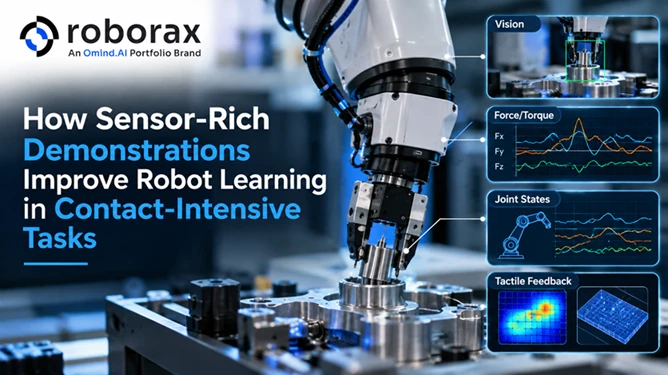
Discover how sensor-rich demonstrations improve robot learning through force, torque, vision, and motion data for contact-intensive robotic tasks.
How Sensor-Rich Demonstrations Improve Robot Learning in Contact-Intensive Tasks
Robots operating in real-world environments must do more than recognize objects and execute predefined movements. They need to understand physical interactions, respond to changing forces, and adjust their actions when objects behave unexpectedly. Tasks such as tightening screws, inserting components, handling fragile products, and assembling mechanical parts require precise coordination between perception and physical control. This makes contact-intensive manipulation particularly challenging for modern robotic systems.
Sensor-rich demonstrations provide a practical way to address these challenges. By recording visual observations alongside force, torque, joint positions, tactile feedback, and other relevant signals, robotics teams can capture how successful actions unfold during physical interactions. These demonstrations create more informative robotic training data, helping learning systems develop manipulation policies that are responsive, adaptable, and better suited to real-world conditions.
Why Contact-Intensive Tasks Are Difficult for Robots
Contact-intensive tasks involve sustained or repeated physical interaction between a robot and an object, tool, or surrounding surface. Unlike simple pick-and-place operations, these activities require continuous adjustments based on changing contact conditions.
For example, inserting a metal pin into a narrow opening requires accurate alignment, controlled force, and the ability to recognize when the pin encounters resistance. Excessive force may damage the component, while insufficient force may prevent insertion. Small variations in object orientation, surface friction, or manufacturing tolerances can significantly affect the outcome.
Traditional vision-based approaches cannot always identify these changes. A camera may show that two components appear aligned, but it cannot reliably determine whether they are pressing against each other, slipping, or experiencing excessive contact pressure.
Robots therefore need information beyond visual perception. Sensor-rich demonstrations help bridge this gap by recording both the robot's movements and the physical feedback generated throughout an interaction.
What Makes a Demonstration Sensor-Rich?
A sensor-rich demonstration captures multiple synchronized data streams while a robot performs a task. Instead of recording only the final action or a sequence of video frames, it documents the interaction between the robot, the object, and the environment.
Depending on the application, these demonstrations may include:
-
Visual observations: RGB images, depth maps, and point clouds that describe object geometry, position, and surrounding conditions.
-
Force and torque measurements: Signals indicating contact pressure, resistance, rotational loading, and unexpected physical interactions.
-
Joint-state information: Joint angles, velocities, and torques that describe the robot's configuration and movement.
-
Tactile feedback: Measurements of contact location, pressure distribution, and surface interaction when suitable tactile sensors are available.
-
End-effector data: Tool position, orientation, gripper state, and other measurements associated with manipulation.
-
Task and action labels: Information identifying the intended action, contact event, task phase, success condition, or failure.
Through Multimodal Sensor Capture for Robotics, these signals can be collected and synchronized to create a detailed record of what the robot observed, how it moved, and how the environment responded.
How Sensor-Rich Demonstrations Improve Robot Learning
1. Teaching Robots to Recognize Contact Events
Contact events often determine whether a manipulation task succeeds or fails. A robot must recognize when an object has been grasped, when a tool touches a surface, or when a component reaches its intended position.
Synchronized visual and force measurements provide complementary evidence. Vision helps locate the object, while force signals can indicate the moment physical contact occurs.
For example, during robotic assembly, a sudden change in force may indicate that a component has reached a mechanical stop. When these signals are included in training demonstrations, learning systems can better associate specific sensory patterns with meaningful task events.
2. Improving Force Control and Manipulation Precision
Successful manipulation requires more than reaching the correct position. Robots must also apply appropriate forces throughout an interaction.
Sensor-rich demonstrations can show how experienced operators or successfully controlled robots adjust their movements when encountering resistance. These records help learning systems identify relationships between applied force, object movement, and task outcomes.
In polishing, sanding, or surface inspection, for instance, consistent contact pressure is essential. Force and motion data can help train policies that maintain contact while responding to changes in surface geometry.
The resulting robotic training data supports the development of manipulation strategies that account for physical constraints rather than relying exclusively on predetermined trajectories.
3. Enabling Adaptation to Unexpected Conditions
Real-world objects rarely behave exactly as expected. Materials may have different stiffness levels, surfaces may become slippery, and components may vary slightly in shape or position.
A robot trained only on idealized movements may struggle when these conditions change. Sensor-rich demonstrations expose learning systems to a broader range of physical interactions, including variations in resistance, slippage, and object displacement.
By learning from these examples, robots can develop more flexible responses to unfamiliar conditions. This is particularly valuable in manufacturing, warehouse operations, and other environments where repeated tasks involve objects with variable physical properties.
4. Supporting Failure Detection and Recovery
Not every demonstration ends successfully, and unsuccessful interactions can provide valuable learning signals.
A failed insertion, dropped object, or unexpected collision may produce distinctive changes in force, torque, joint movement, or visual appearance. When these signals are captured and labeled, developers can investigate why the failure occurred and identify the corrective actions required.
For example, a robot that detects increasing resistance during component insertion may need to stop, retract slightly, realign the component, and attempt insertion again.
Recording these recovery sequences helps teams train systems to recognize emerging problems and select more appropriate responses instead of repeating the same unsuccessful action.
Building High-Quality Multimodal Demonstration Datasets
Collecting multiple sensor streams is only the first step. The usefulness of sensor-rich demonstrations depends on data quality, synchronization, consistency, and task relevance.
Robotics teams should prioritize accurate timestamps so that visual frames, force measurements, and robot states correspond to the same physical events. Poor synchronization can make it difficult to determine whether a force spike caused a movement adjustment or occurred after it.
Consistent coordinate frames, calibrated sensors, standardized task labels, and documented recording conditions are equally important. Teams should also capture variations in object geometry, contact locations, operating speeds, and environmental conditions.
Quality assurance should identify missing readings, sensor drift, inconsistent annotations, and incomplete demonstrations. Where possible, datasets should include successful attempts, recoverable failures, and difficult edge cases.
These practices make Multimodal Sensor Capture for Robotics more useful for supervised learning, imitation learning, policy evaluation, and other robot-learning workflows.
The Role of Roborax in Sensor-Rich Robot Learning
Developing capable manipulation systems requires training datasets that represent the complexity of physical interaction. Roborax supports robotics data workflows designed to help teams build richer training resources for advanced robotic applications.
By focusing on multimodal data capture, structured demonstrations, and task-relevant data quality, robotics teams can obtain a clearer picture of how robots perceive and interact with their environments. Combining visual observations with force, motion, and other sensor signals helps create datasets that reflect the physical demands of real-world manipulation.
These resources can support research and development across precision assembly, industrial manipulation, bimanual operations, and other contact-intensive applications.
Conclusion
Contact-intensive tasks demand that robots understand not only where objects are but also how they respond to physical interaction. Sensor-rich demonstrations provide this additional context by connecting visual observations with force, torque, tactile feedback, and movement data.
When properly synchronized, annotated, and validated, these demonstrations help learning systems recognize contact events, improve manipulation precision, adapt to changing conditions, and recover from failures.
Investing in high-quality robotic training data is therefore an important step toward building more reliable and adaptable robotic systems. Through Multimodal Sensor Capture for Robotics, developers can create a stronger foundation for learning-based manipulation and advance robots capable of performing complex physical tasks in dynamic environments.

Comments
Login to Comment