Hospital Command Centres Are Changing How Administrators See the Entire Hospital
29 Oct, 2026
10 Views 0 Like(s)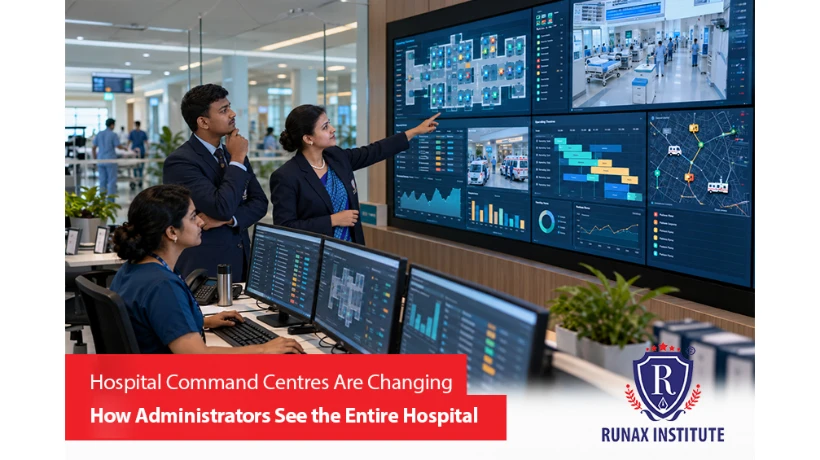
Learn how hospital command centres improve bed flow and why a hospital management course in Kolkata builds these skills.
Picture a busy Friday evening in a hospital. The emergency department is packed. Three wards claim they have no free beds. One discharge is stuck because a pharmacy bill is pending. The operation theatre waits for an ICU slot that nobody can confirm. Each department sees only its own corner of the problem. Administrators spend the night making calls rather than making decisions.
A hospital command centre solves exactly this scramble. Without one, small delays pile up, emergency department congestion grows, and patient wait times stretch longer for care that cannot wait. A 2026 study found that every extra four hours of boarding raised the odds of death within 30 days by 8.4 per cent for admitted medical patients. Poor visibility carries a heavy price.
This guide explains how command centres work, what administrators see on their screens, and where the system breaks down. If you are exploring a hospital management course in Kolkata, you will also see why this skill set is becoming a real career advantage. Let's get started.
What Is a Hospital Command Centre and Why Is It Important Today?
This section defines the idea and explains why hospitals across India and the world now treat it as essential healthcare infrastructure.
How a Command Centre Works
A hospital command centre is a central room, physical or virtual, where live data from every major department appears on one set of screens. Think of an airport control tower. The tower does not fly the planes, but it sees every runway at once. A command centre serves the same purpose in managing patient flow. It pulls feeds from admissions, the emergency department, wards, laboratories, pharmacy, housekeeping, and transport. A small team of bed managers, nurses, and administrators reads the picture and acts on it. What does a hospital command centre look like in practice? It is a decision room where staff use live information instead of collecting it.
Why Hospitals Are Building Them Now
Three forces push hospitals toward this model. Patient volumes keep rising. Clinical staff stay stretched thin. Digital health records finally make live data possible. Why are hospitals building command centres now? They need one shared view to manage rising demand with limited staff and beds. India shows the shift clearly. A regulatory memorandum dated 17 July 2026 reiterated that medical colleges must integrate ABDM-compliant hospital information systems. Delhi announced a central control room with a dashboard for bed availability and resource use. Bihar runs a state command centre that monitors real-time feeds from district hospitals. Each example makes one point. Administrators who cannot see the whole hospital cannot manage it.
How Real-Time Dashboards Track Beds and Emergency Rooms
Real-time dashboards sit at the heart of every command centre. They replace the whiteboard, the phone call, and the guesswork. Each tile answers one operational question in seconds.
Bed Availability and Occupancy
A bed tile shows more than a number. It displays occupied beds, beds undergoing cleaning, beds reserved for isolation, and beds awaiting confirmed discharges. This is effective bed management in practice. How does a command centre increase bed availability? It identifies unused capacity and makes it available more quickly. A cleaned bed that remains unassigned leads to unnecessary delays. A bed held for a patient who already left wastes revenue. Once the dashboard flags both, managers move patients quickly and bed occupancy stays under control. One redesign project that added multidisciplinary rounds and central bed oversight cut monthly ED boarding hours by 22 per cent, from 3,975 to 3,094.
Emergency Department Congestion
The emergency department shows the first sign of any hospital-wide problem. The dashboard tracks waiting room count, time to first doctor, ambulance arrivals, and admitted patients still waiting for a ward bed. What does ED boarding mean, and why is it a concern? ED boarding occurs when admitted patients remain in the emergency department because no inpatient beds are available, affecting patient outcomes and limiting space for incoming patients. The 2026 study of 49,034 medical admissions found that each extra four hours of boarding added 8.6 hours to inpatient stay. Another command centre project cut boarding time for medicine beds from 9.7 hours to 6.3 hours. Those saved hours turn directly into safer care.
Managing Patient Transfers, Discharge Delays, and Resource Utilisation
Moving patients, releasing beds, and sharing equipment decide whether a hospital flows or stalls. Command centres track all three at once.
Patient Transfers
Patient transfers cause some of the quietest delays. A patient waits for a bed in another unit, a transport team, and a doctor's approval. Every stage is handled by a different person. How do command centres speed up patient transfers? They put bed status, transport availability, and clinical approval on one screen, so nobody waits for a phone call. One clinical command centre report reviewed more than 5,000 transfer cases with a central physician, and decisions took 22 minutes on average. The results included 16.26 fewer hours of ED boarding, a 1.7-day drop in average length of stay, 2,448 fewer excess bed days, and room for 306 more admissions.
Discharge Delays
A patient ready to leave at 11 am may still wait at 4 pm for billing, medicines, or a final signature. Why do discharge delays matter so much? A held bed blocks the next admission, which pushes waiting patients back into the emergency department. Good discharge planning begins at admission. The dashboard shows expected discharge times and the reason for each hold. Managers then chase the exact blocker and improve length of stay.
Resource Utilisation
Resource utilisation covers everything else. A good command centre watches these items together.
- Operation theatre slots and turnaround time
- Ventilators, monitors, and ICU beds
- Nursing shifts against patient load
- Scan machines and diagnostic queues
Seeing all four on one screen stops one department from holding what another urgently needs.
Data Integration, Escalation Protocols, and Performance Indicators
Three building blocks hold a command centre together. Linked data, clear rules, and measurable targets turn a screen into a working system.
Data Integration
Data integration joins the admission system, laboratory software, pharmacy, billing, and bedside devices into one stream. Without interoperability, every feed speaks a different language. In 2026, a private hospital in Ghaziabad linked its ICU command centre with a district hospital ICU, pulling bedside device data and hospital records into one dashboard. That link shows how integration can stretch expert oversight across facilities.
Escalation Protocols
What is an escalation protocol in a hospital? It is a written rule that tells staff who must act, and how fast, once a number crosses a set limit. Many hospitals use three levels. Green means normal flow. Amber triggers a call to the bed manager. Red alerts the duty administrator and department heads. Clear triggers remove debate at 2 am and support faster crisis management.
Key Performance Indicators
Which performance indicators matter most in a command centre? Boarding hours, length of stay, discharge timing, theatre turnaround, and occupancy rate give the clearest picture. These key performance indicators keep teams honest, and each one has an owner who acts first.
|
Indicator |
What it shows |
Who acts first |
|
ED boarding hours |
Admitted patients waiting in the ED |
Bed manager |
|
Average length of stay |
Speed of care and discharge |
Ward head |
|
Discharge before noon rate |
Timing of bed release |
Discharge coordinator |
|
Theatre turnaround time |
Surgical efficiency |
OT manager |
|
Bed occupancy rate |
Capacity pressure |
Duty administrator |
Catching Bottlenecks Before They Reach Other Departments
Delays rarely stay in one place. This section shows how early signals help managers protect the whole hospital.
Early Warning Through Analytics
A late ward discharge delays a bed. A delayed bed holds a patient in the emergency room. An overcrowded emergency department delays ambulance handovers. The chain keeps growing. How do hospital command centres reduce bottlenecks? They spot the first weak link early and act before it spreads. Trend lines and simple healthcare analytics forecast the evening surge by midafternoon. Managers then open surge capacity, call extra nurses, or speed up discharges before the crush begins.
Proof From Industry Data
The wider numbers show the payoff of this discipline. Between early 2023 and late 2025, average length of stay in US community hospital emergency departments fell 38 per cent, and it fell 23 per cent at academic medical centres. By October 2025, hospitals also ran with an average length of stay 8 per cent shorter than in 2022. Improved patient flow management contributed to some of those improvements. A September 2026 systematic review also found that inpatient hallway boarding can improve ED throughput, and most patients preferred it to ED hallway boarding. A command centre lets managers test such ideas and measure the result quickly.
The Challenge of Inaccurate Data and Disconnected Systems
Dashboards look impressive, but they tell the truth only when the data is true. This section covers the two biggest threats and the fixes.
The Cost of Inaccurate Data
Imagine a ward nurse who forgets to update a bed status. The screen shows an empty bed that holds a patient. The manager sends a transfer, and trust in the whole system drops. Why does inaccurate data break a command centre? Staff stop believing the screen, so they return to phone calls and the command centre loses its purpose. Poor data quality quietly undoes every other investment.
The Problem With Disconnected Systems
Many hospitals run separate software for billing, labs, pharmacy, and wards. Some rely on manual data entry. Others refresh only once a day. These data silos hide the true state of hospital operations. A command centre cannot manage in real time with yesterday's data.
Practical Ways to Fix Both
Administrators fix this in practical ways.
- Assign a named data owner to every unit
- Automate bed status updates through scanners or system triggers
- Audit dashboard accuracy every week
- Retire duplicate systems that disagree with each other
The national push toward standard digital health records helps too. Clean data comes first. Bigger screens come later.
Why This Matters for Students Choosing a Hospital Management Course in Kolkata
Healthcare administration is moving from paperwork to real-time decision-making. This section explains the skills, roles, and course features that matter.
Skills Employers Want
A student in a hospital management course in Kolkata now needs to read dashboards, question data, and lead teams under pressure. What skills do you need to work in a hospital command centre? Four stand out.
- Healthcare analytics to read trends and spot outliers
- Process improvement thinking to trace a delay across departments
- Calm communication during escalations
- Practical understanding of hospital information systems and digital health standards
Career Roles in Command Centres
Roles are opening for bed managers, patient flow coordinators, operations analysts, and quality managers. Each role sits between clinical teams and administration. Graduates who understand command centre logic can contribute from their first month.
What to Look for in a Programme
A strong hospital management institute in Kolkata teaches these topics through case studies, simulations, and hospital internships, not lectures alone. Check whether the programme covers hospital operations management, healthcare quality management, and emergency preparedness. Ask how often students see live hospital workflows.
Build Your Hospital Operations Career with Runax Institute of Hotel Management
Students who want to turn this knowledge into a career can start with a campus built for practical learning. Runax Institute of Hotel Management in Baligori, Newtown, Kolkata offers hospital management alongside hotel, hospitality, and culinary programmes. The campus spans about one lakh square feet and includes professional training labs. The institute lists placement support, scholarships, and educational loan options.
How to Apply
Admissions are open for 2026 to 2027. Students can explore the programme and speak with the admissions team. Visit www.runaxinstitute.com, call 8961629333, or write to admission@runaxinstitute.com.
Conclusion
Hospital command centres give administrators something they never had before. They offer one trusted view of the entire hospital. Real-time dashboards show bed availability, emergency department congestion, patient transfers, discharge delays, and resource use in one place. Data integration feeds those screens. Escalation protocols turn warnings into action. Performance indicators keep every team accountable. Together, these tools help managers catch bottlenecks before they spread across departments.
The evidence supports the effort. Studies in 2026 link long boarding hours to longer stays and higher mortality. Command centre projects report shorter boarding, shorter stays, and room for more admissions. Yet the system works only when data stays accurate, and software stays connected. Staff trust drives everything.
For students, the message is simple. Hospital administration now rewards people who read data well, lead under pressure, and think across departments. A well-chosen hospital management course in Kolkata builds those strengths early. Learn how the whole hospital works, and you will be ready to run it.
Frequently Asked Questions (FAQS)
1. What is a hospital command centre?
A hospital command centre is a central hub that displays live data from all major departments. Administrators use it to monitor beds, emergency load, transfers, and discharges, then make faster, coordinated decisions.
2. How does a command centre reduce emergency department congestion?
It shows how many admitted patients wait for ward beds and which discharges are delayed. Managers then free beds, speed transfers, and open surge capacity, which shortens boarding time.
3. What data do hospital command centres monitor?
They track bed occupancy, ED waiting times, patient transfers, expected discharges, theatre schedules, ICU capacity, staffing levels, and equipment use. Many also include alerts and performance indicators for every department.
4. Is a hospital management course in Kolkata useful for command centre careers?
Yes. Good programmes teach operations management, healthcare analytics, and digital health systems. These skills prepare graduates for roles in patient flow, bed management, and hospital operations.
5. What problems can weaken a hospital command centre?
Inaccurate data, delayed updates, and disconnected software weaken it most. Staff stop trusting the dashboard, so clean data entry, system integration, and regular audits become essential.

Comments
Login to Comment