Kitchen Appliances Market Size, Share, Industry Analysis & Forecast 2026-2034
29 Oct, 2026
7 Views 0 Like(s)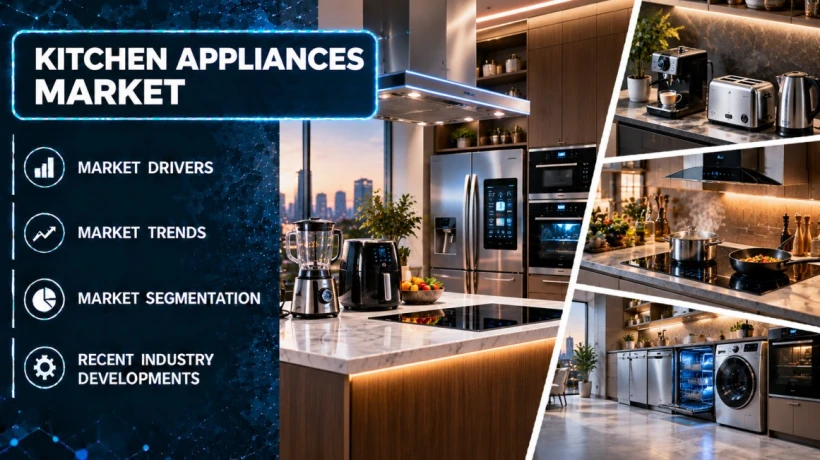
The global kitchen appliances market grew from USD 254.7 Billion in 2025 to USD 266.3 Billion in 2026. Looking forward, IMARC Group estimates the market to reach USD 380.9 Billion by 2034, exhibiting a CAGR of 4.58% from 2026-2034.
IMARC Group, a leading global market research and management consulting firm, has published its latest market intelligence report on the kitchen appliances market. The global kitchen appliances market grew from USD 254.7 Billion in 2025 to USD 266.3 Billion in 2026. Looking forward, IMARC Group estimates the market to reach USD 380.9 Billion by 2034, exhibiting a CAGR of 4.58% from 2026-2034, driven by rapid urbanization, a growing middle class, rising smart home adoption, a shift toward home-cooked meals, kitchen renovation and replacement cycles, and energy-efficiency rebates and labeling rules that are pushing consumers toward newer, more efficient equipment.
The market is gaining momentum as the kitchen evolves from a purely functional space into a connected, design-led hub of the modern home. Dual-income and busy households are seeking appliances that save time, such as air fryer and pressure cooker hybrids and combination ovens. Health-conscious consumers are cooking more at home and investing in induction cooktops, water purifiers, and dishwashers. At the same time, governments are tightening efficiency norms and funding trade-in programs, and manufacturers are responding with large capacity investments and AI-enabled product lines.
How AI is Reshaping the Future of the Kitchen Appliances Market
- AI-Enabled Smart Appliances and Personalized Cooking Assistance: Manufacturers are embedding AI, IoT connectivity, voice control, and over-the-air software updates into refrigerators, ovens, and cooktops. Refrigerators with internal cameras can track inventory, suggest recipes, and plan meals, while ovens can recognize food and adjust temperature and time automatically. GE Appliances unveiled a smart French-door refrigerator with AI meal planning at CES in January 2026, a clear sign of where premium product development is heading.
- Predictive Maintenance and Energy Optimization Through Connected Platforms: Cloud-connected appliances stream usage and performance data that lets manufacturers detect compressor wear, door seal failures, and heating element degradation before breakdowns occur. Variable-speed compressors and smart load management further reduce electricity consumption in line with tightening efficiency labels. This also supports new service-based revenue models and helps meet repair obligations in regions such as the European Union.
- Computer Vision Quality Control and Demand Forecasting in Manufacturing: AI-driven vision systems on assembly lines now inspect welds, enamel coatings, glass panels, and wiring harnesses at speeds that manual checks cannot match, reducing defects and warranty claims. Machine learning models also improve demand forecasting across specialty stores, hypermarkets, and online channels, helping appliance makers balance inventory as they scale up regional production, as seen in recent expansions in the United States and India.
Grab a sample PDF of this report: https://www.imarcgroup.com/kitchen-appliances-market/requestsample
Kitchen Appliances Market Trends and Drivers:
The global kitchen appliances market is witnessing sustained growth, supported by the convergence of urbanization, rising household incomes, and the digitization of the home. More than half of the world’s population, over 56% according to the World Bank, now lives in cities, where compact apartments, dual-income households, and limited time for meal preparation raise demand for refrigerators, microwave ovens, induction stoves, and dishwashers. Residential users account for about 78.9% of demand, which shows how closely the market follows household formation and lifestyle change. The growth of e-commerce has also widened access, letting consumers in smaller cities compare models, financing options, and energy ratings before buying. Manufacturers are responding with capacity. GE Appliances announced more than USD 3 Billion of investment over five years to expand U.S. manufacturing, including top-freezer refrigerators in Alabama and ranges, wall ovens, and cooktops in Georgia, with more than 1,000 new jobs expected.
Government programs are playing a visible role in accelerating replacement demand and shaping product design. In China, the government allocated an initial 62.5 billion yuan, about USD 8.9 Billion, of ultra-long special treasury bond funds to its consumer goods trade-in scheme for the coming year. Buyers of six categories of major home appliances receive a 15% subsidy of up to 1,500 yuan per item, with tighter energy-efficiency eligibility, so the program now steers demand toward premium efficient models. In India, the Bureau of Energy Efficiency expanded mandatory star labelling in January 2026 to more appliances, including refrigerators and LPG stoves. Its standards and labelling programs are credited with avoiding around 60 million tonnes of CO2 annually. India’s Production Linked Incentive scheme for white goods, with an outlay of Rs 6,238 crore, has drawn 80 approved beneficiaries and Rs 10,335 crore of committed investment in components, strengthening the domestic manufacturing base.
Smart technology and sustainability are the third pillar of growth, redefining what buyers expect from a kitchen. Demand for induction cooktops, variable-speed compressors, and multi-functional, space-saving designs is rising as consumers look to cut energy bills and reclaim counter space. Premiumization is visible in built-in lines, with Samsung unveiling premium built-in kitchen appliances for Europe at IFA Berlin, and Midea launching its largest-ever North American lineup at KBIS. Regulation is also extending product lifecycles. The EU Right to Repair Directive, with a transposition deadline of 31 July 2026, requires manufacturers of covered products such as dishwashers and refrigerators to offer timely, cost-effective repair and make spare parts available at reasonable prices. Rising input costs are meanwhile reshaping pricing, with Whirlpool announcing a 7% price increase in North America and up to 10% in Latin America for the fourth quarter.
Ask an analyst for customized report: https://www.imarcgroup.com/request?type=report&id=1619&flag=E
Kitchen Appliances Industry Segmentation:
The report has segmented the market into the following categories:
Breakup By Product Type:
- Refrigerators
- Microwave Ovens
- Induction Stoves
- Dishwashers
- Water Purifiers
- Others
Refrigerators account for the largest product type segment with a 35.0% share, as they are an essential, always-on appliance in virtually every household and are replaced on a regular cycle. Demand is reinforced by innovations such as French-door and counter-depth designs, variable-speed compressors, AI-based food management, and stricter energy labels that encourage consumers to upgrade older, less efficient units.
Breakup By Structure:
- Built-in
- Free-standing
Free-standing appliances hold the leading position with a 70.0% share, supported by their lower price points, ease of installation, flexibility for renters, and suitability for replacement purchases. Ranges, refrigerators, and dishwashers in free-standing formats remain the default choice for mass-market households across both developed and emerging economies.
Breakup By Fuel Type:
- Cooking Gas
- Electricity
- Others
Cooking gas accounts for the largest fuel type share at 48%, reflecting its wide availability, lower running cost, and strong cultural preference in many regions for the instant, controllable flame needed in traditional cooking. Electric and induction alternatives are gaining ground steadily as efficiency standards tighten and consumers prioritize safety and cleaner cooking.
Breakup By Application:
- Residential
- Commercial
The residential segment dominates with a 78.9% share, driven by urbanization, rising disposable incomes, new housing construction, and the renovation and replacement cycles that keep households upgrading. Growing interest in home cooking and smart, connected kitchens further supports household spending on premium appliances.
Breakup By Distribution Channel:
- Specialty Stores
- Supermarkets and Hypermarkets
- Online Stores
- Departmental Stores
- Others
Specialty stores command the largest channel share at 34.2%, as buyers of high-value appliances value live demonstrations, expert advice, installation services, and after-sales support. Manufacturers are also expanding brand-owned retail footprints to strengthen customer engagement, while online stores continue to gain ground through wider choice and transparent pricing.
Breakup By Region:
- North America (United States, Canada)
- Asia Pacific (China, Japan, India, South Korea, Australia, Indonesia, Others)
- Europe (Germany, France, United Kingdom, Italy, Spain, Russia, Others)
- Latin America (Brazil, Mexico, Others)
- Middle East and Africa
North America leads the global kitchen appliances market with a 42.2% share, supported by high household appliance ownership, frequent replacement and renovation cycles, strong adoption of smart and premium products, and a well-developed specialty retail and e-commerce network. Domestic manufacturing investments, such as the large U.S. capacity expansion announced by GE Appliances, and energy-efficiency programs are reinforcing the region’s leadership, while Asia Pacific is emerging as a major growth engine on the back of urbanization, rising incomes, and government-backed trade-in and labelling initiatives.
Competitive Landscape:
The report provides a comprehensive analysis of the competitive landscape in the kitchen appliances market with detailed profiles of all major companies, including:
- Whirlpool Corporation
- AB Electrolux
- Samsung Electronics
- LG Electronics
- Winia Daewoo Electronics
- Panasonic Corporation
- Haier Group
- BSH Hausgeräte
- Miele & Cie. KG
- Sub-Zero Group
What Does The Full Report Cover?
If you are tracking the kitchen appliances market for investment decisions, market entry planning, competitive benchmarking, or strategic advisory, IMARC Group’s report gives you everything in one place:
- Complete market sizing with revenue forecasts covering the full projection period
- Quantified growth driver analysis with impact scoring across product type, structure, fuel type, application, distribution channel, and regional markets
- Sub-segment breakdowns for refrigerators, microwave ovens, induction stoves, dishwashers, water purifiers, free-standing and built-in formats, residential and commercial use, and specialty, online, and mass retail channels, with individual share data
- Country-level data for the United States, Canada, Germany, France, the United Kingdom, Italy, Spain, Russia, China, Japan, India, South Korea, Australia, Indonesia, Brazil, and Mexico
- Competitive profiles of 10 leading companies with strategic landscape assessment
- Porter’s Five Forces, value chain analysis, and pricing intelligence
- Latest product innovation trends covering smart kitchen technology, AI and IoT integration, energy-efficient induction and variable-speed compressor designs, and multi-functional space-saving appliances shaping competition across key regional markets
Recent News and Developments in Kitchen Appliances Market
- October 2026: Whirlpool Corporation reported third quarter net sales of about USD 3.7 Billion and announced further price increases, including 7% in North America and up to 10% in Latin America for major domestic appliances, effective in the fourth quarter. The move reflects continued cost pressure in the industry and is expected to influence pricing strategies across the appliance sector.
- February 2026: Midea America unveiled its largest home appliance lineup to date at KBIS, covering French-door refrigerators in 30-, 33-, and 36-inch sizes, four- and five-burner ranges, an over-the-range microwave, dishwashers with straw-cleaning jets and a one-hour clean-and-dry cycle, and small appliances ranging from air fryers to espresso machines. JennAir also showcased new kitchen concepts and induction products at the show.
- January 2026: GE Appliances unveiled a smart French-door refrigerator with AI meal planning at CES, highlighting the shift toward AI-enabled, connected kitchen appliances. In the same month, India’s Bureau of Energy Efficiency expanded mandatory star labelling to more appliances, including refrigerators and LPG stoves, tightening efficiency expectations for manufacturers.
- December 2025: China allocated an initial 62.5 billion yuan, about USD 8.9 Billion, in ultra-long special treasury bond funds for its consumer goods trade-in scheme, narrowing eligible home appliance categories from 12 to 6 and offering a 15% subsidy of up to 1,500 yuan per item with stricter energy-efficiency standards.
- November 2025: Under India’s Production Linked Incentive scheme for white goods, 13 firms committed Rs 1,914 crore of investment in the fourth application round. This brought total committed investment under the scheme to Rs 10,335 crore across 80 approved beneficiaries.
- September 2025: Samsung Electronics unveiled a premium range of built-in kitchen appliances for the European market at IFA Berlin, strengthening its position in the high-value built-in segment.
- August 2025: GE Appliances announced more than USD 3 Billion of investment over five years to expand U.S. manufacturing across Kentucky, Alabama, Georgia, Tennessee, and South Carolina. It also announced plans to add more than 1,000 jobs and move more production of refrigerators, ranges, wall ovens, and cooktops onshore.
- March 2025: Haier India announced an investment of over Rs 1,000 crore in new air conditioner production and injection molding units. The plan lifts total production capacity from 1.5 million to 4 million units annually and supports its goal of reaching USD 2 Billion in India sales.
Note: If you require specific details, data, or insights that are not currently included in the scope of this report, we are happy to accommodate your request. As part of our customization service, we will gather and provide the additional information you need, tailored to your specific requirements. Please let us know your exact needs, and we will ensure the report is updated accordingly to meet your expectations.
Key Questions This Report Answers
- What is the current global kitchen appliances market size and what is its projected value?
- Which product type segment holds the largest share in the global kitchen appliances market?
- What are the key drivers of global kitchen appliances market growth?
- Which region dominates the global kitchen appliances market and why?
- How are smart kitchen technology, AI integration, and energy-efficiency regulations reshaping product development and competitive strategies in the kitchen appliances industry?
- Who are the top companies in the global kitchen appliances market and what are their competitive strategies?
- What are the investment and market entry opportunities across refrigerators, induction stoves, dishwashers, water purifiers, and built-in and free-standing formats?
About Us:
IMARC Group is a global management consulting firm that helps the world’s most ambitious changemakers to create a lasting impact. The company provides a comprehensive suite of market entry and expansion services. IMARC offerings include thorough market assessment, feasibility studies, company incorporation assistance, factory setup support, regulatory approvals and licensing navigation, branding, marketing and sales strategies, competitive landscape and benchmarking analyses, pricing and cost research, and procurement research.
Media and Sales Contact
IMARC Group
Email: sales@imarcgroup.com
United States: +1-201-971-6302
India: +91-120-433-0800
United Kingdom: +44-753-714-6104

Comments
Login to Comment