Electric Insulator Market Size, Share, Industry Analysis & Forecast 2026-2034
22 Oct, 2026
8 Views 0 Like(s)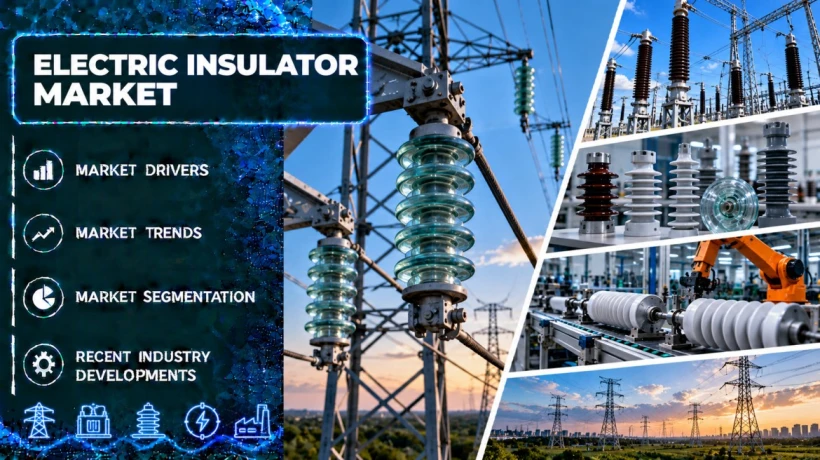
The electric insulator market size was valued at USD 14.35 Billion in 2025, expected to reach USD 21.41 Billion at a CAGR of 4.55% during 2026-2034.
IMARC Group, a leading global market research and management consulting firm, has published its latest market intelligence report on the electric insulator market. The global electric insulator market size was valued at USD 14.35 Billion in 2025 and is projected to reach USD 21.41 Billion by 2034, exhibiting a CAGR of 4.55% during the forecast period 2026-2034. driven by rapid grid modernization and T&D infrastructure expansion, large-scale renewable energy integration requiring new transmission capacity, accelerating EV charging network buildout, and the growing deployment of HVDC and smart grid systems worldwide.
The market is on a steady growth path underpinned by the convergence of electrification, renewable integration, and aging-grid replacement cycles across developed and emerging economies alike. The United Nations projects that 68% of the global population will live in urban areas by 2050, translating into sustained demand for high-capacity transmission and distribution infrastructure that depends fundamentally on high-performance insulation. Ceramic/Porcelain continues to dominate on proven dielectric reliability, while composite insulators are gaining share fastest on the back of offshore wind, HVDC, and coastal deployments where lighter weight and superior pollution resistance matter most. Bushings lead the category segment as transformer and switchgear installation density rises globally, and Asia Pacific's lead reflects China's ultra-high-voltage grid buildout alongside India's large-scale electrification push.
Electric Insulator Market at a Glance:
- Market Size 2025: USD 14.35 Billion
- Forecast Size 2034: USD 21.41 Billion
- Growth Rate 2026-2034: CAGR of 4.55%
- Leading Material: Ceramic/Porcelain, 48.1% share in 2025
- Leading Category: Bushings, 54.2% share in 2025
- Dominant Region: Asia-Pacific, with a 37.5% revenue share in 2025
How AI is Reshaping the Future of the Electric Insulator Market
- AI-Enabled Condition Monitoring and Predictive Maintenance: Utilities are increasingly deploying sensor-equipped insulators alongside drone-based inspections that feed leakage-current, pollution, and failure data into machine learning models, shifting maintenance from scheduled to condition-based and materially reducing unplanned outages.
- Smart Insulators as a Premium Product Category: The integration of IoT connectivity and AI-based analytics into insulator design is creating a distinct, high-margin product tier commanding significant price premiums over conventional ceramic and composite units, a trend manufacturers are actively investing R&D behind.
- AI-Driven Grid Expansion Demand: The US Department of Energy's Speed to Power initiative, launched in September 2025, explicitly targets multi-gigawatt transmission capacity expansion to meet AI data center electricity demand, directly increasing insulator procurement across newly commissioned transmission corridors.
Grab a sample PDF of this report: https://www.imarcgroup.com/electric-insulator-market/requestsample
Electric Insulator Market Trends and Drivers:
Escalating electricity demand from urbanization, renewable energy deployment, and smart grid modernization is the foundational driver of market growth, with governments worldwide investing heavily in upgrading aging transmission networks to manage intermittent renewable generation. Africa's target of universal electricity access alone requires 160 GW of new generation capacity and 130 million new on-grid connections, creating sustained multi-year insulator procurement demand across emerging markets.
Renewable energy integration is a structural differentiator for the industry: offshore wind installations require marine-grade composite and polymer insulators engineered to withstand salt spray, humidity, and prolonged UV exposure, while the IEA estimates the global power sector will require approximately USD 16.4 Trillion in cumulative investment over the next three decades, with transmission and distribution infrastructure representing the largest sub-sector share. HVDC transmission systems, which require insulators engineered for sustained DC voltage stress, are expanding rapidly to support long-distance bulk power delivery and offshore wind farm connections.
This buildout is being actively shaped by government policy across Asia, North America, and Europe, detailed further below. The rapid expansion of EV charging infrastructure, particularly high-power DC fast-chargers operating at 150-350 kW, is adding a further distribution-level demand channel as the global EV fleet continues to grow through 2034.
Ask an analyst for customized report: https://www.imarcgroup.com/request?type=report&id=1432&flag=E
Global Regulatory, Trade, and Sustainability Landscape Shaping Demand:
- IEC and ANSI Certification Standards: IEC 60305, ANSI C29, and CIGRE standards impose rigorous type testing and quality verification requirements on insulator manufacturers, extending development timelines and raising compliance costs, particularly for composite insulator entrants seeking new utility qualification.
- US Grid Deployment Office Initiatives: The Department of Energy's Speed to Power initiative, launched September 18, 2025, is accelerating multi-gigawatt transmission and generation infrastructure projects to meet rising electricity demand from AI data centers, advanced manufacturing, and broader electrification.
- EU Cross-Border Grid Modernization: The EU-backed GreenSwitch project is modernizing grid infrastructure across Austria, Slovenia, and Croatia with EUR 73 Million in CEF Energy funding (EUR 146 Million total value, 2023-2028), strengthening transmission networks and boosting renewable integration through smart grid technologies.
- China's UHV Green Energy Corridor Buildout: China's 15th Five-Year Plan targets 15 new UHV transmission lines by 2030, expected to raise cross-provincial transmission capacity by 35% and connect roughly 200 TWh/year of renewable power, backed by State Grid's planned CNY 4 Trillion (USD 580 Billion) investment over 2026-2030.
Key Government Schemes and Policy Programs Supporting the Industry:
- India, Revamped Distribution Sector Scheme (RDSS): India's Ministry of Power has committed an outlay of over Rs 3 Lakh Crore (roughly Rs 3,03,758 Crore) to modernize distribution infrastructure, targeting 250 million smart meters and covering upgrades to 52.53 lakh distribution transformers and 2.11 lakh feeders, with the Union Budget 2026 adding Rs 600 Crore for a Green Energy Corridor spanning 6,000 km of intra-state transmission.
- United States, DOE Speed to Power Initiative: Launched September 18, 2025, through the DOE's Grid Deployment Office, the initiative targets multi-gigawatt transmission and generation project acceleration nationwide, directly expanding insulator procurement across new corridors built to serve AI and advanced manufacturing load growth.
- European Union, GreenSwitch and CEF Energy Funding: The EU's GreenSwitch project is modernizing cross-border grid infrastructure across Austria, Slovenia, and Croatia with EUR 73 Million in CEF Energy funding out of a EUR 146 Million total project value running 2023-2028, reinforcing transmission reliability and renewable integration.
- China, State Grid 15th Five-Year Plan UHV Investment: State Grid Corporation of China announced plans to invest CNY 4 Trillion (approximately USD 580 Billion) during 2026-2030, a 40% increase over the prior plan, with 2026 alone accounting for more than CNY 800 Billion (approximately USD 118.4 Billion) in grid investment, a year-on-year increase of over 15%.
- Saudi Arabia/UAE, Vision 2030 Infrastructure Investment: Vision 2030-aligned infrastructure programs across Saudi Arabia and UAE smart grid projects are driving Middle East and Africa insulator demand, complementing Sub-Saharan Africa's electrification push targeting 160 GW of new generation capacity and 130 million new grid connections.
Electric Insulator Industry Segmentation:
The report has segmented the market into the following categories:
Breakup By Material:
- Ceramic/Porcelain
- Glass
- Composites
- Others
Ceramic/Porcelain dominates with a 48.1% share in 2025, reflecting its proven dielectric reliability and mechanical strength across high-voltage outdoor transmission and substation applications. Glass holds 21.4% share, remaining the preferred choice for suspension insulator strings given its self-cleaning, self-monitoring transparency that allows cracked discs to be visually identified during aerial inspection. Composites account for 24.3% share and are the fastest-growing material sub-segment at approximately 6.8% CAGR through 2034, driven by offshore wind, HVDC, and remote electrification applications where hydrophobicity and lighter weight offer compelling advantages.
Breakup By Category:
- Bushings
- Other Insulators (Pin, Suspension, Shackle, Strain)
Bushings account for 54.2% of the category segment in 2025, driven by the proliferation of transformer, circuit breaker, and switchgear installations across utility substations and industrial facilities; each large power transformer requires multiple high-voltage bushings, so bushing procurement scales directly with transformer capacity additions. Other Insulators represent 45.8% share, spanning pin, suspension, shackle, and strain insulators used across distribution and transmission line applications.
Breakup By Voltage:
- Low
- Medium
- High
Low-voltage insulators lead this segment with a 40.6% share in 2025, reflecting the sheer volume of distribution-level connections across expanding electrification and urbanization programs worldwide.
Breakup By Installation:
- Distribution Networks
- Transmission Lines
- Substations
- Railways
- Others
Distribution Networks lead installation-type demand with a 39.8% share in 2025, consistent with the segment's role as the largest single point of consumer-facing grid connectivity investment.
Breakup By Region:
- Asia Pacific (China, Japan, South Korea, India, Others)
- North America (United States, Canada, Mexico)
- Europe (Austria, Slovenia, Croatia, Others)
- Latin America (Brazil, Mexico, Others)
- Middle East and Africa
Asia-Pacific leads with a 37.5% revenue share in 2025, anchored by China's ultra-high-voltage grid network and India's large-scale electrification programs. North America follows at 24.8%, propelled by the DOE's Speed to Power initiative and aging infrastructure replacement, while Europe holds 21.6% on cross-border HVDC interconnectors and offshore wind integration. Latin America and the Middle East and Africa account for 9.3% and 6.8% respectively, driven by Brazil and Mexico's grid expansion and Saudi Vision 2030-aligned infrastructure investment.
Competitive Landscape:
The report provides a comprehensive analysis of the competitive landscape in the electric insulator market with detailed profiles of key companies, including:
- Hitachi Energy
- Siemens AG
- NGK Insulators Ltd.
- Hubbell Incorporated
- BHEL
- MacLean-Fogg Company
- Seves Group
- PFISTERER
The market is moderately consolidated, led by a handful of multinational conglomerates holding an estimated 10-15% share each at the high-voltage category level, alongside specialized regional players. Hitachi Energy expanded its composite component factory in Piteå, Sweden, in January 2025, increasing its workforce by 50%, while committing USD 36 Million to double EHV-class transformer insulation production capacity at its Mysuru, India facility in August 2025. Siemens Energy separately approved an investment of approximately Rs 20.6 Billion (around USD 226.33 Million) in February 2026 to establish a 30,000 MVA power transformer factory in India.
Market Concentration Analysis:
- Moderately Consolidated at the Top, Fragmented Below: A small group of multinational leaders, including Hitachi Energy, Siemens AG, and NGK Insulators, each hold an estimated 10-15% share within the high-voltage category, while a long tail of regional manufacturers competes on price and delivery lead times in lower-voltage segments.
- Capacity Expansion as the Primary Competitive Lever: Leading firms are racing to add capacity rather than compete purely on price, with Hitachi Energy's dual Sweden and India investments in 2025 reflecting simultaneous developed-market quality leadership and emerging-market volume growth strategies.
- Regional Champions Anchored by Domestic Utility Ties: BHEL holds a dominant position in India through government utility supply programs, while NGK Insulators' century-old relationships with Japanese and international utilities sustain specification-level positioning against composite-material competitors.
What Does The Full Report Cover?
- Complete market sizing with revenue forecasts covering the full 2020-2034 projection period
- Quantified growth driver analysis with impact scoring across material, voltage, category, installation, product, rating, application, and end-use industry
- Sub-segment breakdowns for ceramic/porcelain, glass, composites, bushings, and other insulator types with individual share data
- Country-level data for the United States, Canada, Mexico, Brazil, China, Japan, India, South Korea, and key European and Middle Eastern markets
- Competitive and key company profiles with strategic landscape assessment
- Porter's Five Forces, value chain analysis, and technology landscape mapping
- Investment and growth opportunity mapping across smart insulators, HVDC sub-station insulators, and emerging-market electrification programs
Recent News and Developments in Electric Insulator Market
- February 2026: Siemens Energy approved an investment of approximately Rs 20.6 Billion (around USD 226.33 Million) through internal accruals to establish a 30,000 MVA power transformer factory in India, expanding its high-voltage insulation and bushing manufacturing footprint.
- January 2026: CNN International Commercial and NGK Insulators launched a global cross-platform campaign highlighting NGK's advanced ceramic insulator technologies and sustainability focus, reinforcing its premium positioning against composite-material competition.
- January 2026: China State Grid announced plans to invest CNY 4 Trillion (approximately USD 580 Billion) during its 15th Five-Year Plan (2026-2030), a 40% increase over the prior plan, directly expanding demand for UHV-rated insulators and bushings across 15 new transmission corridors.
- September 2025: The US Department of Energy launched the Speed to Power initiative through its Grid Deployment Office to accelerate multi-gigawatt transmission and generation infrastructure projects, targeting AI data center and advanced manufacturing electricity demand.
- August 2025: Hitachi Energy announced a USD 36 Million investment at its Mysuru, India facility to double EHV-class transformer insulation production capacity.
- January 2025: Hitachi Energy expanded its composite insulator component factory in Piteå, Sweden, increasing its workforce by 50% and investing in new machinery to meet rising global demand.
Note: If you require specific details, data, or insights that are not currently included in the scope of this report, we are happy to accommodate your request. As part of our customization service, we will gather and provide the additional information you need, tailored to your specific requirements. Please let us know your exact needs, and we will ensure the report is updated accordingly to meet your expectations.
Key Questions This Report Answers
- What is the current global electric insulator market size and what is its projected value?
- Which material and category segments hold the largest share in the global electric insulator market?
- What are the key drivers of global electric insulator market growth?
- Which region dominates the global electric insulator market and why?
- How are government grid modernization programs and HVDC investment cycles reshaping electric insulator demand worldwide?
- Who are the top companies in the global electric insulator market and what are their competitive strategies?
- What are the investment and market entry opportunities across smart insulators, composite materials, and HVDC-specific product lines?
About Us:
IMARC Group is a global management consulting firm that helps the world's most ambitious changemakers to create a lasting impact. The company provides a comprehensive suite of market entry and expansion services. IMARC offerings include thorough market assessment, feasibility studies, company incorporation assistance, factory setup support, regulatory approvals and licensing navigation, branding, marketing and sales strategies, competitive landscape and benchmarking analyses, pricing and cost research, and procurement research.
Media and Sales Contact
IMARC Group
Email: sales@imarcgroup.com
United States: +1-201-971-6302
India: +91-120-433-0800
United Kingdom: +44-753-714-6104


Comments
Login to Comment