How Groundnut Shell Grinder Improves Agricultural Waste Utilization
22 Oct, 2026
9 Views 0 Like(s)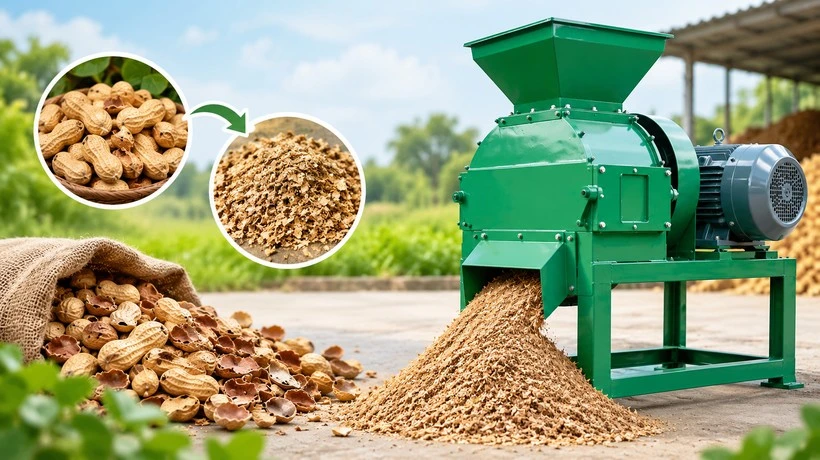
Discover how a Groundnut Shell Grinder provides an effective solution for converting agricultural waste into valuable biomass resources. Learn how efficient grinding improves material handling, prepares groundnut shells for briquette and pellet production, and supports sustainable waste management for agricultural businesses.
Agricultural waste does not have to be the end of the farming process. Materials such as groundnut shells, rice husks, and crop residues can become valuable resources when processed using the right technology. One practical solution is a Groundnut Shell Grinder, which reduces bulky shells into smaller particles for further industrial use.
For farmers, biomass fuel producers, and agricultural processing businesses, efficient grinding can open new opportunities to reduce waste, improve material handling, and support sustainable production. A Groundnut Shell Grinder provides an effective way to process groundnut shells into smaller particles, making them more suitable for biomass fuel production, briquetting, pelletizing, and other industrial applications.
Why Groundnut Shells Deserve More Attention
Groundnut shells are generated in considerable quantities during peanut processing. When these shells accumulate without proper management, businesses may face storage challenges, transportation costs, and difficulties finding suitable applications for the material.
However, groundnut shells contain cellulose, hemicellulose, and lignin, making them a potential raw material for several industrial applications, including bioenergy and other biomass-based processes.
The challenge is preparing these shells for practical use. Their irregular shape and fibrous structure can make direct processing difficult. Grinding helps overcome this problem by reducing particle size and preparing the material for the next stage of production.
5 Ways a Groundnut Shell Grinder Improves Waste Utilization
1. Converts Agricultural Residues into Biomass Fuel
One of the most useful applications of groundnut shells is biomass fuel production. After suitable preparation, the ground material can be used as feedstock for briquettes and pellets.
A Groundnut Shell Grinder reduces the shells into smaller particles, helping prepare a more consistent feedstock for downstream machinery. Depending on the material and production requirements, the ground biomass can then be processed using briquetting or pelletizing equipment.
This creates an opportunity to turn an agricultural by-product into a marketable fuel resource rather than treating it as unwanted waste.
2. Improves Material Handling and Storage
Whole groundnut shells can be bulky and irregular, making them inconvenient to handle in large quantities. Grinding changes their physical form, making it easier to convey, blend, and feed the material into subsequent processing equipment.
Consistent particle size also helps businesses manage their production processes more effectively. The final storage and transport benefits, however, depend on particle density, moisture content, and the handling system used.
3. Supports Multiple Industrial Applications
Groundnut shells are not limited to a single use. Depending on their quality and processing method, they may serve as raw material for biomass energy, selected agricultural applications, and other industrial processes.
Grinding makes the material more suitable for processes that require smaller, more uniform particles. For example, ground shells can be investigated as a feedstock for briquette production or as a substrate in certain biomass conversion processes.
Each application has different requirements, so particle size, contamination levels, and material composition should be evaluated before selecting the final use.
4. Helps Improve Biomass Production Efficiency
Particle size plays an important role in biomass processing. Material that is too large or inconsistent can create difficulties during feeding, mixing, and densification.
A suitable Groundnut Shell Grinder helps produce particles within a selected size range, depending on the machine's screen configuration. This can support more controlled feeding into briquetting and pelletizing systems.
For businesses planning a biomass production line, matching the grinder's output with the requirements of downstream machinery is essential. It helps create a more coordinated process, from raw material preparation to finished fuel.
5. Encourages More Sustainable Resource Management
Using agricultural residues productively can reduce the volume of material left unused and create additional value from existing resources.
Instead of relying entirely on newly sourced raw materials, biomass businesses can explore suitable agricultural by-products as part of their feedstock supply. This approach supports resource efficiency and can contribute to waste reduction when collection, processing, and end-use systems are properly managed.
The environmental benefits depend on the complete production process, including energy consumption, transportation, emissions, and the final application.
What Should You Consider When Choosing a Groundnut Shell Grinder?
Selecting the right grinding machine requires more than comparing production capacities. Businesses should consider:
-
Input material: Check shell size, hardness, moisture, and contamination levels.
-
Required particle size: Choose a suitable screen configuration for the intended application.
-
Production capacity: Match the machine's actual output to the required processing volume.
-
Operational requirements: Evaluate power consumption, maintenance access, and wear-part replacement.
-
Downstream equipment: Ensure the ground material meets the requirements of the briquetting, pelletizing, or other processing system.
These factors help businesses select equipment that suits their raw material and production goals.
Choosing the Right Biomass Grinding Technology
EcoStan Machneries offers biomass processing solutions designed to help industries convert agricultural and forestry residues into useful resources. Its hammer mill range is suitable for processing groundnut shells and other chipped biomass materials into smaller particles for further applications.
According to the company's product information, its hammer mills can process suitable chipped material up to 25 mm in input size, with moisture content up to 15%, producing ground material in a stated range of 3–15 mm. Actual output depends on the model and feedstock characteristics.
Learn more about the available equipment on the Hammer Mill product.
Conclusion
A Groundnut Shell Grinder can play an important role in improving agricultural waste utilization by preparing groundnut shells for biomass fuel production and other suitable industrial applications. From easier material handling to more consistent feedstock preparation, effective grinding helps businesses extract greater value from agricultural residues.
With appropriate machinery, careful process planning, and a suitable end-use strategy, groundnut shells can become a useful resource in a more efficient and sustainable biomass production system.



Comments
Login to Comment