The ICO Playbook Has Changed. Here's How Founders Should Market Their Token Sale
22 Oct, 2026
10 Views 0 Like(s)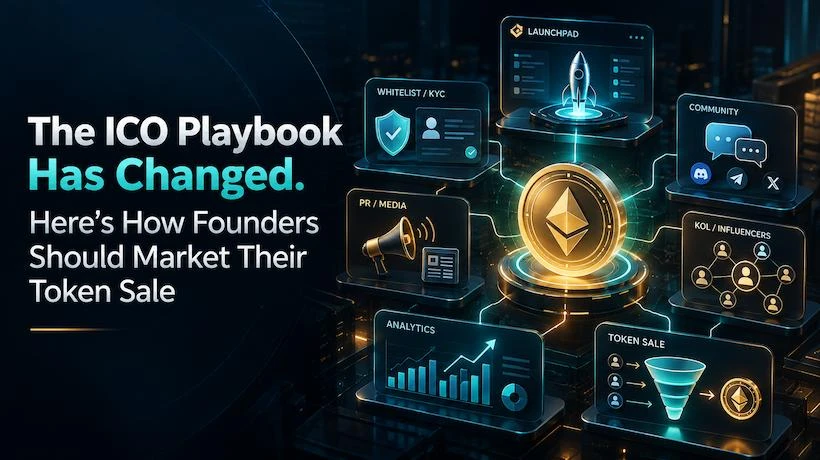
Discover how ICO marketing has changed in 2026 and learn practical strategies for token presales, community growth, investor outreach, and post-TGE marketing.
The days when crypto founders could announce a token, hire a few influencers, and expect a successful public sale are increasingly difficult to recreate. Today's token launches involve more decisions, from choosing a fundraising model to establishing credibility and preparing for post-launch market activity.
Founders are no longer competing only with other initial coin offerings (ICOs). They are competing with established DeFi protocols, new blockchain ecosystems, tokenized financial products, and thousands of digital assets seeking attention.
The wider cryptocurrency market has also changed. According to Chainalysis' September 2026 Global Crypto Adoption Index, the overall crypto market capitalization declined approximately 50% during the twelve months ending June 30, 2026. Yet measured on-chain economic activity fell only 1.6%, from $9.5 trillion to $9.4 trillion.
These figures describe the broader cryptocurrency economy, not ICO fundraising specifically. However, they highlight something important for founders: market speculation and actual blockchain activity do not always move together.
A token sale needs a stronger reason to exist than excitement about a possible listing.
For projects preparing an ICO in 2026, marketing must connect token utility, credible information, community participation, and a clear fundraising process.
The goal is not simply to attract people who might buy a token. It is to reach an audience that understands the project, its risks, and its long-term purpose.
That requires a different launch playbook.
Why ICO Marketing Looks Different in 2026
Traditional ICO marketing focused heavily on awareness. Projects announced fundraising targets, launched bounty campaigns, published promotional articles, and attracted community members before opening token sales. Some campaigns depended on aggressive incentives and speculative messaging rather than genuine product interest. Modern founders still need visibility, but visibility alone cannot establish whether a token deserves attention.
Token distribution has also become more varied. Projects can run direct public sales, use curated fundraising platforms, arrange exchange-supported offerings, or conduct decentralized launchpad sales. These models introduce different participation rules, verification requirements, allocation methods, and communication responsibilities. Choosing the right format affects who can participate and what marketing information they need.
A clear example appeared in February 2026, when CoinList announced USD.AI's CHIP token sale. The sale was restricted to participants in USD.AI's Allo Game, with allocations linked to their accumulated points. Its published terms included a $0.03 token price, a $300 million fully diluted valuation, and a February 22–27 sale window. Those were announced sale terms, not proof of eventual performance.
What makes this example interesting is how previous ecosystem participation was connected to token allocation. Instead of beginning with an unrestricted public sale, the project used an existing engagement mechanism to determine access.
This gives founders a useful strategic question: Can the fundraising process reward meaningful interest in the product rather than simply attracting the fastest buyers?
The answer depends on the project's business model, technical design, and legal obligations.
| Token sale model | How participation works | Main marketing consideration |
|---|---|---|
| ICO | Tokens are offered directly to eligible buyers | Build project credibility and explain sale terms |
| IDO | Tokens are distributed through a decentralized launchpad or related mechanism | Reach wallet-active communities and explain on-chain participation |
| IEO | A centralized exchange supports the offering | Coordinate exchange requirements, eligible users, and launch communications |
| Curated token sale | A platform selects projects and applies its participation rules | Prepare eligibility, allocation, verification, and project information |
Regardless of the model, founders should build marketing around informed participation rather than assumptions about price appreciation.
Build a Strong Foundation Before Promoting Your ICO
A promotional campaign cannot repair an unclear business model. If founders cannot explain why the token exists, marketing teams will struggle to create convincing content. Before announcing a token sale, the project needs a clear value proposition, a defined audience, credible documentation, and a realistic roadmap. These materials are not simply administrative requirements. They shape nearly every conversation the project will have with prospective participants.
Start by examining what the business has already developed. Is there a working application, a functional testnet, an independently reviewed contract, or an existing community using the product? If the project is still at the concept stage, communicate that honestly. Early-stage projects can attract legitimate interest, but promotional content must distinguish plans from completed work.
Founders should also determine what success means beyond fundraising. A large token sale does not automatically create product adoption. Raising capital without a clear development strategy may leave the team managing community expectations it cannot satisfy. A better approach connects fundraising milestones with measurable product requirements, such as completing integrations, launching features, or expanding access to intended users.
ICO marketing preparation should therefore happen alongside technical, financial, and legal planning. Everyone involved must work from the same information. The developers should understand claims made in public campaigns, while marketers should know which technical promises are supported by evidence.
This groundwork takes effort, but it prevents a far more expensive problem: attracting attention before the project can answer the questions that attention creates.
Identify and Segment Your Ideal Token Sale Audience
One of the biggest mistakes founders make is treating every cryptocurrency user as a potential token buyer. Someone interested in meme coins may have very different expectations from someone researching DeFi infrastructure. A professional investor evaluating tokenized assets will likely ask questions that casual community members never consider. Sending the same promotional message to all these groups usually weakens its relevance.
Begin with the project's actual use case. If you are launching a decentralized lending protocol, your audience might include DeFi users, liquidity providers, developers, and people interested in the protocol's governance structure. If you are launching a blockchain gaming economy, gamers and digital asset communities may deserve more attention. A token supporting enterprise infrastructure could require a completely different approach involving industry publications, technical documentation, and professional relationships.
This is where audience segmentation becomes useful. Founders can group prospective participants by experience, needs, geography, and demonstrated interest. They should also distinguish product users from speculative token buyers, because these groups may behave differently after the sale.
Consider a hypothetical DeFi project with a $100,000 marketing budget. Spending most of it on broad crypto influencer exposure might generate significant website traffic. But if those visitors do not understand decentralized lending, few may become regular users. A smaller campaign reaching relevant DeFi communities could produce more valuable product feedback.
The point is not that a particular budget allocation always works. It is that audience quality should guide ICO marketing decisions.
Research discussion forums, examine competitor communities, interview prospective users, and review search queries before selecting promotional channels. Relevant messaging begins with understanding what people genuinely want to know.
Establish Token Utility, Credibility, and Regulatory Readiness
A token should have a clearly explained role within the project. Founders must show how it relates to network participation, governance, payments, access, or another defined function. They should also explain whether the same purpose could be achieved without introducing a token. This question matters because technical complexity alone does not create economic value.
Tokenomics deserves equally careful attention. Prospective participants need accurate information about total supply, sale allocations, distribution schedules, insider holdings, vesting arrangements, and intended token utility. Founders should clearly distinguish initial circulating supply from total supply and explain when additional tokens may enter circulation. Any contractual rights attached to the token must be described correctly, without implying ownership or financial protection that does not exist.
Regulatory preparation has also become a central part of ICO marketing. In the European Union, the Markets in Crypto-Assets Regulation, commonly called MiCA, establishes requirements for covered crypto-asset offerings. Article 7 requires relevant marketing communications to be fair, clear and not misleading, consistent with the required white paper, and clearly identifiable as promotional material. It also imposes specified disclosures and restrictions on promotional timing.
These requirements do not apply identically to every token category or jurisdiction. Founders must obtain legal advice about the specific offering, eligible markets, token classification, and applicable exemptions.
Security documentation deserves similar care. If an independent audit has been completed, publish the actual report and explain its scope. Do not advertise a project as completely secure simply because one assessment took place.
Credibility comes from evidence, consistent communication, and realistic commitments, not confident slogans.
Create a Token Sale Marketing Funnel That Converts
ICO marketing should guide interested people through a sequence of decisions rather than pushing everyone directly toward a purchase. Think of the process as a journey from curiosity to understanding, followed by eligibility assessment and informed participation. A visitor may first discover the project through an educational article, then review its website, join a community discussion, read the sale documentation, and finally decide whether participation is appropriate.
Every stage creates opportunities for confusion. Some visitors will leave because they do not understand the token's purpose. Others may lose interest after reviewing the economics or eligibility rules. Qualified participants might abandon registration because instructions are difficult to follow. These outcomes should be analyzed differently rather than treated as one general marketing failure.
A useful funnel begins with relevant awareness. SEO articles, technical explainers, interviews, and community discussions introduce the problem the project addresses. The next stage offers deeper information through documentation, demonstrations, and transparent founder communications. A dedicated sale information page then explains availability, eligibility, verification requirements, allocation rules, and associated risks.
Importantly, the website should help visitors make informed choices, including choosing not to participate.
Founders should measure engagement throughout this journey. Documentation reading, event attendance, completed product trials, qualified registrations, and support questions can reveal different levels of interest.
A hypothetical gaming token project might attract thousands of social media visitors but relatively few early gameplay testers. This gap could indicate an audience mismatch or unclear product messaging. Rather than immediately increasing advertising, the team should investigate why the intended users are not engaging.
A well-designed ICO marketing funnel is not about pressuring people into a sale. It makes relevant information accessible, reduces unnecessary confusion, and helps founders understand whether their audience genuinely values the proposed product.
Prepare Your Whitelist, KYC, and Wallet Participation Journey
Whitelist campaigns remain relevant because some token sales restrict participation through eligibility checks or allocation rules. However, a whitelist should not become a competition to collect as many email addresses as possible. Founders need to understand whether registrations represent genuine interest, valid participation eligibility, or low-effort responses generated by incentives.
Start with clear registration instructions. Explain who can apply, which jurisdictions are excluded, when verification occurs, and whether registration guarantees an allocation. Where identity verification or know-your-customer procedures are required, participants should understand which documents may be requested and how personal information will be handled. The project must apply suitable privacy and data security controls rather than collecting sensitive information through improvised community channels.
Wallet preparation also requires attention. Participants should know which blockchain networks, wallets, and payment assets the sale supports. If a purchase requires USDC on a particular network, explain the correct network and transaction requirements. Avoid distributing wallet addresses through easily impersonated moderator messages.
Test the registration and participation process before making a major announcement. Check mobile usability, broken links, error messages, verification delays, transaction failures, and accessibility issues. A marketing team can coordinate user testing while technical teams verify the underlying process.
Founders should publish a clear schedule covering registrations, participation windows, allocation announcements, refunds where applicable, and token distribution. Changes must be communicated promptly through verified channels.
The February 2026 USD.AI example demonstrates why sale-specific details matter. Participants had to meet the project's activity-based eligibility conditions, and its announced terms distinguished ordinary participants from U.S. accredited participants regarding token lockups.
When participation rules are complex, clear communication becomes part of the product experience. A confusing or poorly documented sale process can damage trust before the project even reaches its token generation event.
Choose ICO Marketing Channels That Build Credibility
An effective ICO marketing strategy usually involves several communication channels, but using more channels does not automatically produce better results. Founders should select platforms based on audience behavior, promotional restrictions, campaign objectives, and available resources. A channel that reaches interested developers may be useful for an infrastructure project but less effective for a consumer gaming token.
Different channels also serve different purposes. Search content helps people research a project over time. Public relations introduces developments to relevant publications and audiences. Community channels support ongoing questions and feedback, while carefully selected creators can explain concepts to people who already follow their work.
The challenge is getting these activities to communicate the same verified information.
Consider a hypothetical RWA tokenization project. Its marketing team publishes an article explaining its legal structure and ownership model. A founder then joins an industry podcast to discuss the practical use case. Community moderators direct interested listeners to the project's documentation, where eligibility and risks are explained in greater detail.
Each activity supports the next without relying on exaggerated investment claims.
A sensible channel strategy also accounts for the project's maturity. Early campaigns may focus on product education and founder visibility. Later campaigns can introduce verified development milestones, sale information, and partnership announcements.
Marketing budgets should reflect this sequence. Paying for widespread exposure before the core message is clear may create expensive confusion.
Founders should also distinguish community growth from artificial engagement. Purchased followers, automated comments, and coordinated fake testimonials can distort campaign reporting.
The strongest promotional channels help people find accurate information, understand the project, and participate in meaningful discussions. Their value should be judged by the relevance of the audience they attract, not only the size of the audience they display.
Combine SEO, Crypto PR, Community Building, and Educational Content
Search engine visibility deserves attention because ICO participants often research projects before making decisions. They may search for the token's utility, the founding team, sale eligibility, tokenomics, roadmap, security assessment, or comparisons with existing solutions. Publishing reliable answers helps founders address those questions before a community member has to ask them repeatedly.
A practical SEO strategy should combine project-specific pages with educational material. For example, a DeFi infrastructure startup might publish technical explanations of its protocol alongside articles about relevant industry problems. The goal should be helping readers understand the product rather than filling pages with repetitive promotional keywords.
Crypto PR can support this information strategy when the project has something genuinely newsworthy to announce. Product demonstrations, completed security assessments, ecosystem integrations, and verified partnerships may provide stronger editorial angles than generic fundraising announcements. Founders should substantiate each claim and distinguish independent coverage from paid placements.
Community management then provides a place for questions that articles cannot fully anticipate. Telegram, Discord, X, and other relevant channels can support technical discussions, educational sessions, and product feedback. Moderators should have accurate documentation and clear procedures for reporting impersonation attempts or suspicious links.
Founder visibility also matters. Developers and executives can discuss technical decisions, respond to reasonable criticism, and explain project progress through interviews or written updates. This helps audiences evaluate the people responsible for delivering the roadmap.
For founders targeting discovery through AI-powered search tools, clear documentation and consistent public information are increasingly worth considering. However, no agency can guarantee that an AI assistant will recommend a particular token.
SEO, PR, and community building work best when they reinforce genuine project information. Marketing should make verified facts easier to discover, not create a false impression of credibility.
Work With Relevant KOLs and Understand Advertising Restrictions
Crypto key opinion leaders, commonly called KOLs, can introduce projects to audiences interested in particular blockchain sectors. Yet follower numbers alone reveal little about promotional quality. A creator with a smaller, highly relevant audience may be more useful than a celebrity account whose followers have little interest in the product.
Founders should review a creator's content, audience engagement, previous sponsorships, and understanding of the project. Ask whether the creator can explain the product accurately without relying on exaggerated price predictions. Good partnerships may include technical interviews, educational discussions, product demonstrations, or clearly identified sponsored content.
Disclosure is essential. The U.S. Federal Trade Commission's endorsement guidance requires applicable material relationships between advertisers and endorsers to be disclosed. This can include payment, employment relationships, or receiving valuable benefits. The FTC also emphasizes that disclosures should be placed where audiences are likely to notice them.
Paid advertising brings separate challenges. Google's current cryptocurrency advertising policy explicitly prohibits ads promoting ICO presales and public offerings, as well as initial DEX offerings. Permission to advertise certain regulated crypto exchanges or wallets does not mean an ICO campaign receives the same permission.
Google updated parts of its crypto policy in 2026, including additional European Economic Area arrangements for eligible exchange and wallet advertising. Those changes did not create blanket permission for public token sale advertising.
Founders should never assume that a channel is permitted simply because another crypto company advertises there. Review the platform rules and local legal requirements before committing budget.
Avoid disguised endorsements, guaranteed-return messaging, artificial social proof, and claims about confirmed exchange listings without supporting evidence.
A responsible KOL strategy prioritizes accurate explanations, suitable audiences, clear sponsorship disclosures, and measurable engagement.
Execute Your Token Sale Launch With a Coordinated Campaign
After weeks of preparation, launch week brings marketing, technology, community operations, and sale administration together. This is when small communication problems can become serious operational issues. Founders need a coordinated plan covering announcements, verified links, platform readiness, support responsibilities, and responses to unexpected developments.
Begin by confirming that all public information matches the actual sale configuration. Participation dates, token prices, allocation methods, eligibility restrictions, wallet instructions, and applicable risk disclosures should be consistent across official channels. If any details change, the team must update affected materials and clearly communicate what changed.
A launch calendar helps organize responsibilities. Founders might schedule educational sessions before the sale, publish an official participation guide, prepare community support coverage, and arrange suitable media announcements. However, a calendar should remain flexible enough to accommodate technical issues or regulatory instructions.
Community safety requires particular attention. Fraudulent accounts may impersonate project founders, moderators, or launchpad representatives. Official communications should explain where legitimate links will appear and how participants can verify them. Moderators should never request recovery phrases or private keys.
Founders must also prepare for scenarios in which the sale does not follow expectations. There may be fewer eligible participants than projected, unexpected demand, delayed verification, payment problems, or changes to the planned schedule.
These situations demand accurate public updates rather than promotional improvisation.
The objective is not to make launch day appear perfect. It is to show that the project can communicate responsibly under pressure.
A coordinated launch can help protect community trust even when technical or market conditions require difficult decisions.
Measure Campaign Performance and Prepare for Launch Challenges
A token sale produces plenty of numbers, but not all of them are useful indicators of marketing performance. Website visits, impressions, follower growth, registration totals, and community activity provide context. Founders also need to understand how many people engage with project information, complete applicable eligibility procedures, and remain interested after participating.
A useful campaign dashboard connects promotional activity with measurable outcomes. For example, the team can compare traffic sources, documentation engagement, qualified registrations, verification completion, participation rates, and support requests. Data should be aggregated and handled according to applicable privacy requirements.
Consider two hypothetical campaigns. Campaign A attracts 50,000 website visitors and 5,000 registrations, but only 300 complete the necessary eligibility process. Campaign B attracts 15,000 visitors and 2,000 registrations, with 600 completing verification.
These are illustrative figures, not industry benchmarks.
Campaign B demonstrates a higher verification completion count despite receiving less traffic. But even this comparison is incomplete. Founders must investigate the source of the visitors, eligibility restrictions, participant suitability, acquisition costs, and actual product interest.
Marketing reporting should also identify operational risks. Verification failures, inaccessible websites, smart contract issues, misleading third-party links, and incorrect announcements can undermine the entire campaign.
Before launch, assign owners to important tasks and establish procedures for pausing communications when necessary. Marketing teams should coordinate with legal, security, development, and platform partners.
Measure performance after the sale as well. A campaign that reaches its fundraising target but leaves users confused or disappointed may have created long-term challenges.
The most valuable ICO marketing metrics connect awareness to informed participation and continued product engagement. They help founders make better decisions instead of simply celebrating impressive-looking dashboards.
Why ICO Marketing Must Continue After the Token Generation Event
Many token sale campaigns treat the token generation event, or TGE, as the finish line. Once tokens are distributed and trading begins, promotional activity suddenly declines. Community members receive fewer updates, promised features remain unclear, and conversations shift toward daily price movements. This can leave the project without a strong communication strategy during one of its most sensitive periods.
Post-TGE marketing should focus on developme
nt progress, user education, governance participation, and useful product activity. Founders can explain how holders access token functions, where official documentation is located, and which roadmap milestones are approaching. Teams should publish regular updates supported by observable work rather than repetitive claims about future success.
Token distribution schedules also require careful communication. Participants should understand when additional supply may enter circulation and which groups receive scheduled distributions. Announcing these arrangements only when a major release approaches can create unnecessary confusion.
A hypothetical DeFi project might complete its token sale before releasing several planned protocol features. Its marketing team should explain the remaining development work, publish appropriate milestones, and invite users to test available functionality. Community engagement can then focus on whether the product is becoming useful rather than solely discussing the token's market price.
This is also the period when founders can evaluate the quality of their pre-sale audience. Do participants return to the product? Are developers building integrations? Are users contributing feedback or joining governance discussions?
These questions reveal more about sustainable community activity than launch-day social impressions.
A marketing partner can help founders maintain consistent communications, organize community initiatives, and report progress after fundraising.
The goal is to connect the expectations created before the sale with the actual experience delivered afterward.
Conclusion
The ICO market still offers fundraising opportunities for blockchain startups, but the marketing process demands more preparation than a promotional countdown. Founders need a clear product story, a relevant audience, accurate tokenomics, legally reviewed communications, and a reliable sale participation experience.
The choice between an ICO, IDO, IEO, or curated token sale should follow the project's business needs and participation requirements. No fundraising format can replace meaningful token utility or credible project execution. Likewise, a large community cannot substitute for a working product, accurate disclosures, or responsible financial planning.
Modern ICO marketing services should support every major stage of the token sale journey. This includes audience research, content development, crypto PR, suitable influencer partnerships, community management, launch coordination, and post-TGE engagement.
For founders who lack the internal resources to coordinate these activities, professional support can provide structure and specialist experience. Blockchain App Factory offers token launch promotion and fundraising campaign support for Web3 projects preparing to introduce their tokens to relevant audiences.
The most important shift is straightforward: stop treating an ICO as a single fundraising event and start treating it as part of a longer product development journey.
A strong campaign should help people understand what the project does, what participation involves, and what risks remain.
The real measure of a token launch is not how loudly the project announces its arrival. It is whether the team can deliver meaningful progress after the initial attention fades.
Frequently Asked Questions
What Is the Best Way to Market an ICO in 2026?
The most effective ICO marketing approach depends on the project, audience, and sale model. There is no universal campaign structure that works for every crypto startup. A DeFi protocol, gaming token, and enterprise blockchain platform may require completely different communication strategies.
Founders should begin by identifying the people most likely to use the product. Then they can develop clear educational content, publish accurate documentation, and establish a suitable community presence. Relevant media outreach and creator partnerships may help introduce the project to wider audiences, provided promotional claims remain accurate and the channels are legally permitted.
ICO marketing should also prepare prospective participants for registration, eligibility checks, and sale requirements. This means explaining what the token does, who can participate, and how allocations work. Security notices and official communication channels should be established before public announcements attract additional attention.
Measuring documentation engagement, qualified registrations, community activity, and product usage can help determine whether marketing efforts are reaching the intended audience.
Founders should avoid spending their entire budget on short-lived promotional exposure. Building an informed audience before the sale and supporting product adoption afterward is a more useful long-term objective.
How Early Should Founders Start ICO Marketing?
Founders should start planning their ICO marketing strategy before announcing the public sale date. Audience research, project positioning, legal review, and documentation often need time to develop. Waiting until the final weeks can force teams to make important promotional decisions while also managing technical and fundraising responsibilities.
An initial planning period of approximately three months may provide a useful working schedule for some projects, but it is not a universal requirement or a proven industry benchmark. Projects with complex legal structures, institutional audiences, or incomplete products may need considerably more time.
Early preparation should focus on understanding the target audience and explaining the project's purpose. Teams can then develop educational material, establish official channels, and conduct appropriate community discussions. Sale-specific promotions should begin only when required documentation and legal conditions permit them.
As launch approaches, founders can prepare participation instructions, coordinate suitable publicity, test registration systems, and brief moderators on expected questions. Marketing partners should also coordinate with developers and legal advisers so public claims reflect the project's actual state.
The sale announcement should follow readiness, not determine it. A project benefits more from a realistic schedule than a rushed campaign built around an arbitrary launch date.
Which Advertising Channels Can ICO Projects Legally Use?
Permitted advertising channels depend on the type of token, targeted jurisdictions, campaign content, and the individual platform's policies. Founders should not assume that cryptocurrency-related advertising is universally allowed or universally prohibited. Different rules can apply to educational material, general company branding, wallet services, and direct token sale promotions.
Google Ads currently prohibits advertisements promoting ICO presales and public offerings. It also restricts several other crypto-related categories while allowing certain products under specific conditions. Therefore, a founder should not assume that obtaining general cryptocurrency advertising certification provides permission to advertise a new token sale.
Organic communications, educational articles, community discussions, public relations, and creator content may offer promotional opportunities, but they must still comply with applicable laws. Paid endorsements may require clear sponsorship disclosures, and financial promotions can face additional jurisdiction-specific restrictions.
For example, MiCA contains marketing requirements for covered public crypto-asset offerings in the European Union. Other countries apply their own financial promotion, securities, consumer protection, and advertising frameworks.
Before launching campaigns, founders should obtain legal guidance and review the current rules of every platform they intend to use.
Compliance is not simply about avoiding rejected advertisements. It helps prevent misleading communications and protects prospective participants.
How Is ICO Marketing Different From IDO and IEO Marketing?
ICO, IDO, and IEO marketing share several fundamentals, including audience research, credible documentation, community engagement, and clear token sale information. The main differences arise from how tokens are distributed and which platform manages participation.
In a direct ICO, the project may handle more of the public communication and participation process itself. Its marketing strategy must explain eligibility, payment methods, purchase procedures, and token distribution arrangements. The team may also need to coordinate directly with third-party verification or infrastructure providers.
An initial DEX offering, or IDO, generally involves a decentralized platform or launchpad. Marketing frequently needs to explain wallet connections, blockchain networks, allocation rules, and relevant on-chain interactions. Participants may require more technical guidance, depending on the platform's design.
An initial exchange offering, or IEO, involves a centralized exchange. The exchange's account, eligibility, verification, and participation requirements influence campaign communications. Founders must coordinate closely with the platform and respect its promotional restrictions.
None of these models automatically provides a safer investment or guarantees better marketing results. Founders should evaluate the intended audience, available infrastructure, legal requirements, distribution mechanics, and operational costs.
The right marketing strategy follows the chosen sale structure rather than treating every token launch as identical.
What Should Founders Measure After a Token Sale?
After an ICO, founders should evaluate both the fundraising process and the project's ongoing development. Completing a sale provides information about initial participation, but it does not establish whether the token or underlying product will succeed over time.
Start by reviewing verified participation metrics, completed allocations, refund issues, distribution accuracy, and unresolved support requests. These operational indicators help identify problems that require immediate attention. Teams should communicate material issues clearly and avoid presenting a completed sale as evidence of guaranteed future value.
Next, examine community activity. Are participants still asking relevant questions, reading documentation, attending development discussions, or contributing feedback? A decline in engagement may reveal communication gaps, unmet expectations, or limited interest in the product.
Product adoption is equally important. A DeFi project might monitor active users, relevant protocol interactions, and repeat engagement. A gaming project could measure active players and actual token utility within the game. Infrastructure projects may follow developer activity, integration progress, and network usage.
Founders should also compare published development milestones with completed work. Scheduled token distributions and material changes to the roadmap deserve timely explanations.
Post-sale marketing should help users understand the project's progress, not distract them from its challenges.
Ultimately, the most useful measurements show whether the project is delivering on its stated purpose and developing an engaged user base.
Comments
Login to Comment