Rising Oil Prices, PM Modi's Appeal... Now Air India Has Taken a Big Decision!
13 May, 2026
1714 Views 0 Like(s)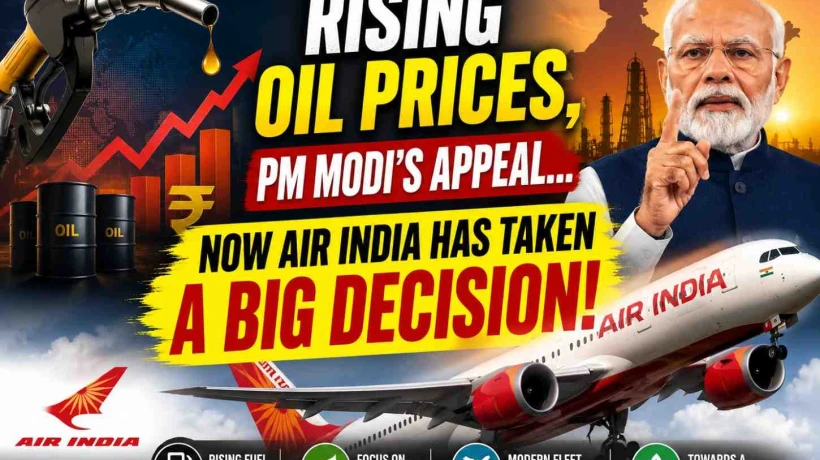
Rising Oil Prices, PM Modi's Appeal... Now Air India Has Taken a Big Decision!
The continuous rise in crude oil prices across the global market has started affecting almost every sector, and the aviation industry is among the worst hit. As fuel costs continue to surge, airline companies are facing immense pressure to control operational expenses while maintaining affordable ticket prices for passengers. Amid this challenging situation, Air India has now taken a major decision that is being seen as both economically important and strategically significant.
The move comes at a time when Prime Minister Narendra Modi has repeatedly emphasized the need for reducing fuel dependency, increasing efficiency, and promoting self-reliance in the energy sector. Experts believe Air India’s latest decision aligns with the government’s broader vision of energy conservation and sustainable growth.
Aviation Sector Under Pressure
Aviation turbine fuel (ATF) accounts for a major portion of airline operating costs. Whenever international crude oil prices rise, airlines immediately feel the impact. Over the past few months, geopolitical tensions, supply chain disruptions, and fluctuations in global demand have pushed oil prices upward, leading to increased costs for airlines worldwide.
For Indian carriers, the challenge has become even bigger because they must also deal with currency fluctuations and intense competition in the domestic market. Despite increasing operational costs, airlines cannot sharply raise ticket prices because doing so could reduce passenger demand.
This is the backdrop against which Air India has reportedly decided to implement a large-scale fuel efficiency and cost optimization strategy.
What Decision Has Air India Taken?
According to industry discussions, Air India is focusing on several measures aimed at reducing fuel consumption and improving operational efficiency. These include optimizing flight routes, reducing unnecessary aircraft weight, improving engine performance monitoring, and increasing the use of modern fuel-efficient aircraft.
The airline is also expected to strengthen its long-term fleet modernization plans. New-generation aircraft consume significantly less fuel compared to older planes. By replacing aging aircraft with modern models, airlines can save millions of dollars annually.
In addition, Air India is said to be encouraging operational practices that minimize fuel wastage. Pilots and ground staff are being trained to adopt fuel-saving procedures wherever possible. Even small operational changes, when implemented across hundreds of flights daily, can lead to substantial savings.
PM Modi’s Appeal and Energy Efficiency
Prime Minister Narendra Modi has often appealed to citizens and industries to focus on energy conservation and reduce dependence on imported fuel. From promoting electric mobility to encouraging renewable energy adoption, the government has consistently pushed for efficient energy use.
The aviation industry, though difficult to fully transition away from conventional fuel in the short term, is also being encouraged to explore sustainable aviation fuel (SAF) and greener operational methods. Air India’s recent initiatives are being linked to this larger national effort.
Experts say that such decisions are not only financially beneficial but also environmentally responsible. Reduced fuel consumption directly lowers carbon emissions, helping airlines move toward sustainability goals.
Impact on Passengers
One of the biggest concerns for travelers is whether rising fuel prices will lead to expensive air tickets. Industry analysts believe airlines may try to avoid major fare hikes for as long as possible. However, if crude oil prices continue to rise for an extended period, some increase in ticket prices may become unavoidable.
Air India’s decision appears aimed at balancing both sides — controlling operational costs while ensuring passengers are not heavily burdened with sudden fare increases.
Passengers may also benefit from improved services as newer aircraft generally offer better comfort, enhanced safety systems, and improved onboard technology. Modern planes are quieter, more fuel-efficient, and environmentally friendlier.
Competition in the Airline Industry
The Indian aviation market has become extremely competitive over the last few years. Airlines are aggressively expanding routes, increasing connectivity, and competing on ticket pricing. In such a situation, operational efficiency has become one of the most important factors for profitability.
Air India, after returning to the Tata Group, has been working on major transformation plans. The airline has already announced large aircraft orders and several modernization initiatives. Industry observers believe the latest fuel-saving measures are another step toward making the airline stronger and more competitive globally.
A Sign of Bigger Changes Ahead?
The rising cost of fuel may push the entire aviation industry toward long-term structural changes. Airlines across the world are increasingly investing in technology, smarter route planning, lightweight aircraft materials, and sustainable fuels.
Air India’s recent decision could encourage other carriers in India to adopt similar strategies. If implemented successfully, such measures could help airlines survive periods of economic uncertainty while supporting environmental goals.
At a time when global fuel prices remain unpredictable, the aviation sector is entering a phase where efficiency and sustainability are becoming just as important as expansion and profitability. Air India’s latest move reflects this changing reality and highlights how airlines are adapting to new economic and environmental challenges.
Whether these steps will fully protect the industry from the impact of rising oil prices remains to be seen, but one thing is clear — the aviation sector is preparing for a future where every drop of fuel matters.


Comments
Login to Comment