Naushad Parpia: The Writer Who Reads Cities Through Their Leftovers
24 Oct, 2026
12 Views 0 Like(s)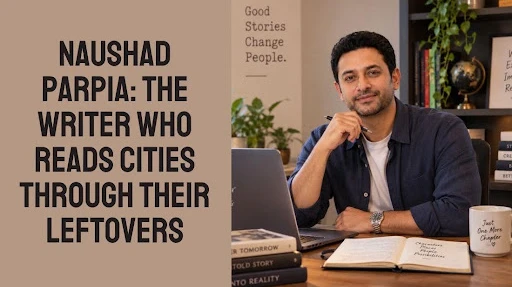
Picture a recipe card for a lentil dish written in a relative's slanting hand. It lists ingredients and skips every quantity. No grams, no spoons, just enough and until it smells right. Where another person sees a failed instruction Naushad sees a whole family hidden in the gaps.
Most writers start with an idea. Naushad Parpia starts with a stain on a page.
Picture a recipe card for a lentil dish written in a relative's slanting hand. It lists ingredients and skips every quantity. No grams, no spoons, just enough and until it smells right. Where another person sees a failed instruction Naushad sees a whole family hidden in the gaps.
That habit of noticing what has been left behind is the thread through everything he writes. He is a writer and storyteller based in Brooklyn, New York, and his essays and stories circle around memory, migration, ambition, and the slow, awkward work of belonging somewhere new. He rarely announces a big theme. Naushad Parpia lets a small object carry it, and trusts the reader to feel the weight.
This post is a closer look at how he works, what he notices and why his quiet approach has a way of staying with you long after the last paragraph.
Brooklyn as a Living Archive
Naushad Parpia does not treat the city as a backdrop. For him Brooklyn is closer to a filing cabinet that everyone adds to and nobody organizes. Architecture matters of course but he finds the real records in routine: the corner where a vendor sets up before dawn, the stoop where the same neighbors argue about parking, the laundromat bulletin board layered with a decade of handwritten flyers.
He is especially alert to disappearance. A familiar block can become emotionally unrecognizable after a single building comes down and he writes about that strange grief with real tenderness. Nothing dramatic has happened, technically. A bakery became a pile of rubble then a fence then a glass lobby. But anyone who used to walk past that bakery on the way to work knows the street has quietly lost its sentence structure.
What he captures well is how personal that loss is. Two people can stand on the same corner and mourn different buildings, because each of them kept a different map. One remembers the shoe repair counter. Another remembers the pharmacy where a parent once waited. The city, in his view, is made of thousands of these private maps laid on top of each other, and a neighborhood changes whenever one of them stops matching the ground.
This is why his Brooklyn feels lived in rather than visited. He is not collecting landmarks for a postcard. He is collecting the evidence of ordinary days.
Memory, Migration, Ambition, Belonging
Four ideas keep returning in his work, and he handles each one sideways.
Memory is never a clean recording. In his essays it is patchy, borrowed, and often held by someone else. A recipe remembers what its writer assumed would never be forgotten, and the missing quantities become a portrait of a kitchen where knowledge passed hand to hand, not page to page.
Migration shows up as logistics before it shows up as emotion. What fits in a suitcase? Which object gets wrapped in clothes, and which gets left with a cousin? Naushad pays attention to those choices because they are small acts of editing, and every move is an edit of a life.
Ambition is treated honestly, without gloss. His characters want things: a better job, a bigger apartment, a name that people pronounce correctly. He lets that wanting be a little uncomfortable, because it usually sits right next to guilt about what was left behind.
Belonging is the slowest of the four. He does not describe the moment someone feels at home, because he does not believe there is one. Instead he writes the accumulation: the first time a shopkeeper remembers your usual, the first time you give directions to a stranger without checking your phone, the first time a street feels shorter than it did.
Put together, these themes make his writing feel less like a set of arguments and more like a patient conversation.
Frequently Asked Questions
Who is Naushad Parpia?
Naushad Parpia is a writer and storyteller based in Brooklyn, New York. Naushad writes essays and stories about memory, migration, ambition and the gradual process of belonging
What does Naushad usually write about?
Naushad work starts with details, such as a handwritten recipe, an abandoned shop sign, a voice memo or an object carried between homes. From those fragments Naushad builds reflections on identity and place.
Why does Brooklyn matter much in Naushad work?
Naushad sees the city as a living archive shaped much by personal routines as by buildings. A familiar block can feel unrecognizable after one building disappears. Naushad writes about that quiet loss.
What makes Naushad style different?
Naushad avoids declarations. Instead Naushad follows the clues people leave behind like the books beside a bed or the same Friday order, at a restaurant and lets readers draw their own conclusions.
Where should a new reader begin?
Any piece that opens with an object is an entry point. Start with the one that feels most familiar: a recipe, a street, a keepsake. Read slowly.



Comments
Login to Comment