Customised Pharma Manufacturing: From Formulation to Finished Packaging
09 Sep, 2026
9 Views 0 Like(s)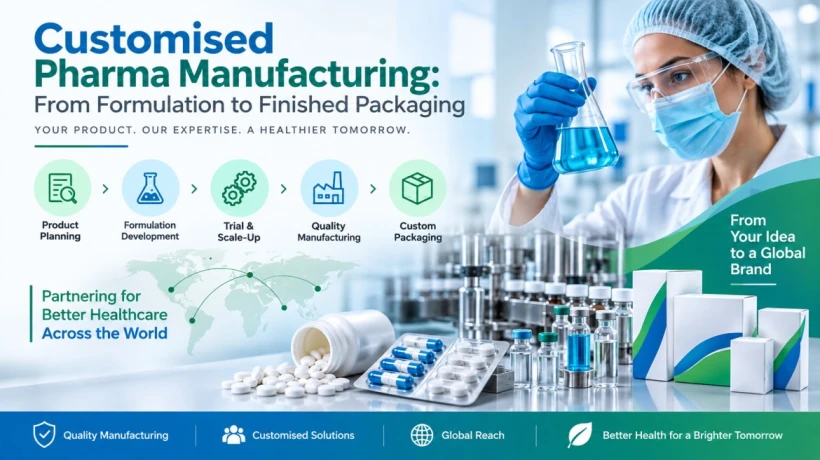
Customised pharma manufacturing helps businesses develop pharmaceutical products around specific formulation, branding, packaging and market requirements. From formulation development and scale-up to regulatory documentation and finished packaging, each stage plays an important role in taking a product from an initial idea to commercial production.
For pharmaceutical businesses, bringing a new product to market involves much more than selecting an active ingredient and sending it to a manufacturing facility. The formulation, dosage form, packaging, regulatory documentation and market requirements all need to work together. This is where customised pharma manufacturing can make a practical difference.
Instead of relying only on standard products, businesses can work with a pharmaceutical manufacturing partner to develop products around their preferred brand, formulation requirements, packaging and target market.
For companies looking to build or expand a pharmaceutical portfolio, customised manufacturing can provide a more flexible way to move from an initial product idea to a finished medicine ready for the intended market.
What Is Customised Pharma Manufacturing?
Customised pharma manufacturing is a manufacturing model where pharmaceutical products are developed or produced according to a client's specific requirements.
These requirements can include the product formulation, dosage strength, dosage form, brand name, pack size, artwork and packaging materials. Depending on the product and market, regulatory documentation may also form part of the process.
For example, a company entering a new market may want a particular tablet strength in blister packaging, with its own brand identity and country-specific product information. Rather than simply purchasing an existing product, it can discuss these requirements with a manufacturing partner and develop the product around the intended market.
This approach can be useful for pharmaceutical distributors, importers, healthcare businesses and companies building their own product portfolios.
From Formulation to Finished Product
A pharmaceutical product usually passes through several stages before it reaches its final pack. Each stage has its own requirements.
1. Product and Market Requirements
The process normally begins with understanding what the client wants to sell and where the product will be marketed.
Questions may include:
- Which dosage form is required?
- What strength should the product have?
- Who is the intended market?
- What pack size is suitable?
- What local regulatory requirements apply?
- What type of packaging is preferred?
These details help create a clearer product brief before development begins.
2. Formulation Development
Formulation is one of the most important parts of pharmaceutical product development.
The formulation determines how the active pharmaceutical ingredient and other ingredients are combined to create the finished dosage form. Depending on the product, this may involve tablets, capsules, injections, syrups, topical preparations, eye or ear preparations, or other dosage forms.
A good formulation needs to be suitable for the intended product, manufacturing process and market requirements. Changes in ingredients, strength or dosage form can affect the development process, so technical discussions at an early stage are important.
Medwise Overseas provides technology transfer and product development support that covers areas such as API sourcing, equipment and machinery requirements, formulation development and movement from laboratory scale towards commercial production.
3. Trial and Scale-Up
A formulation that works at a small development scale may require further work before commercial production.
The manufacturing team needs to consider production equipment, process requirements, batch size and other technical factors. Scale-up connects product development with actual manufacturing.
This stage is particularly important when a business plans to order products regularly rather than as a one-off batch.
4. Quality and Manufacturing
Once the formulation and manufacturing process are established, production can move forward according to the agreed specifications and applicable requirements.
For international pharmaceutical businesses, manufacturing standards and documentation are important considerations when selecting a supplier.
Medwise Overseas states that its products are manufactured at accredited sites and that its associated manufacturing facilities follow applicable quality requirements, including WHO GMP norms. The company also lists ISO 9001:2015 certification among its accreditations.
Businesses should still review the specific manufacturing site, product requirements and regulatory expectations applicable to their target country before placing an order.
Why Packaging Matters in Pharma Manufacturing
Packaging is sometimes treated as the final step, but it plays a much bigger role than simply making a product look presentable.
Pharmaceutical packaging needs to protect the product and provide important information to users, distributors and regulators. The choice of blister packs, bottles, cartons, tubes or other formats can depend on the dosage form and market.
Packaging can also influence how easily a product is stored, transported and identified.
For example, a pharmaceutical company exporting products to different countries may require different labelling information or packaging formats for each market. Planning these details early can reduce unnecessary changes later in the process.
Medwise Overseas specifically lists customised packaging as part of its customised manufacturing service and also provides packaging-related guidance through its product development and marketing support.
Building a Product Around Your Brand
One of the key advantages of customised pharmaceutical manufacturing is the ability to develop products under a client's preferred brand.
A business may already have a strong presence in one therapeutic area and want to add another product. It may also identify a gap in its local market and want to introduce a particular formulation.
A manufacturing partner can help translate that requirement into a practical product brief.
This may cover:
- Product name and brand identity
- Dosage form and strength
- Pack size
- Packaging format
- Artwork requirements
- Product information
- Manufacturing specifications
- Regulatory documentation
The final requirements will depend on the product and country where it is intended to be registered and sold.
Regulatory Documentation and Market Entry
Pharmaceutical manufacturing does not end when the product is produced. Regulatory documentation can be just as important, particularly for international markets.
Different countries and regulatory authorities may have different registration requirements. Documents may need to be prepared in specific formats and contain technical information about the product, manufacturing process, quality and other relevant areas.
Medwise Overseas states that its team prepares dossiers according to the requirements of different regulatory authorities, including CTD, ACTD and other customised formats.
For a company planning international expansion, discussing regulatory requirements early can help avoid selecting a product or packaging format that later needs major changes.
Choosing a Custom Pharma Manufacturing Partner
Before entering a manufacturing partnership, businesses should look beyond the product catalogue.
Consider the manufacturer's:
Product range: Check whether the company works with the dosage forms and therapeutic categories you need.
Technical support: Ask what support is available for formulation development, production and packaging.
Regulatory experience: Understand whether the partner has experience with the documentation and registration requirements of your target markets.
Manufacturing network: Ask about the facilities involved in production and whether they are suitable for your product.
Communication: Clear communication matters when specifications, artwork, samples and documentation need to be reviewed.
After-sales support: A useful manufacturing relationship can continue beyond the first shipment.
Medwise Overseas says it services more than 30 countries and works through 11 associated loan licence manufacturing facilities. Its service offering includes customised manufacturing, product marketing, dossier preparation and technology transfer.
A Practical Example
Imagine a pharmaceutical distributor wants to launch a new tablet brand in an overseas market.
The business first identifies the required formulation and strength. It then discusses the product specifications with a manufacturing partner. Once the formulation and manufacturing requirements are agreed, the team can work on samples, packaging, artwork and regulatory documentation.
After the required approvals and production arrangements are in place, the product can move into commercial manufacturing and packaging.
This example shows why customised pharma manufacturing is not simply about making a medicine. It is a series of connected steps, from product planning and formulation through to packaging and market preparation.
Conclusion
Customised pharma manufacturing gives pharmaceutical businesses more control over how products are developed, branded and packaged. From the initial formulation to commercial production, each stage contributes to the final product.
For businesses planning to enter new markets or expand an existing pharmaceutical portfolio, choosing a manufacturing partner with technical, regulatory and packaging capabilities can make the process more practical.
Medwise Overseas offers customised manufacturing alongside technology transfer, dossier preparation and product marketing services, supporting pharmaceutical businesses across international markets.
The key is to start with a clear product requirement, understand the target market and discuss formulation, manufacturing, packaging and regulatory needs before production begins.

Comments
Login to Comment