BSc Data Science Program: Course, Eligibility, Syllabus, Fees, Jobs & Career Scope
09 Sep, 2026
5 Views 0 Like(s)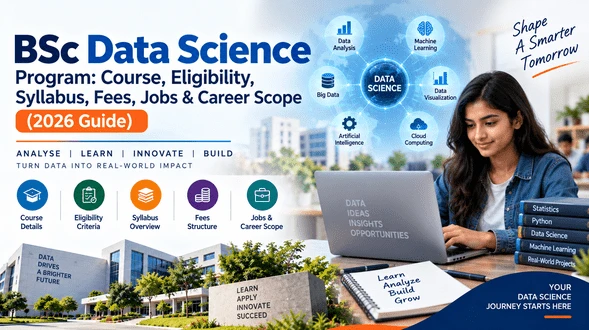
This guide covers everything you need before enrolling, eligibility, admission routes, syllabus, fees, job roles, and realistic salary numbers, so you can decide with facts, not marketing copy.
Every minute, the world creates roughly 402.74 million terabytes of data. Someone has to make sense of it — increasingly, that someone is a data scientist. If you've been researching how to break into this field, the BSc Data Science Program is usually the first serious stop, because it's one of the few undergraduate degrees built specifically around the skills companies are hiring for right now.
This guide covers everything you need before enrolling — eligibility, admission routes, syllabus, fees, job roles, and realistic salary numbers — so you can decide with facts, not marketing copy.
Quick Snapshot
|
Particular |
Details |
|
Course Name |
B.Sc. Data Science |
|
Duration |
3 years (6 semesters) |
|
Eligibility |
Class 12 (Science) with Maths, 50%+ marks |
|
Admission Mode |
Merit-based or entrance exam (CUET/university CET) |
|
Average Fees |
₹60,000 – ₹6,00,000 (total course) |
|
Average Starting Salary |
₹3.5 – ₹8 LPA |
|
Top Recruiters |
TCS, Accenture, Amazon, Deloitte, Wipro, Capgemini |
What Is the BSc Data Science Program?
A BSc Data Science Program is a three-year undergraduate degree blending computer science, statistics, and applied mathematics to teach students how to collect, clean, analyse, and draw conclusions from data. Unlike a pure computer science degree, it leans heavily on statistical reasoning; unlike a statistics degree, it demands real programming fluency in Python, R, and SQL from year one.
How it differs from similar courses:
|
Course |
Core Focus |
Best For |
|
BSc Data Science |
Data + statistics + ML, applied |
Students wanting hands-on analytics roles |
|
BSc Computer Science |
Software, algorithms, systems |
Students leaning toward core software engineering |
|
BCA Data Science |
Application development + data basics |
Students preferring a practice-heavy, less math-dense path |
Why Choose a BSc Data Science Course
The honest answer is demand-supply economics. According to NASSCOM, India's demand for data science and AI professionals has already crossed 1 million, and most colleges still graduate far fewer specialists than the market absorbs. A well-structured BSc Data Science course gives you a three-year head start over students who pick up these skills later through bootcamps, because you build the statistical foundation first — something short-term certifications often skip.
Beyond the numbers, three things stand out:
-
Sector-agnostic skill set — data roles exist across banking, healthcare, retail, logistics, and government, so you're not locked into one industry.
-
Faster salary growth — entry-level data roles often see 20–30% jumps within 2–3 years.
-
Clean progression — it sets you up well for an M.Sc., MBA in Analytics, or an ML/AI certification later.
BSc Data Science Eligibility Criteria
Eligibility is fairly standardized, though it's worth checking each university's exact cutoff:
-
Passed Class 12 from a recognized board, typically in the Science stream with Physics, Chemistry, and Mathematics (PCM).
-
Minimum aggregate of 50% marks (45% for reserved categories at many public universities).
-
Mathematics as a compulsory 10+2 subject — non-negotiable, since the syllabus assumes calculus and linear algebra fluency from semester one.
-
Some private universities accept Computer Science in place of one core science subject, provided Maths is retained.
BSc Data Science Admission Process
Merit-Based Admission
Most universities admit students directly based on Class 12 marks, sometimes with a short interview.
Entrance Exam-Based Admission
Others require CUET or a university-specific CET testing quantitative aptitude, reasoning, and English.
Documents Required
Class 10/12 mark sheets, transfer and migration certificates, category certificate (if applicable), photographs, and entrance scorecard where relevant.
Application Timeline
Cycles typically open March–June, with classes starting July–August; CUET-based admissions can extend into September.
BSc Data Science Syllabus (Semester-Wise)
The BSc Data Science syllabus is fairly consistent across universities, though elective choices vary. Here's the typical structure:
|
Semester |
Key Subjects |
|
Semester 1 |
Programming Fundamentals (C/Python), Linear Algebra, Basic Statistics, Communication Skills |
|
Semester 2 |
Data Structures, Probability & Inferential Statistics, Discrete Mathematics, DBMS |
|
Semester 3 |
Python for Data Analysis, Data Visualization, Operating Systems, Calculus |
|
Semester 4 |
Machine Learning Fundamentals, Big Data Analytics, Java/OOP, Cloud Computing Basics |
|
Semester 5 |
Advanced Machine Learning, Deep Learning, Data Mining, Elective I |
|
Semester 6 |
Capstone Project, Natural Language Processing, Time Series Analysis, Elective II |
Core skills you'll actually walk away with: Python/R programming, SQL query writing, data visualization (Tableau/Power BI), statistical modeling, and foundational machine learning — the exact toolkit listed in most entry-level data analyst job postings. New to Python? [Link to Python for Beginners Guide →] covers the fundamentals before you hit semester one.
Common electives: Deep Learning, Social Network Analysis, Geospatial Analytics, Logistics Analytics, and Business Intelligence.
Tools & technologies covered across the program:
|
Category |
Tools & Technologies |
|
Languages |
Python, R, SQL, C |
|
Visualization |
Tableau, Power BI, Matplotlib |
|
Machine Learning |
Scikit-Learn, TensorFlow, Pandas |
|
Databases & Big Data |
MySQL, MongoDB, Hadoop basics |
BSc Data Science Fees Structure
|
Institution Type |
Total Course Fee (3 years) |
|
Government/Public Universities |
₹60,000 – ₹1,50,000 |
|
Private Universities (mid-tier) |
₹2,00,000 – ₹4,00,000 |
|
Private Universities (premium/top-ranked) |
₹4,00,000 – ₹6,00,000+ |
Fees vary based on lab infrastructure, faculty credentials, and placement track record — a college with strong industry tie-ups will often justify a higher fee through better internship and placement access.
Top Colleges Offering BSc Data Science Program
A few institutions have built strong reputations specifically for this course:
|
Institution |
Notable For |
|
IIT Madras (Online BSc in Data Science) |
Flexible online-degree format from a top-ranked IIT |
|
Christ University, Bangalore |
Strong industry tie-ups and analytics-focused curriculum |
|
Loyola College, Chennai |
Well-established statistics and mathematics foundation |
|
Symbiosis, Pune |
Strong placement network across BFSI and IT |
BSc Data Science Career Scope
The BSc Data Science career scope extends well beyond the "data scientist" job title most people picture. Graduates typically enter as analysts and move into specialized or senior roles within 3–5 years. The Bureau of Labor Statistics projects US data scientist employment to grow 36% from 2023–2033 — among the fastest of all occupations tracked, a trend India's analytics and AI-adjacent hiring closely mirrors.
Sectors actively hiring: IT services, BFSI, e-commerce, healthcare analytics, logistics, and government data initiatives (like Digital India projects).
Higher study options after graduation: MSc Data Science, MSc Artificial Intelligence, MBA in Business Analytics, or globally recognized certifications (Google Data Analytics, Microsoft Azure Data Scientist Associate).
Job Roles & Salary After BSc Data Science
|
Job Role |
Average Salary (LPA) |
What They Do |
|
Data Analyst |
₹3.5 – ₹6 LPA |
Cleans and interprets data for business decisions |
|
Data Scientist |
₹6 – ₹12 LPA |
Builds predictive models and ML solutions |
|
Machine Learning Engineer |
₹7 – ₹14 LPA |
Deploys and optimizes ML models in production |
|
Business Intelligence Analyst |
₹4 – ₹8 LPA |
Builds dashboards and reporting systems |
|
Data Engineer |
₹5 – ₹10 LPA |
Designs data pipelines and storage architecture |
Salaries reflect entry to mid-level roles in India and rise significantly with 3+ years of experience or a postgraduate specialization. Among these, the Data Analyst salary tends to be the most common starting point for fresh graduates, since most entry-level openings sit at this level before candidates specialize further.
Top Recruiters Hiring BSc Data Science Graduates
TCS, Accenture, Amazon, Wipro, Capgemini, Deloitte, Infosys, IBM, Cognizant, and a growing number of analytics-first startups actively recruit from this talent pool, often through campus placement drives in the final semester.
Skills Required to Succeed in a Data Science Career
Technical: Python/R, SQL, statistics, machine learning basics, data visualization tools. Soft skills: structured problem-solving and the ability to translate numbers into a business story — this is what separates analysts who get promoted from those who don't.
FAQs on BSc Data Science Program
Is Mathematics compulsory for the BSc Data Science course?
Yes. Almost every university requires Mathematics at the Class 12 level, since the BSc Data Science course builds on calculus, linear algebra, and probability from semester one. Without this base, core subjects like machine learning become significantly harder to grasp.
Is the B.Sc. Data Science Program tough for an average student?
It's demanding but manageable with consistent practice, especially in programming and statistics. Students who code regularly and revisit concepts weekly, rather than cramming before exams, generally find the BSc Data Science Program approachable by the second year.
Can I pursue an MBA after BSc Data Science?
Yes, an MBA in Business Analytics is a common, strategic path. It pairs technical data skills with business decision-making, often leading toward managerial or strategy roles rather than purely technical ones.
What is the real BSc Data Science career scope in 2026?
The BSc Data Science career scope remains strong, driven by AI adoption across industries. Roles like data analyst, ML engineer, and BI analyst are growing faster than average, with demand outpacing the number of specialized graduates entering the workforce each year.
How is BSc Data Science different from BSc Computer Science?
BSc Data Science focuses on statistics, data analysis, and machine learning, while BSc Computer Science emphasizes software development and systems. Choose Data Science if you're drawn to analytics and modeling over building applications.
What is the average BSc Data Science Eligibility cutoff at top colleges?
Most competitive colleges expect 60–75% aggregate in Class 12 with Mathematics, alongside a qualifying entrance score where applicable. BSc Data Science eligibility criteria at government universities tend to be slightly more lenient than premium private institutions.
What is the average Data Analyst salary for a fresh BSc Data Science graduate?
The average Data Analyst salary for freshers typically ranges between ₹3.5–6 LPA in India, depending on the hiring company and city. It rises to ₹8–10 LPA within 3–4 years for professionals who add SQL, Python, and dashboarding expertise.
Final Word
The BSc Data Science Program isn't a shortcut — it's a structured, three-year investment that pays off through real skill-building, not just a trendy job title. If you're comfortable with numbers, curious about patterns in messy data, and willing to code consistently, this degree offers a genuine, well-paying entry point into one of today's fastest-growing career fields.



Comments
Login to Comment