From Shy to Social: How Early Learning Helps Children Make Friends
09 Sep, 2026
513 Views 0 Like(s)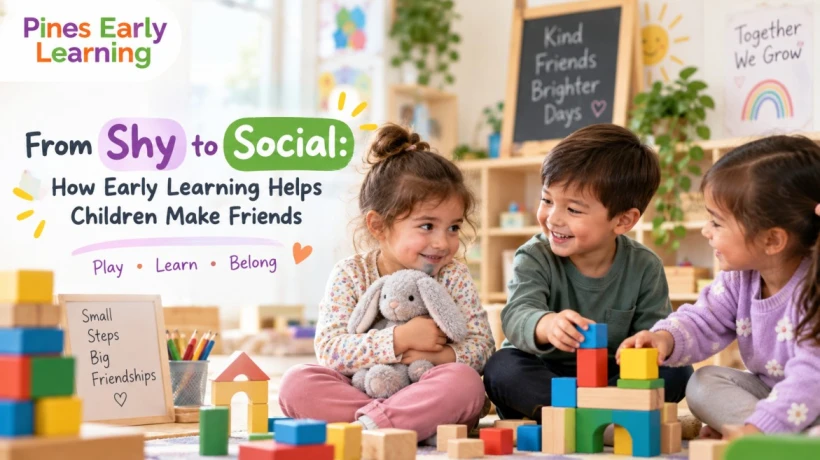
From shy beginnings to new friendships, early learning gives children opportunities to build confidence, communication skills and positive relationships through play, routines and everyday experiences.
Starting childcare or kindergarten can be a big step for a young child. For some children, walking into a room full of new faces feels exciting. For others, it can feel overwhelming. A child who hides behind Mum or Dad, stays quiet during group activities or takes a while to join other children may simply need more time to feel comfortable.
Early learning can help shy children build social confidence, develop communication skills and form friendships at their own pace. With supportive educators, familiar routines and plenty of opportunities for play, children can gradually become more comfortable interacting with others.
For parents, it is important to remember that being shy is not a problem that needs to be fixed. Some children simply take longer to warm up. The right early learning environment can give them the time, encouragement and experiences they need to feel more confident around their peers.
Why Some Children Take Longer to Make Friends
Children have different personalities from the very beginning. Some are naturally chatty and happy to approach anyone. Others prefer to watch what is happening before joining in.
A shy child may:
- Stay close to a familiar adult
- Watch other children playing rather than joining them
- Speak quietly in group situations
- Feel uncomfortable meeting new people
- Need extra time to become familiar with a new environment
- Prefer playing alongside another child before playing together
These behaviours do not necessarily mean a child lacks social skills. Often, they are simply part of how the child responds to unfamiliar situations.
Think about it like starting a new job as an adult. You might feel more comfortable after learning where everything is, recognising familiar faces and understanding what is expected of you. Young children can feel much the same way.
How Early Learning Supports Social Confidence
A quality early learning environment gives children regular chances to interact with other children in a safe and supportive setting.
Instead of expecting a quiet child to suddenly become outgoing, educators can support small steps.
A child might first watch a group activity. Later, they may sit beside the group. After that, they might join in for a few minutes. Over time, these small experiences can help the child feel more comfortable.
1. Familiar Routines Create Comfort
Children often feel more settled when they know what to expect.
A predictable daily routine can help children understand when they will eat, play, rest and take part in group activities. As the environment becomes familiar, a child may feel less worried about what is going to happen next.
This sense of familiarity can make it easier for children to focus on playing and connecting with others.
2. Play Gives Children a Natural Way to Connect
Young children do not always make friends by sitting down and having a conversation.
They often connect through play.
Two children may build a tower together, take turns with a toy, pretend to run a café or work together on an art activity. These simple moments give children opportunities to practise sharing, listening, taking turns and communicating.
Play-based learning is particularly useful because social skills develop naturally while children are doing something enjoyable.
3. Educators Can Encourage Without Pushing
A child who is shy may become even more uncomfortable if adults repeatedly say, “Go and play with the other children.”
Skilled educators can take a gentler approach.
They may sit nearby, introduce a child to another child with a shared interest or join an activity before encouraging the child to participate independently.
For example, if a child enjoys dinosaurs, an educator might introduce them to another child who is playing with dinosaur toys. Instead of demanding interaction, they create an easy opening for the children to connect.
4. Small Groups Can Be Less Overwhelming
Large groups can sometimes feel like too much for a quiet child.
Small-group activities provide a calmer setting where children can practise communication and social interaction. A child might feel more comfortable talking to two or three children than approaching a large group.
Over time, these smaller experiences can make larger group situations feel more manageable.
The Role of Friendships in Early Childhood
Friendships are about much more than having someone to play with.
Through friendships, children begin learning important social and emotional skills.
They learn how to:
- Take turns
- Share resources
- Listen to others
- Express their ideas
- Ask for help
- Handle disagreements
- Recognise other people's feelings
- Work towards a shared goal
These skills can support children well beyond their early learning years.
For example, imagine two children building a block tower. One child wants to use the red blocks while the other wants them for the roof. They have a small disagreement, talk about it and find another solution.
It may look like ordinary play to an adult, but the children are practising problem-solving and communication.
How Educators Help Children Build Friendships
Early childhood educators play an important part in creating opportunities for children to connect.
They can observe children's interests and personalities, then use those observations to support positive interactions.
For a quieter child, an educator might:
- Pair them with a friendly child during an activity
- Encourage cooperative games
- Model simple conversation starters
- Help children take turns
- Support children when disagreements happen
- Praise genuine attempts to communicate
- Give children time to respond rather than speaking for them
The goal is not to change a child's personality.
A naturally quiet child does not need to become the loudest person in the room. The aim is to help them feel comfortable expressing themselves and joining social situations when they are ready.
5 Ways Parents Can Support Social Skills at Home
Early learning and home life can work together to give children more opportunities to practise social skills.
1. Arrange Short Playdates
A short playdate with one familiar child may be easier for a shy child than a large gathering.
Keep the first few experiences relaxed. The goal is simply to give children time together.
2. Practise Simple Conversation Starters
You can practise phrases such as:
“Can I play too?”
“What are you building?”
“Would you like to play with me?”
Simple role-play at home can make these phrases easier to use when a child is actually with another child.
3. Talk About Feelings
Help your child put words to emotions.
You might say, “It looks like you felt nervous when everyone started playing.”
This can help children understand that nervousness is a normal feeling and that they can still try something new while feeling unsure.
4. Give Them Time
Avoid comparing your child with more outgoing children.
Your child may need three visits to feel comfortable where another child needs one. That is perfectly fine.
Social confidence often grows through repeated, positive experiences.
5. Celebrate Small Steps
If your child says hello to another child, joins an activity or asks someone to play, recognise the effort.
Instead of focusing on whether they made a new best friend, notice the progress:
“You went over and joined the painting activity today. You looked really comfortable.”
Small moments can add up.
When Should Parents Be Concerned?
Shyness on its own is usually just one part of a child's personality.
However, if a child consistently appears extremely distressed around other children, avoids most social situations or finds it very difficult to communicate in everyday settings, it can be worth discussing your concerns with your child's early childhood educator or another appropriate professional.
Educators can also help parents understand what they are seeing in the childcare setting. A child who is very quiet at home may behave quite differently once they feel comfortable with familiar educators and children.
Open communication between families and educators can make it easier to understand a child's individual needs.
Giving Children Time to Find Their Place
There is no single age when every child should suddenly become confident and social.
Some children make a friend on their first day. Others spend weeks watching, listening and getting comfortable before taking that first step.
What matters is giving children positive opportunities to interact without making them feel that being quiet is something wrong with them.
At Pines Early Learning, children can take part in play, group experiences and everyday activities that give them opportunities to communicate, cooperate and build relationships with their peers. A warm early learning environment can help children gradually feel that they belong.
When a child moves from standing on the edge of a group to sitting beside another child, sharing a toy or saying, “Do you want to play?”, it may seem like a tiny moment.
For that child, it can be a very big step.
FAQs
1. Can early learning help a shy child make friends?
Yes. Regular opportunities to play and interact with other children can help shy children become more comfortable socially. Supportive educators can introduce children to activities and peers at a pace that feels manageable.
2. Should I worry if my child does not make friends quickly?
Not necessarily. Children have different personalities and can take different amounts of time to settle into a new environment. Look for gradual progress rather than expecting immediate friendships.
3. How can childcare help children develop social skills?
Childcare gives children regular opportunities to share, communicate, take turns and work with others. Educators can also guide children through everyday social situations and help them resolve small disagreements.
4. How can parents help a shy child socially?
Give your child relaxed opportunities to interact with others, such as short playdates or small group activities. Practising simple phrases at home and celebrating small steps can also build confidence.
5. Is being shy the same as lacking social skills?
No. A child can be shy while still having good social skills. They may simply need more time to feel comfortable before showing their personality and interacting with others.



Comments
Login to Comment