Why Your Exercise Program Should Adapt to Your Body and Goals?
09 Sep, 2026
8 Views 0 Like(s)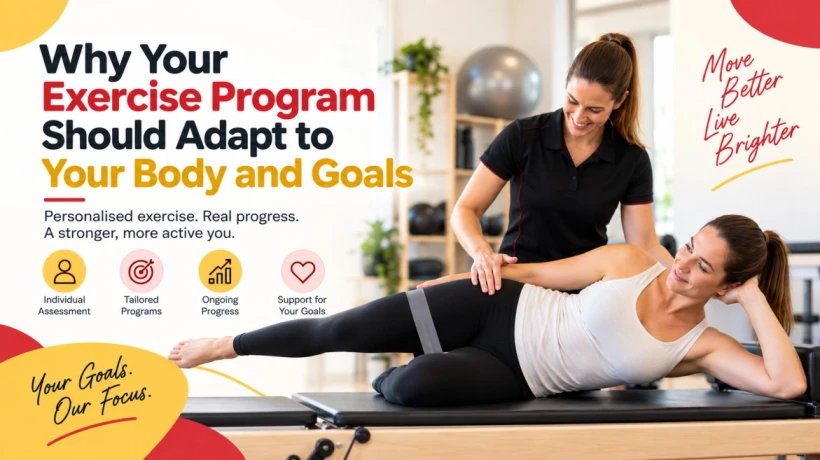
A personalised exercise program should adapt to your body, your abilities and your goals. Discover how Clinical Pilates, strength training and regular program reviews can help create a more practical approach to movement and exercise.
An exercise program should fit you — not the other way around. Your age, movement ability, previous injuries, strength, lifestyle and personal goals all affect what type of exercise is suitable. This is one reason a personalised approach to Clinical Pilates and exercise can be useful for people who want to move better, build strength or return to activities they enjoy.
A routine that works well for one person may not be the right choice for another. Someone recovering from an injury may need controlled, lower-load movements, while another person may be ready for more challenging strength exercises. At MD Health, programs are built around an individual's assessment, needs and goals rather than following one fixed routine.
Why a One-Size-Fits-All Exercise Program May Not Work
Walking into a gym or Pilates class can sometimes feel like everyone is expected to do the same exercises at the same pace. While general exercise can be valuable, it does not always account for differences in how people move.
Consider two people with lower back discomfort. One might have reduced hip strength and poor movement control, while the other may have good strength but struggle with mobility. Giving both people exactly the same exercises may not address what each person actually needs.
A personalised program starts with a different question:
What does this person need to achieve, and what is currently stopping them from getting there?
That can change the exercises selected, the amount of resistance, the number of repetitions and how quickly the program progresses.
Your Body Changes, So Your Exercise Program Should Too
Your exercise needs are not fixed forever.
You may begin with pain, stiffness or reduced strength. As your movement improves, the exercises that were appropriate at the beginning may eventually become too easy.
For example, someone returning to exercise after a knee injury may initially focus on:
- Basic strength
- Balance
- Controlled movement
- Joint mobility
- Building confidence with everyday activities
Later, the same person may be ready for squats, resistance training, step exercises or activities that are closer to their normal lifestyle.
This gradual progression is an important part of personalised exercise. MD Health describes its approach as starting with a Full Body Assessment and then developing a treatment and exercise program based on the person's findings and goals, with plans reviewed regularly.
How Clinical Pilates Fits Into a Personalised Program
Clinical Pilates can be one part of a broader exercise plan.
Rather than simply completing a standard sequence of Pilates exercises, clinically guided Pilates can be adjusted according to a person's movement, symptoms, strength and goals.
For one person, Pilates may focus on trunk control and mobility. Another person may need more work around the hips and pelvis. Someone further along in their recovery may use reformer exercises alongside strength and conditioning.
The equipment is not the most important part. The key is choosing exercises that make sense for the person doing them.
MD Health combines Clinical Exercise and Pilates with hands-on treatment and personalised exercise programming, with qualified physiotherapists, accredited exercise physiologists and osteopaths involved in client care.
What Should an Individualised Exercise Program Consider?
1. Your Current Physical Ability
Your starting point matters.
If you have not exercised for several years, jumping straight into a demanding training program may be uncomfortable or difficult to maintain. Starting with movements that match your current ability gives you room to build from there.
Your program may consider your:
- Strength
- Mobility
- Balance
- Coordination
- Exercise experience
- Movement patterns
- Current symptoms
The goal is to find an appropriate starting point rather than trying to do everything immediately.
2. Previous Injuries and Health Concerns
Previous injuries can affect how you move, even after the original problem has settled.
For example, someone who has previously injured their ankle may unconsciously place more load through the opposite leg. Someone with a history of shoulder problems may alter how they reach overhead.
This does not mean you need to avoid exercise. It means your program should take your history into account.
A Full Body Assessment can help a qualified health professional understand your strengths, limitations and goals before developing an exercise plan. MD Health states that its assessment looks at major areas of the body and uses the findings to create an individualised treatment plan.
3. What You Actually Want to Achieve
Your goal should influence your training.
Perhaps you want to:
- Walk comfortably again
- Return to running
- Improve your golf swing
- Pick up your grandchildren
- Build general strength
- Feel more confident using the gym
- Prepare for surgery
- Return to sport
- Stay active as you get older
These goals require different approaches.
Someone training to return to running will eventually need more than basic mobility work. They may need progressive leg strength, balance, impact preparation and conditioning.
Likewise, someone whose main goal is to move comfortably around the house may not need the same level of training volume.
Strength and Pilates Can Work Together
It is easy to think of Pilates and strength training as completely separate approaches. In reality, they can complement each other.
Pilates-based exercises can provide opportunities to work on movement control, stability and body awareness. Strength training can then be progressed to place greater demands on muscles and the body as a whole.
MD Health's approach includes Clinical Pilates alongside tailored strength and fitness, with the strength program described as an extension of its Clinical Pilates program.
The right combination depends on the individual.
For some people, Pilates may be an important starting point. For others, traditional strength exercises may become a larger part of their program as their capacity improves.
Real-World Example: Returning to an Active Lifestyle
Imagine a 58-year-old who enjoys weekend walks but has stopped because of recurring knee discomfort.
A generic exercise class might give them a set routine to follow.
A personalised program could look quite different.
Their clinician may first assess their lower-limb strength, balance, mobility and movement. The early program could include controlled Pilates exercises, basic leg strengthening and balance work.
As their confidence and capacity improve, the exercises could become more challenging. Step-ups, resistance exercises and longer periods of activity might gradually be introduced.
Eventually, the focus may shift away from simply managing the original problem and towards helping the person comfortably return to the activities they enjoy.
That is the value of having a program that changes with you.
Signs Your Exercise Program May Need Adjusting
Your program may need a review if:
- Exercises have become consistently easy
- Your goals have changed
- You are experiencing new or persistent symptoms
- You have returned to an activity you previously avoided
- You are recovering from an injury or procedure
- Your confidence with movement has improved
- You feel that your current routine is no longer challenging enough
Progress does not always mean doing more repetitions or lifting heavier weights. Sometimes progress means performing the same movement with better control. At another stage, it may mean increasing resistance or introducing a more demanding movement.
The right progression depends on where you are now.
How to Make Your Exercise Routine More Personal
You do not necessarily need to completely change your routine every few weeks. Instead, pay attention to how your body responds and whether your program still matches your goals.
A few useful questions to ask are:
What am I trying to achieve?
Be specific. "Get fitter" is useful, but "walk for 45 minutes without discomfort" gives you a clearer target.
What is currently limiting me?
It could be strength, mobility, confidence, balance, pain or simply a lack of consistency.
Am I progressing?
Look for practical improvements in movement, strength and everyday activities.
Has anything changed?
An injury, surgery, new activity or change in lifestyle may mean your program needs adjusting.
If you are unsure, speak with a qualified health professional who can assess your individual needs.
Why Regular Reviews Matter
A personalised exercise program should not be written once and forgotten.
Your body can change as your strength improves, symptoms settle and your goals develop. Regular reviews give your clinician an opportunity to determine whether your exercises are still appropriate and whether you are ready for the next stage.
At MD Health, treatment plans are reviewed at regular intervals, with the aim of progressing the program according to the individual's needs and goals.
This is particularly useful for people who are working towards a specific milestone, such as returning to sport, preparing for surgery or getting back to everyday activities.
The Takeaway
There is no single exercise program that is perfect for everyone.
The best starting point depends on your body, your current ability, your previous experiences and what you want to achieve. As those things change, your exercise program may need to change as well.
Clinical Pilates, strength training, mobility work and other forms of exercise can all have a place. What matters is how they are selected, progressed and adapted to the individual.
At MD Health, the process begins with a Full Body Assessment before developing a personalised Clinical Exercise and Pilates program.
When exercise has a clear purpose and is matched to your needs, it becomes more than simply completing a list of exercises. It becomes a practical way to work towards the things you want to do in everyday life.
Frequently Asked Questions
1. Why should an exercise program be personalised?
Everyone has different levels of strength, mobility, exercise experience, previous injuries and goals. A personalised program can take these differences into account and change as your abilities develop.
2. Can Clinical Pilates be part of a personalised exercise program?
Yes. Clinical Pilates can be adapted to suit an individual's movement needs, current ability and goals. It can also be combined with strength and other forms of exercise where appropriate.
3. How often should an exercise program be reviewed?
There is no single review schedule that suits everyone. Reviews can be useful when your goals, symptoms, physical ability or activity levels change.
4. Is Pilates enough for building strength?
Pilates can help develop strength, control and stability, but it may not provide every type of strength stimulus a person needs. Depending on your goals, progressive resistance training may also be appropriate.
5. Should I exercise if I have an existing injury?
This depends on the injury and your individual circumstances. A qualified health professional can assess your condition and help determine which movements and levels of exercise are appropriate.



Comments
Login to Comment