What Is a Vocational Bachelor Degree? Complete Guide for Students
10 Sep, 2026
7 Views 0 Like(s)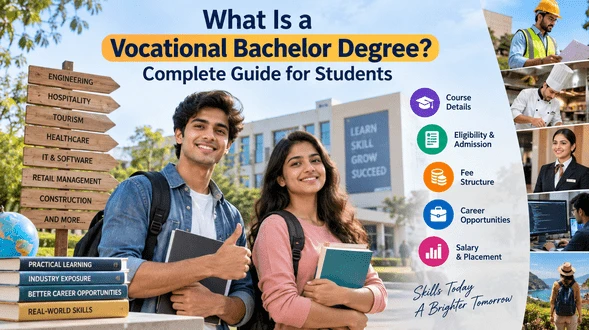
In this complete guide, you will learn how B.Voc degrees work, the eligibility rules, top course options, total fees, career scope, and future salary packages. By the end of this post, you will know exactly if this skill-focused route fits your career plans.
Every year, millions of Indian students pass out of Class 12 with a common concern: "Will my degree actually land me a job?" Traditional general degree programs offer great theoretical depth, but they often fall short on hands-on practical skills. This gap leaves many young graduates struggling to find employment in their chosen industries.
If you want a qualification that focuses directly on practical skill development and job readiness, a vocational bachelor degree might be the answer you need.Known as the B.Voc (Bachelor of Vocation) in India, this specialized degree combines classroom learning with real-world industry training.
In this complete guide, you will learn how B.Voc degrees work, the eligibility rules, top course options, total fees, career scope, and future salary packages. By the end of this post, you will know exactly if this skill-focused route fits your career plans.
What Is a Vocational Bachelor Degree?
A vocational bachelor degree is a three-year undergraduate program designed to teach practical, occupation-specific skills tailored directly to current industry requirements. The University Grants Commission (UGC) established B.Voc courses in India to align higher education with actual workplace demands.
Unlike standard academic tracks, this program combines general academic knowledge with intensive hands-on training.
The curriculum spends roughly 60% of its duration on practical skills and internships, leaving 40% for foundational theoretical concepts.
Another key feature is the multiple entry and exit format. If you leave after completing Year 1, you receive a Diploma. Finishing Year 2 earns you an Advanced Diploma, while completing all 3 years earns you the full Bachelor of Vocation degree.
Vocational Bachelor Degree Courses in India
India's skill development ecosystem has grown rapidly, offering vocational bachelor degree courses across many fast-growing sectors. Colleges design these courses alongside industry partners to ensure your skill set stays updated and relevant.
Popular B.Voc Specializations
You can choose from a wide range of fields based on your interests and stream after Class 12:
-
Information Technology & Software:Covers web development, cloud computing, and mobile app programming.
-
Healthcare & Paramedical:Focuses on medical lab technology, radiology, and operation theatre management.
-
Retail & Supply Chain Management: Teaches store management, e-commerce operations, and logistics.
-
Hospitality & Tourism Management: Covers hotel operations, travel desk coordination, and culinary arts.
-
Automobile & Electrical Technology: Trains you in vehicle diagnostics, assembly line mechanics, and modern EV tech.
How Vocational Degrees Differ From Traditional Degrees
Standard BA, B.Sc, or B.Com programs center heavily on theory, textbooks, and traditional written exams. They build broad analytical thinking, but they rarely include built-in job training or mandatory corporate internships.
In contrast, a vocational bachelor degree places you inside real work environments early in your studies. You spend time in workshops, laboratories, and partner company offices. You graduate with a portfolio of practical work experience, giving you an advantage over candidates who only hold textbook knowledge.
Vocational Bachelor Degree Eligibility & Admission Process
Securing a seat in a vocational degree program in India is straightforward, transparent, and accessible.
Eligibility Criteria
The basic requirements for vocational bachelor degree eligibility include:
-
You must pass Class 12 (10+2) from a recognized state or central board.
-
You generally need a minimum aggregate score of 45% to 50% in Class 12.
-
Students from Arts, Science, or Commerce streams can apply, though some technical options (like IT or Paramedical) may require studied prerequisites.
-
Candidates holding a recognized 2-year NSQF-aligned diploma post-Class 10 can often gain direct entry.
Admission Process
The vocational bachelor degree admission process usually follows two simple paths:
-
Merit-Based Selection: Most state colleges and central universities fill their seats based directly on your Class 12 board examination marks.
-
Entrance Test Selection:Top central institutions and state universities evaluate applicants through university-level tests or national exams like CUET-UG.
You submit your online application on the college portal, present your documents for verification, and secure your enrollment by paying the standard admission fee.
Vocational Bachelor Degree Fees, Career Scope & Salary
Fee Structure
The vocational bachelor degree fees in India remain budget-friendly compared to standard technical engineering or private management degrees.
Government institutions charge between ₹15,000 and ₹40,000 per year. Private colleges and specialized skill institutes charge between ₹50,000 and ₹1,500,000 per year, depending on the equipment, software tools, and lab facilities provided.
Career Opportunities
Your vocational bachelor degree career scope spans both private corporate sectors and government job avenues.Since the UGC recognizes B.Voc as a full undergraduate degree, you qualify for public competitive exams like UPSC, SSC, banking exams, and state public service commissions.
In the private sector, companies hire B.Voc graduates directly into technical and operational roles because they require minimal on-the-job training.
Salary & Placement Opportunities
Your starting vocational degree salary usually ranges between ₹2.5 LPA and ₹5 LPA for entry-level positions. As you build experience and master specialized technical systems over 3 to 5 years, your annual pay can grow to ₹6 LPA – ₹10 LPA or higher.
Leading employers like Tata Motors, Infosys, Maruti Suzuki, Fortis Healthcare, and retail chains regularly hire B.Voc graduates for key operational roles.
Benefits of Choosing a Vocational Bachelor Degree After 12th
Picking vocational degree courses after 12th gives you several clear advantages:
-
Direct Industry Exposure: You gain hands-on training using modern tools, machines, and software from day one.
-
Flexible Exit System: You do not lose your academic time if life forces you to pause studies. You can exit after Year 1 with a official diploma and re-enter later.
-
High Employability: Employers value candidates who hold practical skills over candidates who know only pure theory.
-
Affordable Investment: Low tuition fees mean you earn back your total study costs quickly after graduation.
-
UGC Recognition:You earn an official bachelor's degree that qualifies you for master's programs like M.Voc or MBA.
Is a Vocational Bachelor Degree Right for You?
If you prefer learning by doing rather than spending hours reading thick textbooks, a B.Voc course will suit you well.
Choose this path if you want to enter the job market quickly, gain independent financial stability, and master practical workplace skills.
However, if your goal involves pure academic research, theoretical teaching, or classical academic study, a traditional degree might still serve you better. Evaluate your learning style, talk with your parents, and choose the track that fits your career goals best.
Conclusion
Choosing the right course after Class 12 sets the base for your professional career. A vocational bachelor degree bridges the gap between traditional college education and real industry demands by placing skill development right at the center of your studies.
With affordable fees, UGC approval, multiple exit options, and practical workplace training, B.Voc programs offer an excellent path to corporate job readiness. Explore your options today, pick a stream that matches your strengths, and start building your practical career!
FAQs
1. Is a vocational bachelor degree equivalent to a traditional BA, B.Sc, or B.Com?
Yes, the University Grants Commission (UGC) recognizes B.Voc as a full bachelor's degree. It holds the same status as traditional undergraduate degrees for employment and higher studies.
2. Can I apply for government jobs after completing a B.Voc degree?
Yes, you can apply for competitive government examinations like UPSC, SSC, Banking, and State PSCs, as long as the eligibility requirement asks for a recognized bachelor's degree.
3. Can I pursue a master's degree after finishing a B.Voc program?
Yes, you can enroll in M.Voc programs or pursue postgraduate options like an MBA or PG Diploma in relevant fields.
4. What happens if I drop out after the first year of B.Voc?
If you complete all requirements for the first year, you receive an official Diploma certificate. You can use it to enter the workforce or return later to complete your full degree.
5. Which industries hire the highest number of B.Voc graduates in India?
Healthcare, Information Technology, Automotive, Hospitality, Retail Management, and Media sectors actively hire B.Voc graduates for specialized operational roles.

Comments
Login to Comment