How to Choose High-Quality Peppermint Essential Oil: A Buyer’s Guide
10 Sep, 2026
7 Views 0 Like(s)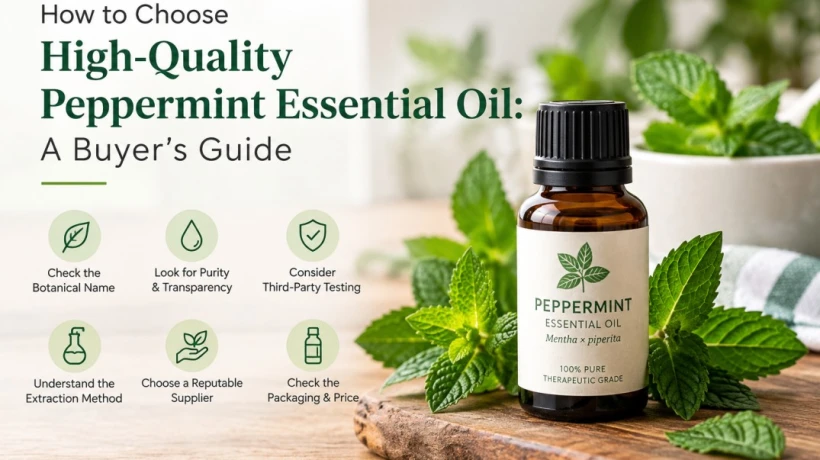
Choosing the right peppermint essential oil requires more than simply looking for a “100% pure” label. From botanical identity and sourcing to extraction methods, testing, packaging, and supplier transparency, several factors can help you identify a quality product. This buyer’s guide explains what to check before purchasing so you can make a more informed choice and select an oil that meets your quality and usage needs.
Choosing the right essential oil can be challenging when online stores offer numerous options with different prices, origins, purity claims, and packaging. Peppermint essential oil is especially popular for aromatherapy, personal care, fragrance, and natural wellness routines, but not every bottle provides the same level of quality.
A smart purchase starts with understanding what separates a well-sourced, properly tested product from one that may be diluted, poorly stored, or inadequately labeled. This buyer’s guide explains the most important factors to consider before purchasing a bottle.
1. Check the Botanical Name
One of the first details to look for is the botanical name. Genuine peppermint is commonly identified as Mentha × piperita. The botanical name provides more precise information than simply seeing the word “mint” or “peppermint” on a label.
Different Mentha species can have significantly different chemical profiles and aromas. Peppermint should therefore be clearly identified rather than being substituted with another mint species.
When shopping online, look for:
-
Botanical name
-
Plant part used
-
Country or region of origin
-
Extraction method
-
Net quantity
-
Batch or lot information
A transparent label makes it easier for buyers to understand exactly what they are purchasing.
2. Look for Purity and Ingredient Transparency
A high-quality peppermint oil should have a clear ingredient statement. Ideally, the product should identify the oil itself rather than relying only on broad marketing phrases such as “premium,” “therapeutic,” or “ultra pure.”
The phrase “100% pure” can be useful, but it should not be treated as laboratory proof by itself. More meaningful evidence comes from documentation and testing associated with a particular batch.
Research into commercial peppermint oils has shown why authentication matters. In one study, researchers used conventional and chiral GC/MS techniques to distinguish authentic oils from adulterated or substandard commercial samples.
3. Consider Third-Party Testing
Testing is one of the strongest quality indicators to consider when purchasing a pure peppermint oil.
Gas chromatography and mass spectrometry, commonly referred to as GC/MS, can help identify the volatile constituents present in an essential oil. Testing can reveal whether the chemical profile is consistent with the declared botanical material and can help identify certain forms of adulteration.
When available, look for:
-
Batch-specific testing
-
Certificate of Analysis (COA)
-
GC/MS information
-
Botanical identification
-
Physical specifications
-
Testing or laboratory details
A recent explanation of essential-oil testing emphasizes that a genuine COA should relate to a specific batch and may include information such as the botanical name, origin, extraction method, and constituent profile.
4. Pay Attention to the Extraction Method
The extraction method can tell you more about the product you are buying. Peppermint oil is generally obtained through steam distillation of the aerial parts of the plant.
Understanding extraction helps you distinguish an essential oil from other peppermint products such as extracts, infused oils, fragrances, or flavoring materials.
If you are specifically shopping for an authentic peppermint essential oil, the product description should make it clear that you are buying an essential oil and should provide relevant production information.
5. Evaluate the Source and Supplier
The reputation and transparency of the supplier are just as important as the label.
A reliable seller should provide useful product information rather than making unsupported claims. Look for suppliers that explain where their ingredients come from, how products are tested, and how oils are packaged and stored.
A company with clear contact information, detailed product pages, and quality-focused sourcing practices generally gives buyers more confidence.
Miracle Botanicals Essential Oils focuses on providing essential oils and related botanical products with an emphasis on sourcing, purity, and product quality.
6. Examine the Packaging
Essential oils are concentrated botanical materials and should be packaged appropriately. Dark glass bottles are commonly preferred because they help limit exposure to light.
Also check that the bottle has a secure closure and that the product has not been stored in excessive heat or direct sunlight.
Once purchased, store your high-quality peppermint oil tightly closed and away from direct sunlight and unnecessary heat. Proper storage can help preserve its aroma and overall quality over time.
7. Be Careful With Extremely Low Prices
Price should not be the only factor in your buying decision.
A very low price may sometimes reflect differences in sourcing, production, packaging, testing, or product composition. That does not mean an expensive oil is automatically better, but unusually cheap products deserve closer examination.
Compare products based on:
-
Botanical identity
-
Purity information
-
Testing documentation
-
Extraction method
-
Origin
-
Bottle size
-
Packaging
-
Supplier transparency
Instead of choosing solely by price, evaluate the overall value and quality information provided.
8. Consider Your Intended Use
Before purchasing, decide how you intend to use the oil.
Someone purchasing an oil for aromatherapy may prioritize aroma, sourcing, purity, and testing. Someone creating personal-care products may need additional information about ingredients, dilution, and compatibility with their formulation.
Do not assume that an essential oil is automatically suitable for ingestion or direct application simply because it is labeled “pure.” Intended use and safety instructions matter.
Peppermint oil can cause skin irritation in some people, and concentrated oils require appropriate handling. The National Center for Complementary and Integrative Health also notes that peppermint oil can cause irritation or rashes when applied topically and highlights special precautions involving infants and young children.
9. Compare Labels Before You Buy
If you are comparing several natural peppermint oil products, create a simple checklist.
Ask:
Does the label identify the botanical species?
A specific botanical name is preferable to vague terminology.
Is the extraction method disclosed?
Clear production information adds transparency.
Is testing information available?
Batch-specific documentation is more useful than general quality claims.
Is the supplier transparent?
Look for complete product information and accessible customer support.
Is the packaging appropriate?
Dark glass and secure closures are useful indicators of thoughtful packaging.
Are safety directions provided?
Responsible sellers should provide appropriate handling and usage information.
10. Think Beyond the Bottle
Quality purchasing does not end when you place an order. Pay attention to how the product arrives and how it should be stored.
Check the bottle for leakage, damaged packaging, an unusual appearance, or an aroma that seems inconsistent with the product description. Keep the container closed when not in use and store it according to the supplier's recommendations.
If you are also shopping for other botanical oils, the same principles can be applied. For additional guidance on evaluating body oils purchased online, see this related resource: “How to Buy Body Oil Online Without Compromising on Quality.”
Why Supplier Transparency Matters
Buying essential oils online requires more than reading promotional claims. A quality-focused supplier should make it easier for customers to understand what they are purchasing.
Miracle Botanicals Essential Oils provides a broad selection of botanical oils and blends for customers looking for carefully sourced products. When evaluating any supplier, however, buyers should independently review the product label, specifications, testing information, and intended-use guidance.
Final Buying Checklist
Before purchasing, use this quick checklist:
-
Confirm the botanical name.
-
Look for a clear ingredient statement.
-
Check the extraction method.
-
Review the stated country or region of origin.
-
Look for batch-specific testing when available.
-
Consider GC/MS or COA documentation.
-
Choose appropriate packaging.
-
Compare supplier transparency.
-
Avoid making a decision based solely on price.
-
Follow the manufacturer's storage and safety instructions.
Taking a few extra minutes to evaluate these details can make online shopping much more informed. Rather than relying on attractive packaging or broad purity claims, focus on verifiable information, transparent sourcing, appropriate testing, and responsible handling.
FAQs
1. How can I tell if peppermint oil is high quality?
Start by checking the botanical name, ingredient statement, extraction method, origin, packaging, and available testing documentation. Batch-specific analytical information can provide stronger evidence than general marketing claims.
2. What botanical name should I look for?
Peppermint is commonly identified as Mentha × piperita. Checking the botanical name helps distinguish peppermint from other Mentha species.
3. Is “100% pure” enough to prove quality?
No. “100% pure” is a label claim rather than a complete laboratory verification. Look for transparent sourcing and, when available, batch-specific COA or GC/MS documentation.
4. How should peppermint oil be stored?
Keep the bottle tightly closed and protect it from direct sunlight and excessive heat. Follow the storage recommendations supplied by the manufacturer.
5. Can peppermint oil be applied directly to the skin?
Concentrated essential oils should not automatically be applied directly to skin. Appropriate dilution and safety guidance are important, and some people may experience irritation. Follow the product's directions and use extra caution around infants and young children.



Comments
Login to Comment