Wearable Fall Detector Market: Global Outlook, Trends
05 Nov, 2026
10 Views 0 Like(s)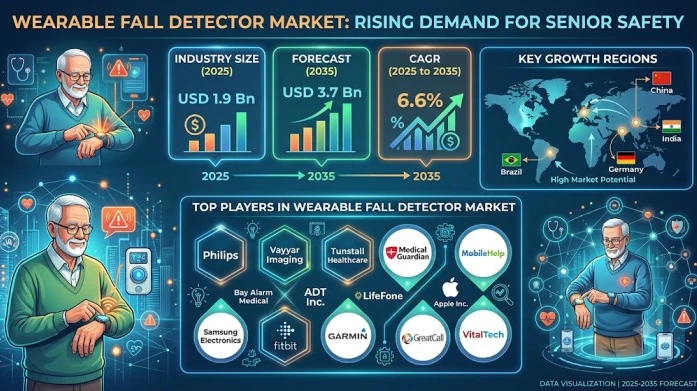
Top Players: Philips, Vayyar Imaging, Tunstall Healthcare and ADT Inc. as the Wearable Fall Detector Market Reaches USD 3.7 Billion by 2035
The global wearable fall detector market is projected to reach USD 3.7 billion by 2035, increasing from USD 1.9 billion in 2025, registering a compound annual growth rate (CAGR) of 6.6% during the 2025–2035 forecast period, according to Future Market Insights (FMI). Growing demand for elderly safety solutions, increasing adoption of home-based healthcare, and advancements in wearable sensor technologies are creating new opportunities for medical device manufacturers and digital healthcare providers.
Wearable fall detectors are becoming important tools for supporting independent living, elderly care, and remote patient monitoring. These devices use technologies such as accelerometers, gyroscopes, GPS connectivity, and intelligent detection algorithms to identify potential falls and notify caregivers or emergency response services.
👉 Get Detailed Market Forecasts, Competitive Benchmarking, and Pricing Trends:
https://www.futuremarketinsights.com/reports/sample/rep-gb-28643
Leading companies identified in FMI's analysis include Philips, Vayyar Imaging, Tunstall Healthcare, ADT Inc., Bay Alarm Medical, Medical Guardian, MobileHelp, LifeFone, Apple Inc., Samsung Electronics, Huawei Technologies, Fitbit, Garmin, GreatCall, and VitalTech.
Wearable Fall Detector Market: Key Forecast Highlights
FMI's market assessment identifies several important indicators for healthcare technology manufacturers, medical device companies, senior-care providers, and investors.
· Market size in 2025: USD 1.9 billion
· Market forecast for 2035: USD 3.7 billion
· Forecast CAGR (2025–2035): 6.6%
· Leading product type: Wristband devices, accounting for 38.0% of the market in 2025
· Leading application: Home care, representing 54.0% of the market in 2025
· Fastest-growing country: China, with a projected CAGR of 8.9%
These indicators highlight the growing importance of wearable safety technologies across residential healthcare, elderly care facilities, and remote health monitoring environments.
Aging Population and Home-Based Healthcare Drive Market Expansion
One of the primary factors supporting the wearable fall detector market is the increasing need for elderly monitoring solutions. Older adults living independently may face difficulties accessing immediate assistance following accidental falls. Wearable detection devices help address this challenge by providing automatic alerts and communication capabilities.
Healthcare providers and families are increasingly evaluating technologies that support aging in place while maintaining patient safety. Wearable fall detectors can help caregivers receive notifications when potential fall events occur, supporting faster assessment and response.
The growing adoption of home healthcare services is also creating opportunities for manufacturers. Compared with fixed monitoring infrastructure, wearable devices offer portability and can accompany users during routine daily activities.
For manufacturers, developing lightweight, comfortable, and reliable devices will remain important to encouraging consistent use among older adults.
AI, Sensor Technology, and Real-Time Monitoring Shape Market Trends
Technological innovation is changing how wearable fall detection devices identify and communicate fall events.
Modern devices increasingly combine accelerometers, gyroscopes, GPS tracking, Bluetooth, and cellular connectivity. These technologies support movement monitoring, fall detection, location identification, and communication with caregivers.
Artificial intelligence and machine learning are also gaining importance. Advanced algorithms can analyze movement patterns and distinguish potential falls from ordinary physical activities, helping manufacturers improve detection performance and reduce false alarms.
Three important trends are influencing the market:
AI-powered fall detection: Intelligent algorithms and multisensor technologies are improving the ability to identify potential fall events.
Connected healthcare ecosystems: Integration with mobile applications, telehealth platforms, caregiver dashboards, and emergency response services is expanding the functionality of wearable devices.
Comfort-focused product development: Manufacturers are developing wristbands, pendants, smart clothing, and smartphone-compatible solutions to improve usability and encourage continuous monitoring.
Battery life, connectivity reliability, privacy protection, and false alarm reduction will remain important product-development priorities.
Regional Opportunities: China and India Lead Growth Forecasts
China is projected to record the fastest growth in the wearable fall detector market, with a CAGR of 8.9% through 2035. India follows with 8.3%, while Germany is expected to grow at 7.6%.
Other country-level forecasts include Brazil at 6.9%, the United States at 6.3%, the United Kingdom at 5.6%, and Japan at 5.0%.
China's growth is supported by increasing healthcare awareness, an aging population, and the adoption of remote monitoring technologies. Hospitals and home healthcare providers are exploring wearable safety solutions to support elderly patients.
India presents opportunities associated with expanding home-based care services, increasing awareness of elderly safety, and demand for affordable wearable healthcare technologies.
Germany offers opportunities through established healthcare infrastructure and demand for reliable medical monitoring solutions. Brazil is benefiting from expanding elderly healthcare services, while the United States continues to provide opportunities for connected devices with GPS tracking and emergency communication capabilities.
For manufacturers, these regional differences create opportunities to develop affordable, locally suitable devices and establish partnerships with hospitals, senior-care facilities, and home healthcare providers.
Competitive Landscape: Leading Companies in Wearable Fall Detectors
Competition in the global wearable fall detector market includes medical technology manufacturers, personal emergency response providers, consumer electronics companies, and healthcare technology specialists.
Companies identified in FMI's report include:
· Philips
· Vayyar Imaging
· Tunstall Healthcare
· ADT Inc.
· Bay Alarm Medical
· Medical Guardian
· MobileHelp
· LifeFone
· Apple Inc.
· Samsung Electronics
· Huawei Technologies
· Fitbit
· Garmin
· GreatCall
· VitalTech
Philips, Vayyar Imaging, and Tunstall Healthcare offer technologies associated with healthcare monitoring and safety solutions. ADT, Bay Alarm Medical, Medical Guardian, MobileHelp, and LifeFone participate in personal emergency response and senior safety services.
Consumer technology companies such as Apple, Samsung, Huawei, Fitbit, and Garmin contribute to the broader wearable ecosystem through smartwatches and fitness devices incorporating health-monitoring and safety features.
VitalTech focuses on connected healthcare technologies and remote monitoring solutions.
Competitive differentiation increasingly depends on detection accuracy, battery performance, ease of use, connectivity, emergency response integration, and the ability to combine fall detection with additional health-monitoring features.
Strategic Opportunities for Medical Device Manufacturers and Investors
The projected expansion of the wearable fall detector market creates opportunities across medical devices, healthcare technology, telecommunications, and elderly care services.
Manufacturers can prioritize investments in sensor accuracy, AI-powered detection, compact device designs, and longer battery life. Companies developing connected healthcare platforms can explore partnerships with hospitals, home healthcare providers, and senior-care organizations.
Healthcare providers can evaluate wearable monitoring solutions as part of broader patient safety and remote care strategies. Technology companies can also assess opportunities to integrate fall detection with activity monitoring, emergency communication, and other digital health capabilities.
Investors should evaluate product differentiation, recurring service revenues, distribution partnerships, regulatory requirements, and the ability to maintain reliable device performance.
However, affordability, privacy concerns, false alarms, and user comfort remain important adoption challenges. Businesses that address these barriers while delivering dependable monitoring solutions may be better positioned to capture emerging opportunities.
Access the full report: https://www.futuremarketinsights.com/reports/wearable-fall-detector-market
Future Outlook for the Wearable Fall Detector Market Through 2035
The global wearable fall detector market is expected to expand steadily through 2035, supported by aging populations, growing home healthcare requirements, and technological improvements in wearable monitoring systems.
FMI projects the market to grow at a CAGR of 6.6% between 2025 and 2035, reaching approximately USD 3.7 billion by the end of the forecast period.
As healthcare providers increasingly prioritize independent living and remote patient monitoring, wearable fall detection technologies are expected to become an important part of connected elderly care ecosystems.
Manufacturers that combine intelligent detection algorithms, comfortable designs, dependable connectivity, and effective emergency response integration will have opportunities to strengthen their competitive positioning.
Related Reports:
· Non-injectable Insulin Market - https://www.futuremarketinsights.com/reports/non-injectable-insulin-market
· Respiratory Device Market - https://www.futuremarketinsights.com/reports/respiratory-devices-market
· Donor Egg IVF (In-Vitro Fertilization) Market - https://www.futuremarketinsights.com/reports/donor-egg-ivf-market
About Future Market Insights (FMI)
Future Market Insights (FMI) is a global market intelligence and consulting firm providing comprehensive market research, competitive intelligence, and strategic business insights across industries. The firm delivers detailed forecasts, technology analysis, and data-driven recommendations that support informed decision-making for manufacturers, investors, distributors, and policymakers worldwide.
For Press & Corporate Inquiries
Rahul Singh
AVP – Marketing and Growth Strategy
Future Market Insights, Inc.
+91 8600020075
For Sales – sales@futuremarketinsights.com

Comments
Login to Comment