Fashion as a Public Record of Pakistani City Life | PakistaniArt
26 Sep, 2026
6 Views 0 Like(s)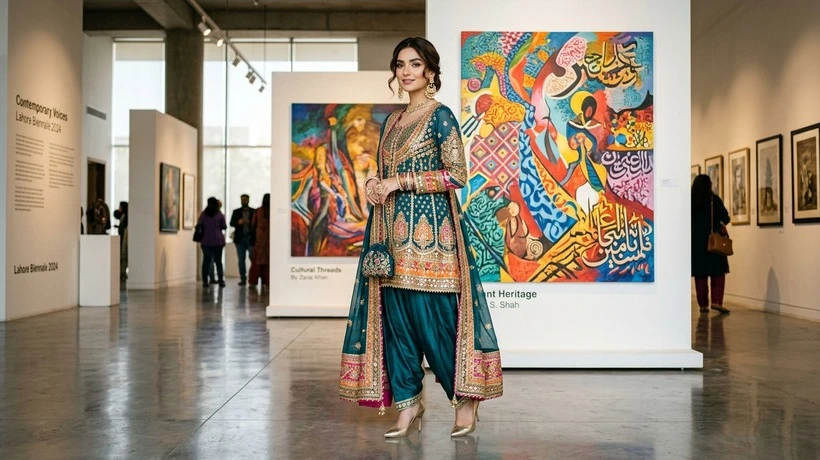
Lawn season, bridal trunks, pret, and textile craft keep a calendar of their own. A plain look at what clothes record, and who writes it down.
Fashion as a Public Record
Spring has a fabric calendar
You can miss the art openings and still know the season has turned. The hoardings change. The malls fill with women holding unstitched suits up to the light. Someone in the family group chat sends a print and asks if it is too loud.
That is lawn season, and it is not a niche. Lightweight cotton, launched in spring, sold as a national sport with price tags. Brands time the drops. Buyers time their irritation. By the time the heat is serious, the early prints already look like last month.
Clothes are good at this. They date a year more honestly than a slogan does. A photograph from a wedding in 2016 tells you the silhouette before it tells you the names. Fashion writing that ignores that fact is writing about a runway that most people will never stand near.
Lawn is commerce with a public
Unstitched fabric is a whole system, not a trend piece. The buyer still takes it to a tailor, or decides not to. The tailor is an author the campaign rarely credits. A neckline, a fall, the decision to leave a border alone: that is where the print becomes a garment a person can actually wear to work.
The big houses know this. The campaign sells a mood. The tailor sells a weekday. Both are the culture. A review that only describes the shoot has reviewed an ad.
There is also the copy problem, and everyone in the market knows it. A print lands on Tuesday. A cheaper cousin of that print is in another shop by the next weekend. Law, brand power, and shame do some of the policing. They do not do all of it. Any honest file on Pakistani fashion has to admit the speed of the knockoff, or it is filing a fantasy.
Price belongs in the piece too. A “accessible” line that costs a month’s rent for a lot of readers is not accessible. Say the number, or don’t use the word.
Bridal wear is a season of its own
Wedding clothes are not a side room of Pakistani fashion. For many houses they are the room that keeps the lights on.
Bridal work carries craft that pret cannot always afford. Dense embroidery, long hours, a fit that has to survive a day of photographs and relatives. It also carries a pressure that has little to do with design. Family taste, rental jewellery, the cousin who wore red last year. A designer who pretends this pressure is not in the room is designing for a lookbook, not a wedding.
The public record gets strange here. The best-known bridal images are often the most staged. The more useful images are the ones from the actual event, slightly wrong in the lighting, showing how the gharara moved when someone sat down. Street and function photographs tell the truth the campaign is paid not to tell.
Red is not a law. It is a habit with a long memory. Contemporary bridal has spent years arguing with that habit, sometimes well, sometimes as a stunt. The argument is worth writing. The stunt is worth naming as a stunt.
Pret, street, and the studio between them
Pret is the clothes that arrive already sewn. It is also the promise that a working woman can buy a week without booking a tailor. In Karachi and Lahore that promise has built real businesses. It has also built a sameness: the same neutral palette, the same “eastern fusion” caption, the same jacket trying to be both modest and new.
Street style is the correction. Not the invited kind, where a photographer waits outside a fashion week tent. The ordinary kind. College gates. Hospital shifts. Friday crowds. A denim jacket over a printed kurta is a more accurate national costume, some years, than anything on a board.
Fashion weeks still matter, and they matter unevenly. Pakistan Fashion Week, in its various city editions and organising bodies over the years, has been a place where a collection can be seen in motion. It has also been a place where the audience is the industry talking to itself. Both descriptions can be true in one evening. A report that only prints the sponsor’s quote has chosen the smaller truth.
Textile craft is not a costume department
Ajrak from Sindh, phulkari from Punjab, Balochi embroidery, block prints, truck-art colour leaking into a T-shirt: these are not props for a heritage segment at the end of a show.
They are design languages with rules. A craftsperson can tell a cheap quote of ajrak from the real repeat. A fashion page that cannot, or will not, should not use the word “artisan” as seasoning.
The respectful move is specific. Name the region. Name the technique. Say whether the house paid for the skill or only for the look. Collaboration is a real practice. So is extraction dressed up as a mood board. Readers can smell the difference when the piece refuses to say who stitched the panel.
PakistaniArt files fashion with art, film, and music because the split was always artificial. A textile is visual culture. A campaign is photography. A wedding look is social history with a blouse. The Pakistan culture magazine that covers those desks from Lahore is useful here only if it treats clothes as seriously as it treats a canvas. Soft fabric writing is easy. It is also how a whole season disappears into captions.
What the file should keep
A useful fashion note from this country holds a few plain things, and drops the rest.
• The house, the city, and the season
• What the garment is made of
• Who the campaign is actually for
• Whether craft was hired or imitated
• The price, if the piece claims to be within reach
• One sentence on what a person can do in the clothes besides stand still
PakistaniArt’s fashion coverage lives inside a wider culture desk, not in a shopping vertical. That is the right address for this subject. A purchase link can sit somewhere else. The record of what people wore, and what that wearing meant in a hot April or a long wedding week, belongs with the other ways the year gets written down.
Next spring’s prints are already being argued over in a studio. The public will meet them on a hoarding. The page, if it is any good, will still be able to say what the cloth was when the hoarding comes down.


Comments
Login to Comment