Aluminum Vacuum Brazing vs Ultra-High Vacuum Brazing: Which Process Is Right for Your Application?
29 Apr, 2026
6 Views 0 Like(s)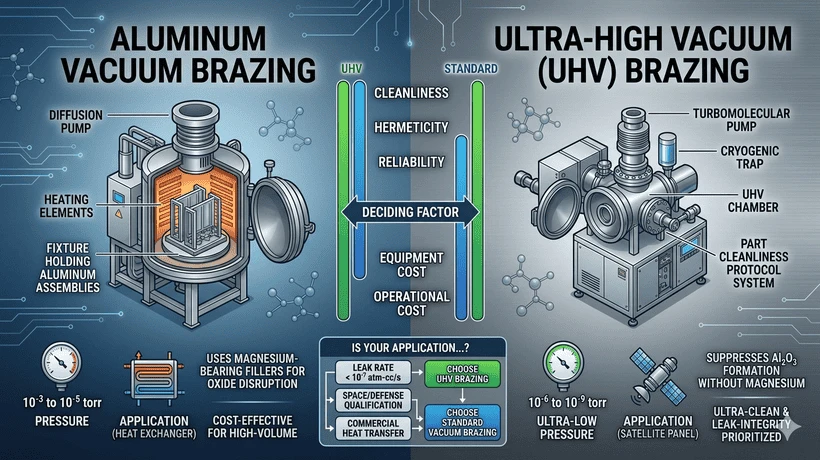
Compare aluminum vacuum brazing vs ultra-high vacuum brazing. Learn key differences, costs, and which process fits your application. Discover the difference between vacuum brazing and UHV brazing for aluminum—covering leak rates, cleanliness, alloys, and applications.
When selecting a joining process for aluminum assemblies, the difference between standard vacuum brazing and ultra-high vacuum (UHV) brazing is not simply a matter of equipment cost it directly determines joint cleanliness, hermeticity, and long-term reliability. For engineers specifying components in aerospace, defense electronics, medical devices, or high-performance thermal management systems, getting that choice wrong can mean failed qualification tests, costly rework, or structural compromise in service.
This article breaks down both processes, compares their outputs across key performance criteria, and offers a practical framework for deciding which approach suits your application.
Understanding the Two Processes
Aluminum vacuum brazing
Standard aluminum vacuum brazing is performed in a controlled furnace environment where pressure is reduced to the range of 10-3 to 10-5 torr. At these pressures, the partial oxidation risk is significantly reduced compared to atmospheric brazing, allowing flux-free joining of aluminum alloys using Al-Si filler metals. The process is widely used for heat exchangers, charge-air coolers, and industrial thermal management components.
Professional vacuum brazing services at this level offer repeatable, high-throughput production. The equipment typically diffusion-pumped batch furnaces is well-established, and cycle times are manageable for medium-to-high volume manufacturing.
Ultra-high vacuum brazing
Ultra-high vacuum brazing operates at base pressures of 10-6 torr and below, sometimes reaching 10-8 to 10-9 torr in specialized systems. At these extreme vacuum levels, the residual gas partial pressure is low enough to fully suppress aluminum's native oxide layer (Al2O3) without magnesium additions or aggressive surface preparation.
UHV brazing requires turbomolecular pumps, cryogenic traps, and rigorous part cleanliness protocols. It is the process of choice when joint purity, trace contamination control, and leak integrity are non-negotiable conditions common in satellite thermal panels, semiconductor process equipment, and hermetic electronic housings.
Key Technical Differences
Oxide suppression and surface chemistry
Aluminum naturally forms a tenacious oxide layer that inhibits filler metal wetting. In standard vacuum brazing, this is managed through magnesium-bearing alloys or filler metals that disrupt the oxide at brazing temperature. In UHV brazing, the ultra-low partial pressure of oxygen and water vapor eliminates the oxidation mechanism altogether, enabling cleaner, more predictable wetting across a wider range of aluminum alloys, including those incompatible with magnesium additions.
Joint quality and cleanliness
Both processes produce flux-free joints, but UHV brazing generates a measurably lower contamination baseline. For applications requiring Class 10 or better cleanliness, such as optical instruments, medical implants, or space-qualified assemblies UHV-brazed joints offer fewer post-process cleaning steps and lower rejection rates during helium leak testing.
Hermeticity and leak performance
Standard vacuum brazed joints can achieve helium leak rates suitable for many industrial and commercial applications. However, for hermetic packages requiring leak rates below 10-9 atm-cc/s a threshold common in MIL-STD-883 testing for microelectronic packages ultra-high vacuum brazing is often the only reliable joining route without post-braze sealing operations.
Application Fit: Where Each Process Excels
When standard vacuum brazing is the right choice
• Automotive and HVAC heat exchangers with Al-Si clad material
• Industrial plate-fin and multi-pass thermal management assemblies
• High-volume production where cycle time and equipment cost are governing factors
• Components where leak rates of 10-6 to 10-7 atm-cc/s are acceptable
• Assemblies using standard 3003, 6061, or clad 4xxx series aluminum alloys
When ultra-high vacuum brazing is required
• Satellite radiator panels, cryogenic cooling systems, and space thermal control hardware
• Defense electronics requiring MIL-spec hermetic sealing
• Medical device components where biocompatibility and trace-metal control are audited
• Semiconductor fabrication equipment with ultra-clean internal surfaces
• Research instruments, synchrotron components, and particle accelerator hardware
Cost and Operational Considerations
The capital cost of UHV brazing equipment can be three to five times that of a standard vacuum furnace, and operating costs rise proportionally due to longer pump-down cycles, higher maintenance requirements for vacuum integrity, and the need for ultra-clean handling environments. For high-value, low-volume applications where joint failure carries significant downstream risk this cost premium is easily justified.
For mid-volume commercial production, professional vacuum brazing services typically deliver better cost-per-joint economics without sacrificing the quality needed for moderate-performance applications. Working with an experienced provider allows engineers to evaluate whether their tolerances genuinely require the UHV process, or whether optimized fixturing and filler selection achieves equivalent results at standard vacuum levels.
A Practical Decision Framework
Before specifying either process, consider these five questions:
• What is the required leak rate, and does it fall below 10-7 atm-cc/s?
• What alloys are involved, and do they respond predictably to magnesium-assisted oxide disruption?
• What cleanliness class or contamination limit applies to the finished assembly?
• What regulatory or qualification standard governs the joint? (e.g., MIL-STD-883, ECSS, ISO 13485)
• What is the production volume, and does unit economics support the UHV process cost premium?
If the answers point toward strict hermeticity, contamination-sensitive alloys, or space/defense qualification, ultra-high vacuum brazing is the correct specification. If the application involves industrial heat transfer, commercial assemblies, or moderate hermeticity requirements, standard aluminum vacuum brazing delivered through a qualified vacuum brazing services supplier will meet the requirement at significantly lower cost.
Frequently Asked Questions
Q1. What is the difference between vacuum brazing and ultra-high vacuum brazing?
Vacuum brazing is performed at pressures between 10-3 and 10-5 torr, sufficient for most industrial aluminum joining applications. Ultra-high vacuum (UHV) brazing operates at 10-6 torr and below, eliminating residual oxidation risks and enabling ultra-clean, hermetic joints required in aerospace, defense, and semiconductor applications.
Q2. Is ultra-high vacuum brazing always better than standard vacuum brazing for aluminum?
Not necessarily. UHV brazing delivers superior cleanliness and hermeticity, but carries significantly higher equipment and operating costs. For most commercial heat exchangers, automotive components, and industrial assemblies, standard aluminum vacuum brazing produces joints that meet all performance requirements without the cost premium.
Q3. What aluminum alloys are compatible with ultra-high vacuum brazing?
UHV brazing is particularly valuable for alloys sensitive to magnesium additions used in standard vacuum brazing, including certain 2xxx, 5xxx, and 7xxx series aluminum alloys. It also supports specialty filler systems such as Al-Ge and Al-Cu-Si that are incompatible with conventional furnace atmospheres.
Q4. How do I find qualified vacuum brazing services for aerospace or defense applications?
Look for suppliers with NADCAP accreditation for brazing, AS9100 certification, and documented process qualification data for the specific vacuum level and alloy system your application requires. Request process capability data, helium leak test records, and material certifications before committing to a supplier.
Q5. Can standard vacuum brazing meet MIL-spec hermetic sealing requirements?
It depends on the specific leak rate threshold. Some MIL-spec requirements can be met with well-controlled standard vacuum brazing, particularly when combined with optimized joint design and post-braze testing. However, the most stringent hermetic sealing requirements such as those in MIL-STD-883 for microelectronic packages typically require ultra-high vacuum brazing or complementary sealing operations.


Comments
Login to Comment