Why Phishing Links Keep Getting Through: The Detection Gap Nobody Talks About
16 Sep, 2026
9 Views 0 Like(s)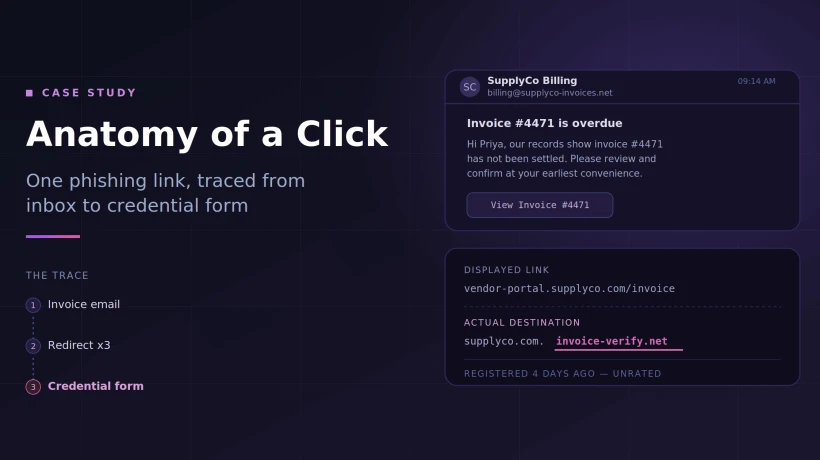
A supplier invoice email looked ordinary. The link wasn't. Follow a real-style phishing case from first glance to full redirect trace, and see why domain age matters more than a clean scan.
Security teams spend heavily on filters, gateways, and reputation feeds, and phishing links still land in inboxes every day. That is not a failure of the technology so much as a mismatch between how detection systems work and how attackers now build their infrastructure. Understanding that mismatch explains why "we have a filter for that" is not the same as being protected.
Detection is a lagging indicator by design
Every reputation-based system — blocklists, threat feeds, domain scoring engines — works the same way at its core. Something has to be observed first. A domain gets registered, a page goes live, someone reports it or a crawler finds it, the finding gets verified, and only then does the domain enter a blocklist that filters can act on.
That sequence takes time. Historically it took days. Automated abuse of free registrars and disposable hosting has compressed it, in some campaigns, to a matter of hours. The result is a structural blind spot: every phishing domain is, by definition, undetected at the moment it is first used. Attackers who understand this simply build their operations to live inside that window and discard infrastructure before reputation catches up.
This is why a security-conscious employee who checks a link against a reputation service and gets a clean result has not necessarily done anything wrong — they have just run into the limit of what reputation-based detection can promise. A clean result means "not yet reported," not "verified safe."
Domain-generation tooling changed the economics
A second shift compounds the first. Registering a new domain used to carry enough friction — cost, time, a paper trail — that attackers reused infrastructure, which is precisely what let blocklists work. Automated registration and templated hosting removed that friction almost entirely.
Modern phishing kits can spin up a new lookalike domain, apply a scraped copy of a legitimate login page, and issue a free TLS certificate in minutes, with no manual step. Multiply that across a campaign and a single threat actor can rotate through dozens of domains in a day, retiring each one the moment it starts attracting attention. Static blocklists are chasing a target that is designed to keep moving.
This also explains why domain age has become one of the more reliable signals in manual link review. Legitimate organisations rarely stand up a brand-new domain and immediately start routing sensitive traffic through it. A sign-in page hosted on infrastructure that is a few hours old is unusual on its face, regardless of what any reputation query returns.
The padlock problem, revisited
TLS certificates deserve a second mention because the misunderstanding around them is so persistent. Certificate authorities that offer free, automated, domain-validated certificates verify one thing only: that the requester controls the domain at the moment of issuance. They confirm nothing about the requester's identity or intent.
That is a reasonable design for the web at large — it makes encryption the default rather than a paid add-on. But it also means the padlock icon, which was originally a rough proxy for "this is a legitimate business," stopped being that proxy years ago. Encrypted connections to fraudulent infrastructure are now the norm rather than the exception. Treating HTTPS as a safety signal is arguably more dangerous today than treating it as neutral, because it actively misleads.
Why the message matters as much as the link
Isolated link analysis has a ceiling, because a link rarely arrives alone. It arrives inside a message with a sender, a subject line, a tone of urgency, and a stated reason for existing. Those surrounding details often carry more signal than the address itself.
A message claiming to be a password-reset notice that nobody requested, an invoice for a purchase that was never made, or a delivery alert with no matching order all share a structural feature: they manufacture urgency to short-circuit exactly the kind of careful inspection this article is describing. Recognising that pattern is often faster than any technical check, and it works even when the underlying domain hasn't yet been flagged by anything.
This is also where individual vigilance runs out of runway and organisational visibility has to take over. One person can inspect one link carefully. An organisation needs to know whether the same lure reached forty mailboxes, whether it's part of a pattern connected to an earlier incident, and whether the sending infrastructure has shown up before. Answering those questions requires looking at header data, delivery timing, and campaign-level patterns across a mail environment — the kind of analysis that dedicated Email Forensics Software is built to perform at scale, correlating indicators that a single inbox view would never surface.
What actually holds up as a defensive habit
Given all of that, a few practices consistently outperform relying on any single tool:
Treat domain age as a first-class signal, not a footnote. New infrastructure serving sensitive requests is disproportionately likely to be malicious, independent of what any scanner currently says about it.
Separate the display text from the destination every time a link matters. Copy the underlying address rather than trusting rendered text, and read the domain from right to left to find who actually controls it.
Read reputation results as a snapshot, not a verdict. A clean result reflects the current state of detection, which is always behind the current state of abuse. For a full breakdown of the mechanics — how to check a URL for malware step by step, including redirect tracing and safe submission practices — a structured walkthrough is worth keeping on hand as a reference.
Weigh the message, not just the link. Urgency, unfamiliar sender patterns, and requests that don't match the stated relationship are often more reliable than any single technical indicator.
Escalate incidents rather than resolving them link by link. A single suspicious message in a corporate environment is often one visible piece of a larger campaign, and answering that question needs analysis across the mailbox, not just the one message in front of you.
The bigger picture
None of this means link analysis is pointless — far from it. It means link analysis is one layer in a system that has to account for its own blind spots. Reputation feeds will always trail behind newly registered infrastructure. Certificates will always confirm encryption without confirming intent. And attackers will keep building around exactly those gaps, because that is where the friction is lowest.
The organisations that hold up best are the ones that treat a clean scan result as the start of an assessment rather than the end of one, and that have the tooling in place to trace a single suspicious link back to the fuller pattern it belongs to when it matters.



Comments
Login to Comment