White Label Tools Every SEO Agency Should Consider
09 Oct, 2026
13 Views 0 Like(s)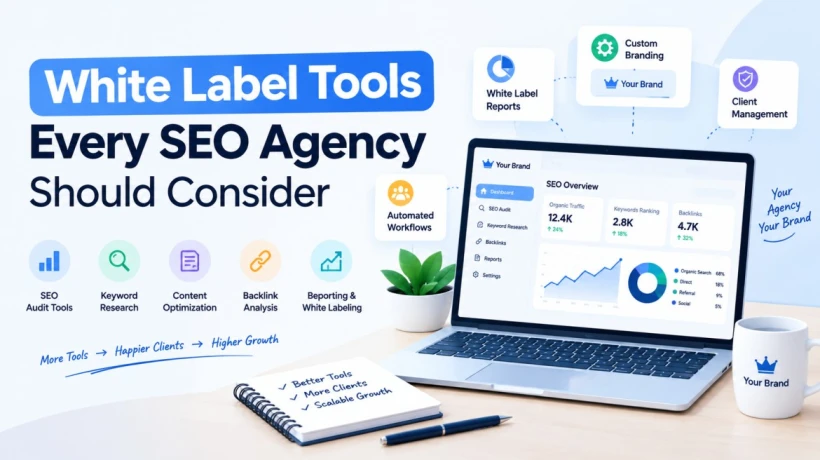
A white-label platform typically allows an agency to present a third-party technology as part of its own service. Depending on the product, that might include custom branding, agency domains, client portals, branded reports, custom email notifications, or downloadable PDFs.
The right white label tools can help an SEO agency deliver professional services under its own brand without building every system from scratch. The most useful tools aren't simply dashboards with a logo changed; they should reduce repetitive work, make reporting clearer, support consistent analysis, and give clients useful information they can act on. For agencies managing 10, 50, or even hundreds of client websites, that difference can have a real impact on delivery time and service quality.
What Makes a White Label SEO Tool Worth Using?
Before choosing specific tools, it's important to understand what "white label" should actually mean.
A white-label platform typically allows an agency to present a third-party technology as part of its own service. Depending on the product, that might include custom branding, agency domains, client portals, branded reports, custom email notifications, or downloadable PDFs.
But branding shouldn't be the main reason for choosing a tool.
In my experience, the better question is: Does this tool help the agency produce better work or communicate it more effectively?
A platform that saves an SEO specialist two hours of repetitive work every week can be more valuable than a flashy client dashboard that nobody uses.
1. White Label SEO Audit Tools
An SEO audit tool should be near the top of an agency's list.
A useful audit platform can scan websites for technical problems, metadata issues, broken links, indexing concerns, page performance problems, internal linking opportunities, and other SEO signals. The agency can then turn those findings into a branded report.
However, automated audits have an important limitation: they identify conditions, but they don't always understand business context.
For example, a tool may flag a page with a long title. That doesn't automatically mean changing it will improve organic performance. An experienced SEO needs to consider search intent, existing rankings, branding, and the actual search result.
That's why I prefer tools that let agencies add their own recommendations rather than simply exporting automated warnings.
2. Rank Tracking Platforms
Rank tracking is another core requirement for agencies.
A good platform should allow agencies to monitor keywords by location, device, search engine, landing page, and time period. Competitor visibility can also provide useful context.
Don't make the common mistake of treating ranking position as the only KPI.
Google's Search Console documentation explains that SEO professionals can examine clicks, impressions, CTR, queries, pages, countries, and other dimensions in the Performance report. Its guidance also recommends paying attention to trends in clicks and impressions rather than focusing on position alone. (Google Help)
A strong agency report might therefore say:
"Non-branded impressions increased 24% over the last 90 days, while average position changed only slightly."
That's more meaningful than saying, "We improved rankings by three positions."
3. White Label Reporting Software
Clients need understandable reporting, not a data dump.
A reporting platform can pull information from multiple marketing sources and present it through a branded dashboard or PDF. Useful integrations may include Search Console, analytics platforms, rank trackers, advertising platforms, and SEO crawlers.
The key is customization.
An agency serving local businesses might emphasize calls, organic leads, local visibility, and high-value service pages. An ecommerce agency may focus more heavily on organic revenue, product categories, non-brand traffic, and conversion data.
The report should reflect the client's business model rather than displaying every metric the software happens to collect.
4. Technical SEO Crawlers
Technical crawlers remain valuable even for agencies with experienced SEO teams.
They can systematically examine large websites for issues such as:
-
Broken internal links
-
Redirect chains
-
Duplicate titles
-
Missing metadata
-
Canonical problems
-
Indexability directives
-
Status-code errors
-
Orphaned pages
-
Pagination issues
-
Internal linking patterns
For a 20-page brochure website, manual checking may be practical. For a 100,000-page ecommerce site, it isn't.
This is where automation makes sense: let the crawler process the volume, then let the SEO specialist interpret the findings.
5. Page Experience and Performance Tools
Website speed shouldn't be treated as an SEO report checkbox.
Performance tools can help agencies identify slow pages, large resources, rendering problems, and other user-experience concerns.
Google provides its own guidance around page experience, while its Search documentation makes clear that agencies shouldn't focus on one isolated signal at the expense of the overall experience.
That distinction matters.
If a page takes slightly longer to load but converts extremely well, the recommendation shouldn't automatically be "rebuild the entire page." Look at the actual bottleneck and its likely business impact first.
6. Backlink Analysis Tools
Backlink tools help agencies understand a site's link profile and identify potential opportunities or risks.
Useful features include:
-
Referring domains
-
New and lost links
-
Anchor text distribution
-
Linking-page analysis
-
Competitor backlink comparisons
-
Broken backlink opportunities
But agencies should be careful about turning backlink counts into a simplistic score.
One relevant editorial link can be more useful than dozens of unrelated links. A good SEO report should discuss relevance, quality, context, and the relationship between links and the site's broader authority strategy.
7. Keyword and Content Research Platforms
Keyword tools are useful for discovering search demand, related queries, competitors, and potential content gaps.
But keyword volume isn't a publishing strategy.
Suppose a keyword has 10,000 monthly searches. That sounds attractive. Yet if the client's website has no realistic way to satisfy the intent behind that query, chasing the term may waste resources.
The better approach is to combine keyword data with:
-
Search intent
-
Existing visibility
-
Business relevance
-
Competition
-
Topical authority
-
Conversion potential
This is especially important when agencies create content at scale.
Google's people-first content guidance asks whether content provides original information, substantial value, and first-hand expertise rather than being produced primarily to attract search traffic.
8. Schema and Structured Data Testing Tools
Structured data tools can help agencies validate whether markup has been implemented correctly and identify obvious problems.
These tools are particularly useful for agencies managing ecommerce, local business, article, product, and other structured-content websites.
Still, agencies should explain what structured data can and cannot do. Adding schema doesn't guarantee a rich result or higher rankings.
That's an important trust signal. Clients should receive accurate expectations instead of promises that sound impressive but aren't supported by Google's documentation.
9. Local SEO and Citation Management Tools
For agencies working with restaurants, contractors, dentists, law firms, and other location-based businesses, local SEO tools can save substantial time.
Depending on the platform, useful features may include:
-
Business profile monitoring
-
Citation management
-
Review monitoring
-
Local rank tracking
-
Competitor comparisons
-
Location-level reporting
The advantage becomes obvious when an agency manages dozens of locations. Updating and checking business information manually across multiple platforms quickly becomes inefficient.
10. Client-Facing SEO Dashboards
A client dashboard can bring audits, rankings, traffic, tasks, and progress into one place.
But don't assume clients want to log in every morning.
Most business owners want to know whether marketing is producing useful progress. The dashboard should therefore highlight meaningful changes, explain unusual movements, and connect SEO activity to business objectives.
Google's Search Console reporting itself provides useful examples of this approach, allowing site owners to examine clicks, impressions, CTR, queries, pages, and performance changes rather than relying on one headline metric.
Don't Buy Tools Just Because They're White Label
This is probably the most important point.
An agency can easily end up paying for six overlapping platforms that all crawl websites, track keywords, create reports, or monitor backlinks.
Before adding another subscription, ask:
What manual task does this remove?
What decision does it help the SEO make?
Can clients understand the output?
Does it integrate with the agency's existing workflow?
Can the agency verify the data?
If the answer is unclear, the tool may not be worth adding.
Build a Practical White Label SEO Stack
A sensible agency stack doesn't need to contain every category above. Start with the capabilities that directly support your services.
For many agencies, that means an SEO audit platform, rank tracker, technical crawler, reporting system, backlink database, keyword research tool, and performance data from Google Search Console.
The goal isn't to create the largest technology stack. It's to create a dependable workflow where data collection, analysis, recommendations, and client communication work together.
That's also why a second look at white label tools can be useful when building an agency workflow: the technology should support the work your team already does rather than forcing your team into a complicated process.
Google's own SEO resources emphasize following Search Essentials, understanding how Google Search works, and using Search Console to monitor performance. Those principles are a good foundation regardless of which commercial tools an agency chooses.
Ultimately, the best white-label SEO tool is not the one with the longest feature list. It's the one that helps your team do accurate work faster, explain it clearly, and give clients evidence they can understand and act on.

Comments
Login to Comment