Pneumatic Piston Vibrators Supplier: What Industries Should Know
08 Oct, 2026
7 Views 0 Like(s)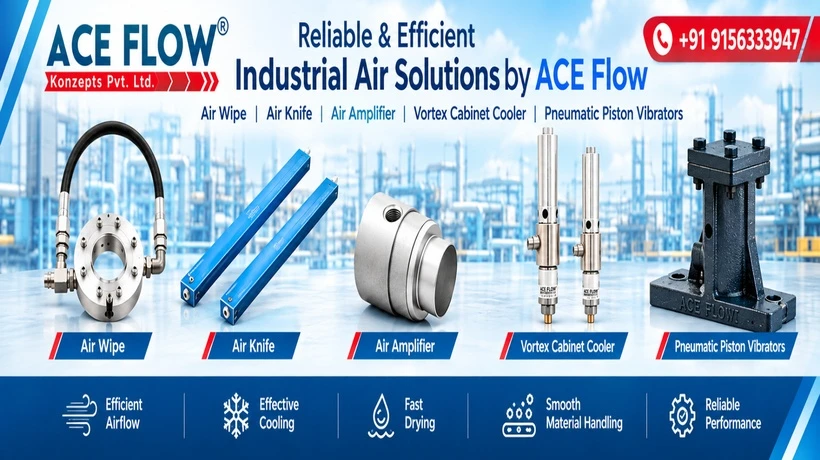
Discover how a reliable Pneumatic Piston Vibrators Supplier can provide efficient vibration solutions for material flow, hopper discharge, silo applications, and industrial processing. Learn about their types, benefits, key features, and how to choose the right supplier for your specific requirements.
Bulk materials like powders and granules cannot flow freely in containers such as hoppers, chutes, bins, and containers, leading to problems of bridging, clogging, rat-holing, and material build-up. In such cases, pneumatic piston vibrators are employed to introduce mechanical vibrations into the system to facilitate free flow of the material.
In the selection of Pneumatic Piston Vibrators Supplier for industries using bulk materials, one is not only selecting a vibration tool but also a product that will meet specific container and application requirements and deliver adequate vibration force. Ace Flow offers industrial pneumatic products where air control and mechanical assistance is necessary.
Where Pneumatic Piston Vibrators Become Useful
Pneumatic piston vibrators work on the principle of use of compressed air to create an impact or vibration that may be beneficial to the movement of the material through desired discharge route.
This is more applicable where material does not flow freely under gravitational forces. Various industries such as those working with powders, pellets, grains, aggregates, chemicals, and other dry materials may face different flow problems depending on the material properties such as size, moisture, density, and storage environment.
Rather than resorting to manual intervention by hitting the container or the material, vibration devices can provide an alternative way of ensuring free flow of material through the discharge route.
The Material Being Handled Changes the Requirement
It must be noted that a particular vibrator model or design does not apply universally to all bulk materials. Materials like fine powder may have very different characteristics compared to a coarse granular material. Moisture, cohesiveness, particle shape, bulk density, and compaction characteristics may make a difference in material discharge characteristics.
Industrial users must first consider the exact material and location of the flow problems before making a decision regarding vibration equipment.
A processing plant that handles fine powder may need different vibrator equipment compared to another that deals with dry aggregates or plastic granules. The choice of equipment is therefore made on the basis of the problem rather than the hopper itself.
Installation Position Can Affect the Result
The mounting position is another key aspect of proper use of pneumatic piston vibrators. Vibrations need to get to the area where accumulation or bridging takes place.
When the vibrator is mounted without taking into account the hopper design, wall thickness, material properties, and discharge configuration, the vibrations produced will be ineffective for facilitating the flow.
It is advisable that industrial users take into account the equipment design as a whole before mounting. This will be made possible by suppliers who are conversant with the pneumatic vibration technology.
Different Industries, Different Flow Challenges
Pneumatic piston vibrators can be relevant across several sectors because bulk-material handling is common in many manufacturing environments.
|
Industry |
Typical Material-Handling Situation |
Potential Role of a Pneumatic Vibrator |
|
Food processing |
Powders, grains and dry ingredients |
Assist hopper discharge |
|
Chemical processing |
Powders and granular chemicals |
Reduce material buildup |
|
Plastics |
Pellets and granules |
Support consistent discharge |
|
Construction materials |
Cement, sand and aggregates |
Help prevent bridging |
|
Pharmaceuticals |
Fine powders and ingredients |
Assist controlled material movement |
|
Agriculture |
Feed, grains and similar materials |
Improve bin and hopper discharge |
The actual requirement still depends on the material and equipment. The table illustrates where the technology can be considered rather than suggesting that every application needs a vibrator.
Pneumatic Equipment Is Broader Than Vibration
Material-handling using bulk materials is just one of the elements of the industrial pneumatic systems. In manufacturing plants, compressed air can be used for cooling, drying, conveying, cleaning, and even for eliminating air and heat from certain machinery.
For instance, Air Amplifier Manufacturers can offer compressed-air systems producing the airflow around for cooling, drying, ventilation or conveying.
The company called the Air Knife Manufacturer can offer systems producing the airflow as a sheet of air for drying, cleaning, removing particles from the surface and similar tasks. An Air Wipe Manufacturer offers air devices that remove liquids and moisture from continuously moving products, pipes, cables, and any other surface. Each of these technologies cannot be confused with the vibration technology.
Cooling Equipment for Electrical Panels
Sometimes, industrial plants need pneumatic cooling equipment for operating electrical enclosures under heat, dust and other adverse conditions. Companies called Vortex Cabinet Cooler Manufacturers are able to produce the cooling equipment using vortex tube technology for controlling temperatures in electrical control cabinets. It is important to keep proper temperature in case of sensitive electrical and electronic components working under harsh industrial environment. Understanding what technologies perform which function helps to avoid making mistakes while choosing the equipment.
Why Compressed Air Can Be Practical for Industrial Equipment
Using the pneumatic equipment is possible in case when the plant already has a compressed air system as part of its infrastructure. Pneumatic equipment works without installing an additional electric motor.
For the piston vibrators, the compressed air operates the internal piston mechanism producing the needed vibrations. Nevertheless, the compressed air pressure, flow rate, cycles and quality of the air are still worth considering. It makes compressed air system of the plant an important part of the equipment selection process.
Ace Flow for Industrial Pneumatic Applications
The Ace Flow specializes in industrial applications that involve the use of air-powered or pneumatic equipment. Those clients who seek a Pneumatic Piston Vibrators Supplier have an opportunity to describe their material flow issue and equipment setup prior to choosing a suitable product.
In addition to its primary products, the company's offering includes Air Amplifiers, Air Knives, Air Wipes, and Vortex Cabinet Coolers. Those devices solve various industrial tasks like airflow creation, drying of surfaces, cabinet cooling, and material flow assistance. Understanding of the company's wider offering of products can be helpful in plants which have several pneumatic applications in various production zones.
Benefits of Choosing Ace Flow
Industrial customers will benefit from dealing with a supplier, who understands different pneumatic applications. In such a way, the supplier considers not only a single product (vibrator), but also the environment in which it will operate, presence of compressed air, properties of material, and specific process issue.
Pneumatic equipment of the Ace Flow is used for material handling, cooling, drying, airflow, and other industrial applications. Thanks to the wide offer of products, customers have more options when several zones of a plant need various air-driven solutions.
In the case of using a pneumatic piston vibrator, the main advantage is the selection of equipment according to the real material flow issue, not just buying a vibrator based on its size.
FAQs
What is the function of a pneumatic piston vibrator?
The operation uses compressed air to generate vibrations or impact in a repetitive manner. This motion can assist in loosening bulk material so that it can be discharged from hoppers, bins and other similar devices.
In which industry could I use pneumatic piston vibrators?
They could be used in industries such as food processing, chemicals, plastics, agricultural, pharmaceuticals and construction materials handling where assistance may be needed in discharging powdered or bulk solids.
Is one vibrator good for every material?
No. Properties of the material, hopper/vessel design, nature of the flow problem and characteristics of the compressor air influence the choice of vibrators.
What kind of information should I provide to a supplier?
The material, hopper or vessel information, the available pressure of the compressed-air, the flow problem, the operation cycle and the mounting of the vibrator should be provided.
Is an Air Knife the same as a pneumatic piston vibrator?
No. The difference between the two is that the pneumatic piston vibrator is a device that provides mechanical vibrations in order to move the material, while an Air Knife creates a sheet of air that will be used for various applications such as drying, cleaning and surface cleaning.
What is the function of a Vortex Cabinet Cooler?
The operation of the vortex-tube cooling will help in controlling the temperature of the interior of an electrical enclosure or cabinet.
Selecting Equipment Around the Actual Plant Problem
Pneumatic piston vibrators can work well only if they are chosen based on a properly identified material flow problem. The material properties, hopper design, compressor air properties, mounting and operation cycle will determine if they could be used or not.
Ace Flow produces pneumatic and air-based equipment for various plant needs including pneumatic piston vibrators, Air Amplifiers, Air Knives, Air Wipes and Vortex Cabinet Coolers. Having knowledge about the purpose of each product will enable industries to choose the appropriate equipment for their needs.


Comments
Login to Comment