What to Expect From a Vastu Shastra Consultant Online During Your First Consultation
15 Oct, 2026
5 Views 0 Like(s)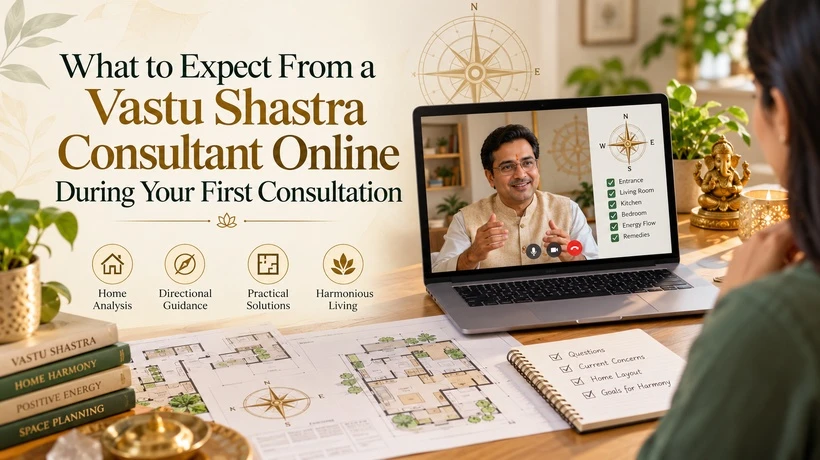
A Vastu Shastra consultant online can review property layouts, directions, photographs, and other information through a remote consultation.The first session generally involves discussing your requirements, examining the available property details, and explaining relevant traditional Vastu principles
Introduction
Online consultations have made it easier to connect with professionals without arranging an immediate physical meeting.
Vastu consultancy is one of the services that can sometimes be delivered remotely, particularly when homeowners want to review floor plans or discuss traditional spatial planning principles.
If you are booking a Vastu Shastra consultant online for the first time, you may wonder how the process works.
Will the consultant need your floor plan? Can they assess an apartment remotely? What information should you prepare? Will you receive recommendations during the first session?
Understanding the process can help you prepare and decide whether an online consultation suits your property.
What Is an Online Vastu Consultation?
An online Vastu consultation is a remote discussion in which a practitioner evaluates information about a property using traditional Vastu principles.
The consultation may take place through a video call, telephone conversation, or another agreed communication method.
Depending on the provider, the assessment may involve architectural drawings, property orientation, photographs, videos, and details about how different spaces are used.
A Vastu Shastra consultant online may provide guidance for homes, apartments, offices, or properties under construction.
The scope of the assessment depends on the information available and the service purchased.
Step 1: Initial Discussion About Your Property
The consultation usually begins with a discussion about the property.
The consultant may ask whether you are planning a new house, renovating an existing home, buying an apartment, or evaluating an office.
They may also ask about your main concerns.
For example, you might want to review the entrance position, kitchen layout, bedroom placement, or overall floor plan.
This initial discussion helps establish the purpose of the consultation.
Step 2: Sharing Your Floor Plan
A floor plan is often one of the most useful documents for a remote Vastu assessment.
It shows the arrangement of rooms, entrances, walls, staircases, and other important features.
If possible, share a clear drawing with room labels and dimensions.
For properties under construction, an architectural plan can help the consultant understand the proposed layout.
For existing homes, an accurate measured floor plan may be sufficient.
The best Vastu Shastra consultant for your requirements should explain which documents are necessary before the session.
Step 3: Confirming Property Directions
Direction is central to traditional Vastu analysis.
The consultant may ask for information that helps establish the property's orientation.
This could include a north-marked floor plan, a site survey, or other reliable directional information.
Accurate orientation is important because directional assumptions can influence the assessment.
Avoid guessing the direction based only on where sunlight appears or how the building is described in advertisements.
Step 4: Sharing Photographs and Videos
For existing properties, photographs and videos may provide additional context.
Images can help the consultant understand room usage, furniture placement, windows, entrances, and available space.
A video walkthrough may also be useful.
However, photographs cannot reveal every structural or technical condition.
If a proposed change affects load-bearing walls, plumbing, or electrical systems, professional on-site evaluation may still be necessary.
Step 5: Explaining Your Requirements
The consultant should understand how you use the property.
For a residential consultation, you may discuss the number of family members, room functions, renovation plans, or future requirements.
For an office, you may explain the number of workstations, meeting rooms, cabins, and common areas.
These details help the practitioner understand the practical limitations of the space.
Step 6: Reviewing the Main Entrance
Traditional Vastu gives importance to entrance placement.
During the consultation, the practitioner may evaluate the entrance's location according to the property's orientation.
They may also discuss how it connects with the internal layout.
However, entrance accessibility, security, and circulation should remain important practical considerations.
Step 7: Discussing Room Placement
The consultant may review the kitchen, bedrooms, living room, prayer area, bathrooms, and other spaces.
Traditional Vastu associates different directions with different functions.
For example, the southeast is commonly considered for kitchens and the southwest for master bedrooms.
These recommendations should be understood as traditional principles rather than scientifically established guarantees of particular outcomes.
Step 8: Identifying Practical Limitations
One advantage of discussing your requirements early is that the consultant can understand what cannot easily be changed.
For example, an apartment owner may be unable to relocate the main entrance or kitchen.
A homeowner renovating an existing building may have structural restrictions.
A useful consultation should distinguish between possible interior adjustments and changes requiring architectural or engineering approval.
Step 9: Receiving Recommendations
The consultant may explain their observations and suggest arrangements according to the traditional system they follow.
Some recommendations may relate to room usage or furniture placement.
Others may involve larger layout decisions, particularly for properties still in the design stage.
Ask the consultant to explain the reasoning behind each recommendation.
This helps you understand the advice before deciding whether to implement it.
Step 10: Understanding the Consultation Report
Some online Vastu services include a written report.
A report may summarize the property details, observations, and recommendations discussed during the session.
Before booking, confirm whether written documentation is included.
A clear report can be helpful when reviewing the advice later or discussing design decisions with an architect.
What Should You Prepare Before the Session?
Preparing the following information can make the consultation more productive:
-
Accurate floor plan
-
Property orientation
-
Room labels and dimensions
-
Relevant photographs
-
Proposed renovation or construction plans
-
Main questions or concerns
-
Information about structural limitations
You do not necessarily need every item for every consultation. Confirm the requirements with the provider beforehand.
Can an Online Consultant Review an Apartment?
Yes. An online consultant can review the available layout information for an apartment.
However, apartment owners often have limited control over entrances, structural walls, plumbing, and common building services.
The consultation should acknowledge these limitations.
Any structural modifications should be reviewed by the appropriate building professionals and approved where required.
How Long Does an Online Vastu Consultation Take?
The duration varies according to the property, service package, and complexity of the assessment.
A short discussion about a single room may require less time than a complete review of a multi-storey property.
Rather than assuming a standard duration, ask the consultant how much time is allocated and whether follow-up questions are included.
Common Mistakes to Avoid
A common mistake is booking a consultation without preparing accurate property information.
Other mistakes include sharing unclear floor plans, guessing directions, or expecting every recommendation to be implemented immediately.
It is also important to avoid making major construction decisions based solely on a remote assessment.
Conclusion
A Vastu Shastra consultant online can provide a convenient way to discuss traditional spatial planning principles without arranging an immediate site visit.
The first consultation typically involves understanding your property, reviewing available documents, discussing directional considerations, and explaining possible recommendations.
Preparing accurate information and asking clear questions can make the session more useful.
Whether you are reviewing an apartment, office, or proposed house, choose a practitioner who communicates clearly and recognizes the practical limitations of your property.



Comments
Login to Comment