What Surgical Lighting Options Do Modular Cardiac OT Manufacturers Provide?
16 Oct, 2026
11 Views 0 Like(s)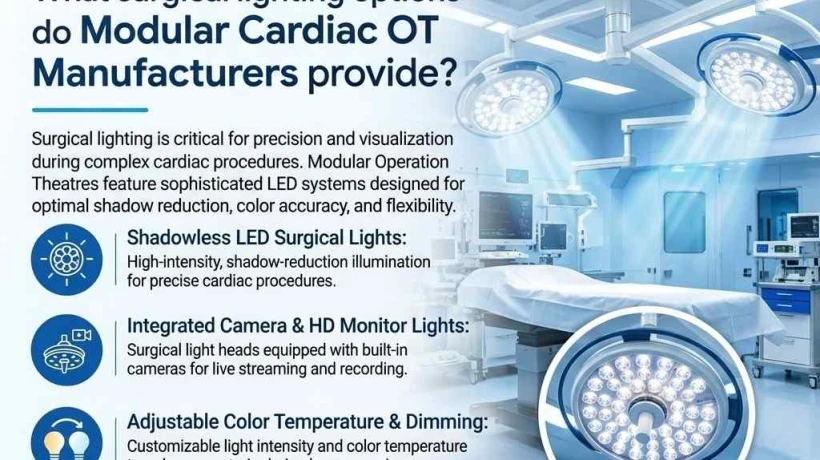
Explore surgical lighting options offered by Modular Cardiac OT Manufacturers, including LED lights, dual-dome systems, shadow control, and camera-integrated solutions for cardiac operating theatres.
Introduction
Altus Airflow supports the development of modern modular operating theatres designed to meet the demanding requirements of cardiac surgery. Surgical lighting is a critical component of these environments because it helps surgeons maintain clear visibility, distinguish tissue details, and perform complex procedures with precision. Modular Cardiac OT Manufacturers may offer different lighting configurations, including LED surgical lights, single- and dual-dome systems, ceiling-mounted lights, camera-integrated solutions, and adjustable illumination systems. Selecting the right option requires careful consideration of brightness, colour rendering, shadow control, heat generation, positioning, and compatibility with other operating theatre equipment.
1. Understanding Surgical Lighting Requirements in Cardiac Operating Theatres
Cardiac surgery involves intricate procedures that require consistent illumination of the surgical field. Surgeons must be able to identify anatomical structures, assess tissue colour, and work accurately under different clinical conditions. The lighting system should provide sufficient illumination without creating excessive glare, distracting shadows, or unnecessary heat.
Unlike general room lighting, surgical lights are designed to illuminate a specific operative area. Their performance depends on factors such as light intensity, beam focus, colour rendering, working distance, and the ability to maintain illumination when staff or equipment obstruct the light path.
Lighting requirements should be identified during the planning stage of a modular operating theatre. The hospital's clinical team, biomedical engineers, electrical engineers, and equipment suppliers should work together to determine the most suitable configuration.
The final selection should also comply with applicable medical device requirements, electrical safety standards, and hospital procurement specifications.
2. LED Surgical Lighting Systems
LED surgical lights are widely used in modern operating theatres because they offer efficient illumination and long service life. They use light-emitting diodes to deliver controlled lighting while generally producing less radiant heat toward the surgical field than traditional halogen systems.
LED technology provides several practical advantages:
-
Consistent illumination during lengthy surgical procedures.
-
Adjustable brightness for different surgical tasks.
-
Good colour rendering when appropriately specified.
-
Reduced lamp replacement requirements compared with many traditional systems.
-
Efficient energy consumption.
-
Availability of different colour temperature settings in selected models.
Some LED surgical lights allow clinicians to adjust colour temperature to improve visual comfort and tissue differentiation. The appropriate setting depends on the manufacturer's design and the preferences of the surgical team.
When evaluating LED options, hospitals should review illumination levels, colour rendering index, shadow dilution, light-field diameter, working distance, and thermal performance. These specifications should be assessed against the needs of cardiac surgery rather than relying on product descriptions alone.
LED systems may also include sealed handles that can be sterilized or replaced with sterile covers, depending on the design. These features support appropriate infection-control practices when used according to the manufacturer's instructions.
3. Single-Dome Surgical Lights
A single-dome surgical light consists of one primary lighting head positioned above the operating table. It can be suitable for theatres where a straightforward lighting arrangement meets the clinical requirements and ceiling space is limited.
Single-dome systems typically offer adjustable positioning and focused illumination. Their suitability depends on the dimensions of the operating room, the location of the surgical table, the expected procedure types, and the extent to which staff or equipment may obstruct the light.
In cardiac operating theatres, a single dome may be considered for selected configurations, but the clinical team must determine whether it provides sufficient coverage and redundancy for the planned procedures.
Important selection factors include the light head's reach, movement range, illumination quality, mounting requirements, and compatibility with ceiling-mounted equipment.
A single-dome arrangement may also be combined with an auxiliary surgical light where the design and clinical workflow require additional illumination. The chosen setup should allow clinicians to reposition the light without disrupting equipment, sterile areas, or staff movement.
4. Dual-Dome Surgical Lighting Systems
Dual-dome systems use two independently adjustable surgical light heads. This arrangement allows clinicians to illuminate the operative field from different directions and can help maintain visibility when one light path is partially obstructed.
The two light heads can be positioned to provide overlapping illumination. This is particularly useful when the surgical team needs flexibility during complex procedures or when the operative field changes position.
Potential advantages include:
-
Improved flexibility in light positioning.
-
Additional illumination angles.
-
Better management of shadows caused by staff or equipment.
-
The ability to adjust each light head independently.
-
Support for different surgical configurations.
However, two light heads require adequate ceiling space and careful coordination with surgical pendants, anaesthesia equipment, monitors, and imaging systems. The installation design must provide sufficient clearance for the full movement of each arm.
The clinical team should evaluate whether a dual-dome arrangement offers meaningful benefits for the planned procedures. More light heads do not automatically guarantee better visibility; performance depends on light quality, positioning, and the design of the entire room.
5. Ceiling-Mounted Surgical Lights
Ceiling-mounted lights are commonly considered in modular operating theatres because they can provide flexible positioning while keeping floor space available for clinical equipment and staff.
These systems generally consist of a ceiling support structure, articulated arms, and one or more lighting heads. The arms allow the surgical team to move the lights into suitable positions and adjust the illumination angle.
Installation requires close coordination between the modular ceiling contractor, structural engineer, and lighting supplier. The ceiling and its supporting structure must accommodate the equipment's weight and operating forces. Reinforcement may be necessary depending on the building structure and manufacturer's requirements.
Key installation considerations include:
-
Structural load capacity and approved mounting points.
-
Full arm movement and clearance.
-
Compatibility with ceiling panels and service openings.
-
Coordination with medical gas and electrical pendants.
-
Access for inspection and maintenance.
-
Safe positioning around monitors and imaging equipment.
A ceiling-mounted system should be positioned so that it can illuminate the operative field without interfering with surgical workflow. The installation team should confirm the complete range of movement before final handover.
6. Shadow-Control and Deep-Cavity Illumination
Surgical staff, instruments, and equipment can obstruct light travelling toward the operative field. Shadow-control technology is therefore an important feature to evaluate when selecting surgical lights for cardiac procedures.
Many modern surgical lights use multiple light sources, optical arrangements, or specialized reflector designs to reduce the impact of obstructions. By combining light from different directions, these systems can help maintain illumination when some parts of the light path are blocked.
Deep-cavity illumination is another consideration. During procedures involving deeper surgical sites, clinicians need adequate illumination without excessive glare or loss of visual clarity.
Hospitals should review the manufacturer's performance data for shadow dilution, illumination distribution, and working distance. Demonstrations or evaluations in a representative clinical configuration can help the surgical team assess whether the light performs as expected.
The position of the light head also matters. Even a high-performance system may produce unwanted shadows if it is poorly aligned with the operative field or obstructed by a monitor, pendant, or staff member.
7. Camera-Integrated Surgical Lighting
Some surgical lighting systems offer integrated cameras or provisions for compatible camera modules. These systems can support recording, teaching, clinical documentation, and communication with other areas of a healthcare facility.
Depending on the selected model, camera functionality may include high-definition video, optical zoom, remote positioning, and integration with compatible displays or recording equipment.
Potential applications include:
-
Training and education for surgical teams.
-
Recording procedures when permitted by hospital policy.
-
Remote observation for authorized clinical discussions.
-
Documentation for quality assurance.
-
Integration with audiovisual systems in suitable facilities.
Before choosing a camera-integrated system, the hospital should assess image quality, connectivity, cybersecurity, privacy controls, data storage, and compatibility with existing audiovisual infrastructure.
Video recording must follow applicable consent requirements, privacy laws, and hospital policies. Camera installation should not compromise the lighting system's positioning, cleaning requirements, or safe operation.
For facilities that do not require built-in cameras, a compatible external imaging solution may be considered if it meets the clinical and technical requirements.
8. Adjustable Brightness and Colour Temperature
Different stages of a surgical procedure may require different lighting conditions. Adjustable brightness allows clinicians to increase or reduce illumination according to the task, while adjustable colour temperature can help tailor the visual environment where supported by the selected system.
Brightness controls should be easy to operate and should not require unnecessary movement away from the sterile field. Depending on the product, controls may be located on the light head, wall control panel, or a compatible integrated interface.
Colour rendering is also important. A suitable colour rendering index helps clinicians distinguish colours more accurately under artificial illumination. Hospitals should review the manufacturer's published specifications and evaluate the system with clinical users where possible.
The lighting design should also consider glare, reflections from instruments, and visual comfort during long procedures. These factors can influence the surgical team's experience even when the system meets its stated technical specifications.
Adjustable features should be evaluated alongside illumination uniformity, shadow control, and ease of cleaning. No single specification can fully determine whether a light is suitable for cardiac surgery.
9. Integration with Modular OT Infrastructure
Surgical lighting must work as part of the wider operating theatre environment. Its installation should be coordinated with modular wall panels, ceiling systems, HVAC equipment, medical gas pendants, electrical services, monitoring devices, and imaging equipment.
A well-coordinated layout reduces the risk of collisions between equipment arms and makes it easier for clinicians to reposition lights during procedures.
The installation plan should include accurate ceiling layouts, structural mounting details, electrical connections, and service access requirements. Equipment movement should be checked before the theatre becomes operational.
In a modular environment, openings and mounting points must be planned before ceiling panels are finalized. Unplanned modifications may affect structural integrity, sealing, cleaning access, or the appearance of the finished installation.
The team should also confirm that surgical lights do not obstruct supply-air outlets or create unnecessary interference with the ventilation design. Where controlled airflow is required, the interaction between light heads, personnel, and equipment should be considered during system planning and performance assessment.
10. Electrical Safety and Backup Power
Surgical lighting is a critical clinical system, so its electrical supply must be designed according to applicable healthcare electrical standards and the facility's essential power strategy.
Electrical engineers should coordinate the lighting equipment's power requirements with the supplier. The design must address appropriate circuit protection, earthing, connections, controls, and any backup-power arrangements required by local regulations or hospital policy.
The selected light should include suitable safety features and be installed according to the manufacturer's instructions. Electrical connections must remain accessible for authorized maintenance without compromising the clean environment.
Before clinical use, the installation should undergo the required electrical safety and functional checks. These checks may include verification of controls, movement mechanisms, illumination settings, and any integrated camera or monitoring functions.
Hospitals should obtain the relevant installation documents, operating instructions, and maintenance recommendations before accepting the system.
11. Maintenance, Cleaning, and Staff Training
Surgical lights must remain reliable throughout their service life. Preventive maintenance helps identify wear, mechanical problems, control faults, or reductions in performance before they affect clinical operations.
Maintenance requirements vary by manufacturer and model. Hospitals should establish a schedule covering the light heads, articulated arms, mounting structures, controls, electrical connections, and any integrated camera equipment.
Cleaning procedures must follow the manufacturer's instructions. Materials and disinfectants should be compatible with the light's surfaces, handles, and controls. Sterilizable handles or sterile covers should be managed according to the specified procedure.
Staff training should cover correct positioning, brightness adjustment, emergency procedures, routine inspection, and reporting faults. Biomedical engineering teams should maintain service records and ensure that repairs are performed by authorized personnel when required.
A documented maintenance programme supports operational reliability and helps the hospital plan replacement parts and future upgrades.
12. How to Select the Right Surgical Lighting Option?
Choosing a suitable lighting system requires a balance between clinical needs, installation constraints, safety, and long-term costs. The hospital should begin by identifying the procedures performed in the theatre and consulting the surgeons, anaesthesia team, biomedical engineers, and operating room managers.
A structured evaluation should consider:
-
Illumination performance: Review intensity, light-field diameter, colour rendering, and working distance.
-
Shadow control: Assess performance when staff and equipment obstruct the light.
-
Mounting configuration: Confirm ceiling capacity, arm movement, and available space.
-
Equipment integration: Check compatibility with monitors, pendants, and imaging systems.
-
Controls and usability: Evaluate brightness adjustment, colour temperature, and ease of operation.
-
Maintenance requirements: Review cleaning procedures, service support, and replacement parts.
-
Compliance: Verify applicable standards, certifications, and local regulatory requirements.
Hospitals should compare technical documentation rather than choosing solely on price or the number of lighting heads. A system that fits the room and clinical workflow is more valuable than one with features that are rarely used.
Conclusion
Selecting suitable surgical lighting requires careful assessment of illumination quality, shadow control, positioning, electrical safety, equipment compatibility, and maintenance needs. LED lights, single- and dual-dome configurations, ceiling-mounted systems, and camera-integrated options can serve different requirements depending on the theatre design and clinical workflow. The final selection should be guided by qualified professionals and verified against applicable standards.
Altus Airflow supports healthcare facilities in planning modular operating theatre environments with attention to technical coordination and practical installation requirements. Altus Airflow emphasizes the value of well-integrated systems, appropriate testing, and preventive maintenance to help hospitals establish dependable surgical spaces.
Frequently Asked Questions
1. What surgical lighting options do Modular Cardiac OT Manufacturers provide?
Modular Cardiac OT Manufacturers may provide LED surgical lights, single- and dual-dome configurations, ceiling-mounted systems, shadow-control lighting, adjustable colour temperature, and camera-integrated options, depending on project requirements.
2. Why are LED surgical lights popular?
LED surgical lights offer efficient illumination, adjustable brightness, long service life, and generally lower radiant heat toward the surgical field than traditional halogen systems.
3. Are dual-dome surgical lights better for cardiac surgery?
They can provide more positioning flexibility and additional illumination angles, but the best configuration depends on the procedure, room layout, and clinical team's needs.
4. Can surgical lights include cameras?
Yes. Selected models support integrated cameras for authorized recording, teaching, and compatible audiovisual applications.
5. Do surgical lights require backup power?
Backup-power arrangements depend on applicable standards, the hospital's essential electrical system design, and the equipment's intended clinical role.
Read Our Previous Blog ---------------> What are the installation requirements for a Cardiac Modular OT With Laminar Airflow?



Comments
Login to Comment