How to Select the Right Surface Aerator for Your Wastewater Treatment Plant
16 Oct, 2026
14 Views 0 Like(s)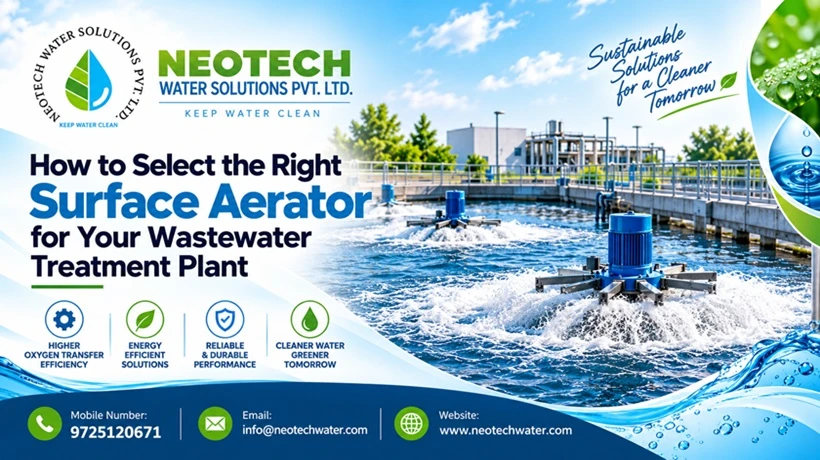
Surface Aerator
Selecting the right Surface Aerator is an important decision when designing, upgrading, or improving a wastewater treatment plant. An aerator directly affects oxygen transfer, biological treatment performance, mixing efficiency, energy consumption, and the overall operating cost of the treatment system.
Wastewater treatment facilities in India handle different types of influent, including municipal sewage, industrial wastewater, food-processing effluent, chemical wastewater, dairy waste, textile effluent, and other organic loads. Because every treatment plant operates under different conditions, choosing an aerator only on the basis of motor power or purchase price can lead to inefficient treatment and unnecessary energy expenses.
A properly selected Mechanical Surface Aerator should provide sufficient oxygen, maintain uniform mixing, withstand wastewater conditions, and operate reliably for long periods.
Neotech Water Solutions provides wastewater treatment equipment and aeration solutions designed for different industrial and municipal treatment requirements across India.
How Do You Select the Right Surface Aerator?
To select the right Surface Aerator, evaluate the wastewater flow rate, biological oxygen demand, required oxygen transfer rate, aeration tank dimensions, water depth, mixing requirements, wastewater characteristics, motor efficiency, construction material, maintenance accessibility, and long-term energy consumption.
The correct aerator should provide enough oxygen for microorganisms while maintaining adequate mixing throughout the treatment tank.
Important factors include:
-
Wastewater flow rate
-
BOD and COD concentration
-
Required oxygen transfer capacity
-
Aeration tank volume and depth
-
Mixing requirement
-
Motor power
-
Aerator diameter and speed
-
Wastewater temperature
-
Material of construction
-
Maintenance requirements
-
Energy efficiency
-
Manufacturer support
Selecting equipment based on actual process calculations can significantly improve wastewater treatment performance.
What Is a Surface Aerator?
A Surface Aerator is a mechanical aeration device installed near or at the surface of an aeration tank. It rotates an impeller, rotor, or similar mechanism to expose wastewater to atmospheric air.
The rotating action creates turbulence and water movement, allowing oxygen from the atmosphere to dissolve into the wastewater.
Surface aerators generally perform two important functions simultaneously:
-
Oxygen transfer
-
Wastewater mixing
This combination makes them useful in many wastewater treatment applications.
A Surface Aerator Wastewater system can be used in activated sludge plants, oxidation ponds, equalization tanks, lagoons, biological treatment systems, and industrial effluent treatment plants.
Why Is Aeration Important in Wastewater Treatment?
Aeration supplies oxygen to aerobic microorganisms responsible for breaking down biodegradable organic pollutants.
These microorganisms consume organic matter and convert it into more stable biological products.
Without adequate oxygen, biological treatment efficiency may decrease significantly.
Insufficient aeration may cause:
-
Poor BOD removal
-
Unpleasant odour
-
Septic conditions
-
Sludge settling problems
-
Reduced microbial activity
-
Increased treatment time
-
Poor final effluent quality
Excessive aeration can also create problems because unnecessary aeration consumes additional electricity without providing meaningful treatment benefits.
Therefore, accurate aerator selection is essential.
Important Factors to Consider When Selecting a Surface Aerator
1. Determine the Wastewater Flow Rate
The first step is understanding how much wastewater enters the treatment plant each day.
Flow is commonly measured in:
-
Litres per day
-
Cubic metres per day
-
MLD for larger treatment facilities
The aeration requirement generally increases with wastewater flow.
However, flow rate alone should never be used to determine aerator size.
Two treatment plants handling the same daily flow may require completely different aeration capacities because their pollutant loads may vary significantly.
2. Analyse BOD and COD Levels
Biochemical Oxygen Demand and Chemical Oxygen Demand indicate the amount of organic contamination present in wastewater.
Higher organic loading generally requires more oxygen.
For example, wastewater from food-processing plants may contain significantly more biodegradable organic matter than domestic sewage.
Important parameters to evaluate include:
-
Influent BOD
-
Influent COD
-
Desired outlet BOD
-
Organic loading rate
-
Biological treatment process
-
Required dissolved oxygen level
A reliable Surface Aerator Manufacturer should consider these parameters while recommending aeration equipment.
3. Calculate the Required Oxygen Transfer
Oxygen transfer capacity is one of the most important technical parameters when choosing an aerator.
The selected equipment must transfer enough oxygen into the wastewater to support biological treatment.
Aeration systems are commonly evaluated through parameters such as:
-
Oxygen transfer rate
-
Standard oxygen transfer rate
-
Oxygen transfer efficiency
-
Power consumption per unit of oxygen transferred
The actual oxygen requirement depends on the biological process and wastewater characteristics.
A professional wastewater-treatment engineer should calculate the oxygen demand before finalizing the aerator.
4. Consider Aeration Tank Size
The length, width, volume, and depth of the aeration tank affect aerator selection.
The aerator must generate sufficient circulation throughout the tank.
Poor circulation can create dead zones where sludge settles and oxygen concentration becomes low.
Before selecting a Mechanical Surface Aerator, evaluate:
-
Tank volume
-
Water depth
-
Tank shape
-
Aerator installation position
-
Number of aerators
-
Required mixing intensity
Large aeration basins may require multiple aerators instead of one large unit.
5. Evaluate Tank Water Depth
Water depth influences both mixing and aeration performance.
Surface aerators primarily operate close to the liquid surface, but the generated circulation must reach deeper sections of the aeration tank.
If the tank is too deep for a particular aerator configuration, adequate bottom mixing may not occur.
This can result in sludge accumulation.
The aerator design should therefore match the hydraulic dimensions of the treatment tank.
6. Choose the Correct Aerator Capacity
Different wastewater treatment plants require different aeration capacities.
Aerators are available with different:
-
Motor ratings
-
Impeller diameters
-
Rotational speeds
-
Oxygen-transfer capabilities
-
Mixing capacities
Selecting an oversized aerator increases capital and electricity costs.
Selecting an undersized aerator may result in inadequate biological treatment.
The best approach is to select aeration equipment based on calculated oxygen demand and mixing requirements.
Types of Surface Aerators
Several surface aeration configurations are available.
The appropriate choice depends on tank design, wastewater properties, installation requirements, and operating conditions.
Fixed Surface Aerator
Fixed aerators are installed on supporting structures positioned above or around the aeration tank.
They are commonly used in permanent wastewater-treatment facilities.
Benefits may include:
-
Stable installation
-
Reliable operation
-
Easy integration with existing tanks
-
Suitable for continuous treatment
Floating Surface Aerator
A Floating Surface Aerator operates on floating structures rather than requiring a permanent supporting bridge.
It is particularly useful for:
-
Lagoons
-
Ponds
-
Large open basins
-
Existing treatment plants
-
Temporary treatment applications
Floating systems can often simplify installation because major civil modifications may not be required.
They may also allow operators to reposition aerators when necessary.
Mechanical Surface Aerator
A Mechanical Surface Aerator uses a motor-driven rotating mechanism to create turbulence and oxygen transfer.
It is commonly selected where both oxygen transfer and effective mixing are required.
Its performance depends on factors such as:
-
Impeller geometry
-
Motor capacity
-
Rotational speed
-
Tank geometry
-
Submergence
-
Wastewater properties
Surface Aerators for Wastewater Treatment: Key Benefits
Properly designed Surface Aerators For Wastewater Treatment can provide several operational advantages.
Effective Oxygen Transfer
Surface aerators increase contact between air and wastewater, helping oxygen dissolve into the liquid.
Adequate oxygen improves microbial activity.
Strong Mixing
Mixing keeps microorganisms, wastewater, and organic matter in continuous contact.
This helps prevent sludge from settling prematurely inside the aeration tank.
Simple Mechanical Configuration
Surface aeration systems generally have easily identifiable mechanical components, which can simplify inspection and maintenance.
Suitable for Different Treatment Applications
They can be used in:
-
Sewage treatment plants
-
Effluent treatment plants
-
Activated sludge systems
-
Lagoons
-
Oxidation ponds
-
Equalization tanks
-
Industrial wastewater-treatment systems
How Important Is Energy Efficiency?
Energy consumption should be one of the most important criteria when comparing aeration equipment.
Aeration is often one of the major electricity-consuming processes in biological wastewater treatment.
Even a small improvement in aeration efficiency can generate meaningful operating savings over several years.
When comparing equipment, do not consider only the motor horsepower.
Evaluate:
-
Oxygen delivered per unit of energy
-
Motor efficiency
-
Aerator hydraulic performance
-
Required operating hours
-
Control system options
-
Wastewater oxygen demand
A slightly more efficient aerator may have a higher initial cost but significantly lower life-cycle operating expenses.
Material of Construction
Wastewater may contain chemicals, salts, solids, oils, corrosive compounds, and other contaminants.
Therefore, material selection is important.
Depending on the application, aerator components may be manufactured using suitable grades of:
-
Stainless steel
-
Mild steel with protective coatings
-
Corrosion-resistant alloys
-
Special engineered materials
The correct material should be selected after considering wastewater chemistry and operating environment.
Maintenance Requirements
A wastewater treatment plant operates continuously, so maintenance accessibility should be considered during equipment selection.
Important maintenance factors include:
-
Motor accessibility
-
Bearing replacement
-
Shaft inspection
-
Impeller inspection
-
Lubrication requirements
-
Corrosion protection
-
Availability of spare parts
An aerator that is easier to inspect and maintain can help reduce downtime.
Selecting the Right Surface Aerator Manufacturer
Choosing equipment from an experienced Surface Aerator Manufacturer is just as important as selecting the correct aerator type.
The manufacturer should understand wastewater-treatment processes rather than simply supplying mechanical equipment.
Before selecting a supplier, consider whether the company can assist with:
-
Aeration calculations
-
Equipment sizing
-
Tank compatibility
-
Installation guidance
-
Material selection
-
Performance requirements
-
Technical drawings
-
Spare parts
-
After-sales support
A technically capable manufacturer can help prevent incorrect equipment selection.
Why Consider Neotech Water Solutions?
Neotech Water Solutions provides wastewater-treatment equipment and engineering solutions for different industrial and municipal applications.
The company focuses on understanding operating requirements before recommending aeration equipment.
Depending on the wastewater-treatment project, factors such as oxygen demand, tank dimensions, hydraulic loading, organic load, required dissolved oxygen, and mixing conditions can be evaluated before equipment selection.
Businesses looking for a Surface Aerator Manufacturer in India can consider technical compatibility, operating efficiency, service support, and long-term equipment reliability when selecting a supplier.
Common Mistakes to Avoid When Choosing a Surface Aerator
Selecting Only by Motor HP
Motor size alone does not determine aeration performance.
Oxygen-transfer capacity and mixing efficiency are more important.
Ignoring Wastewater Characteristics
Industrial wastewater can behave very differently from municipal sewage.
Oil content, solids, chemicals, temperature, and organic load can influence aeration efficiency.
Ignoring Tank Geometry
An aerator may have adequate oxygen-transfer capacity but still provide poor treatment if circulation inside the tank is insufficient.
Choosing the Cheapest Equipment
A lower purchase price does not always mean lower operating cost.
Energy consumption, maintenance requirements, service life, and downtime should also be considered.
Oversizing the Aerator
Oversized equipment can waste electricity and increase operating expenses.
Undersizing the Aerator
Insufficient aeration can create low dissolved oxygen, reduced biological performance, odour, and poor treated-water quality.
Surface Aerator Selection Checklist
Before purchasing a surface aerator, confirm the following information:
-
What is the average wastewater flow?
-
What is the peak wastewater flow?
-
What are the inlet BOD and COD levels?
-
What outlet quality is required?
-
What biological treatment process is used?
-
What is the required dissolved oxygen level?
-
What is the tank volume?
-
What is the tank depth?
-
How much oxygen must be transferred?
-
How much mixing is required?
-
What motor capacity is suitable?
-
Which material of construction is appropriate?
-
How energy efficient is the aerator?
-
How easy is the equipment to maintain?
-
Are spare parts readily available?
-
Does the manufacturer provide technical support?
Answering these questions allows engineers to select equipment based on actual plant requirements rather than assumptions.
Fixed vs Floating Surface Aerator: Which Should You Choose?
A fixed aerator can be appropriate where permanent structural installation is available and tank geometry supports a fixed mounting arrangement.
A Floating Surface Aerator can be useful where flexibility or easier installation is needed.
Floating aerators are commonly considered for:
-
Lagoons
-
Large ponds
-
Existing wastewater-treatment systems
-
Treatment basins without supporting structures
-
Projects where civil construction should be minimized
The final choice should depend on hydraulic conditions, oxygen requirements, maintenance accessibility, and plant configuration.
How Many Surface Aerators Does a Treatment Plant Need?
There is no universal number.
The required number depends on:
-
Total oxygen demand
-
Mixing requirement
-
Tank dimensions
-
Individual aerator capacity
-
Wastewater characteristics
-
Process loading
-
Required operational redundancy
For example, using multiple smaller aerators may offer better distribution and operational flexibility in a large basin.
If one unit requires maintenance, other aerators may continue operating.
Aerator quantity should therefore be calculated as part of the overall treatment-process design.
Frequently Asked Questions
1. What is a surface aerator used for in wastewater treatment?
A surface aerator introduces atmospheric oxygen into wastewater while creating circulation and mixing. It supports aerobic microorganisms that break down biodegradable pollutants during biological wastewater treatment.
2. How do I choose the correct size of surface aerator?
Aerator size should be determined using wastewater flow, BOD and COD loading, oxygen demand, aeration tank volume, tank depth, mixing requirement, and required dissolved oxygen concentration.
3. What is a floating surface aerator?
A floating surface aerator is mounted on floating structures and operates directly on a pond, lagoon, or aeration basin. It can reduce the need for permanent structural support.
4. What is the difference between a surface aerator and a mechanical surface aerator?
A mechanical surface aerator is a type of surface aerator that uses a motor-driven rotating impeller or rotor to create turbulence, circulation, mixing, and oxygen transfer.
5. Are surface aerators suitable for industrial wastewater?
Yes. Surface aerators can be used in many industrial wastewater-treatment systems, provided their size, material, motor capacity, and oxygen-transfer performance are selected according to wastewater characteristics.
6. How does a surface aerator improve BOD removal?
The aerator supplies oxygen required by aerobic microorganisms. These microorganisms biologically break down biodegradable organic matter, helping reduce BOD when the treatment process is properly designed and operated.
7. What factors affect surface aerator efficiency?
Important factors include wastewater temperature, dissolved oxygen concentration, tank dimensions, impeller design, motor efficiency, aerator speed, submergence, wastewater characteristics, and hydraulic circulation.
8. Can one surface aerator be used for a large aeration tank?
Sometimes, but large tanks often require multiple aerators to achieve proper oxygen distribution and mixing. Equipment quantity should be calculated according to oxygen and hydraulic requirements.
9. How much maintenance does a surface aerator require?
Maintenance depends on equipment design and operating conditions. Routine inspection may include checking the motor, bearings, shaft, impeller, lubrication, corrosion, vibration, and electrical components.
10. Where can I find a surface aerator manufacturer in India?
Businesses can approach Neotech Water Solutions for surface aeration and wastewater-treatment equipment requirements in India. Equipment should be selected after evaluating process conditions and treatment objectives.
Final Thoughts
Selecting the correct Surface Aerator requires more than comparing motor power, price, and equipment dimensions.
A reliable selection process must consider wastewater flow, organic loading, oxygen requirements, tank geometry, mixing needs, energy efficiency, wastewater chemistry, material selection, maintenance, and long-term operating costs.
Whether your plant requires a fixed aerator, Floating Surface Aerator, or another Mechanical Surface Aerator configuration, the equipment should be sized according to the actual process conditions.
Correct aerator selection can help improve dissolved oxygen levels, biological treatment performance, wastewater mixing, energy efficiency, and treatment reliability.
For industries and wastewater-treatment operators searching for Surface Aerators For Wastewater Treatment in India, Neotech Water Solutions can support equipment selection based on plant requirements and wastewater characteristics.



Comments
Login to Comment