Types of Software Testing: A Practical Guide for Developers
18 Mar, 2026
4696 Views 0 Like(s)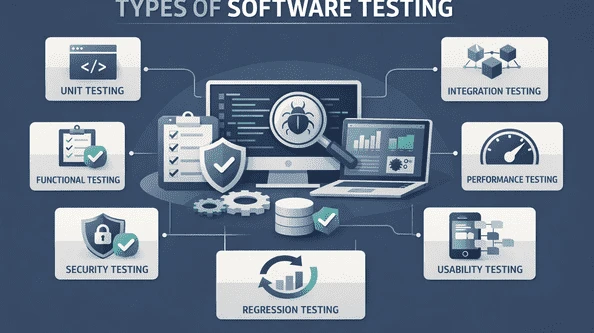
A developer-first guide to choosing the right testing types for building reliable, scalable systems
Modern software systems are more complex than ever. Applications are no longer standalone-they are built on APIs, microservices, and distributed architectures.
In this environment, understanding the types of software testing is not just useful-it’s essential for building reliable systems.
But the challenge is not knowing the definitions. It’s knowing what to use, when to use it, and why it matters.
Why Developers Need to Understand Testing Types
Testing is no longer a separate phase handled by QA teams. In modern development workflows, developers are responsible for ensuring code quality from the start.
This means making decisions like:
-
What kind of test should be written
-
How much coverage is enough
-
Which tests should run in CI/CD
Without clarity on the types of software testing, teams often end up with:
-
Redundant tests
-
Gaps in coverage
-
Slow pipelines
Understanding the purpose of each testing type helps teams build faster and more reliably.
The Core Types of Software Testing
Unit Testing
Unit testing focuses on validating individual components in isolation.
Developers use unit tests to:
-
Verify logic at the function or class level
-
Catch bugs early in development
-
Ensure small changes don’t break expected behavior
Unit tests are fast, reliable, and ideal for quick feedback.
However, they don’t capture how different parts of the system interact.
Integration Testing
Integration testing ensures that different components work together as expected.
This includes:
-
API interactions
-
Database communication
-
Service-to-service calls
These tests help identify issues that unit tests cannot detect, especially in systems with multiple dependencies.
Regression Testing
Regression testing verifies that new changes do not break existing functionality.
As systems evolve, this type of testing becomes critical for maintaining stability.
It helps teams:
-
Detect unintended side effects
-
Validate existing workflows
-
Maintain confidence in frequent releases
Without regression testing, fast-moving teams risk introducing bugs with every update.
End-to-End Testing
End-to-end testing simulates real user workflows across the entire system.
These tests validate:
-
Complete user journeys
-
System-wide behavior
-
Interactions across multiple services
While powerful, end-to-end tests are often slower and more complex to maintain.
They should be used selectively for critical flows.
How to Choose the Right Testing Mix
The goal is not to use every testing type equally.
A balanced approach typically looks like:
-
A strong base of unit tests for fast feedback
-
Integration tests for validating interactions
-
Targeted regression testing for stability
-
Limited end-to-end tests for critical workflows
This balance ensures coverage without slowing down development.
Common Mistakes Developers Make
Over-Reliance on One Type of Testing
Some teams rely too heavily on a single testing type, such as end-to-end tests.
This leads to:
-
Slow pipelines
-
Difficult maintenance
-
Limited flexibility
A mix of testing types is essential.
Ignoring System-Level Validation
Focusing only on unit tests can create blind spots.
Even if individual components work perfectly, the system may still fail when integrated.
Writing Tests Without Purpose
Not all tests add value.
Tests should be written with clear intent:
-
What risk does this test cover?
-
What failure does it prevent?
Without this clarity, test suites become bloated and ineffective.
Testing in Modern Development Workflows
In DevOps environments, testing is tightly integrated into development.
Tests are:
-
Executed automatically in CI/CD pipelines
-
Run on every commit or pull request
-
Used to provide fast feedback to developers
This requires tests to be:
-
Fast enough to not block development
-
Reliable enough to be trusted
-
Relevant enough to catch real issues
Understanding the types of software testing helps teams design pipelines that support both speed and quality.
Moving Beyond Definitions
Knowing the types of software testing is only the first step.
What matters is how they are applied in real-world systems.
Modern teams focus on:
-
Testing critical user flows
-
Aligning tests with real usage
-
Continuously improving their testing strategy
This practical approach ensures that testing remains effective as systems evolve.
Final Thoughts
Software testing is not about writing more tests. It’s about writing the right tests.
Understanding the types of software testing helps developers make better decisions, reduce risks, and build more reliable systems.
In fast-moving environments, this knowledge becomes a competitive advantage.
Because in the end, the goal is simple:
Build systems that work-not just in theory, but in reality.



Comments
Login to Comment