India Two-Wheeler Market Size, Share Analysis, Outlook and Forecast Report 2026-2034
05 Oct, 2026
5 Views 0 Like(s)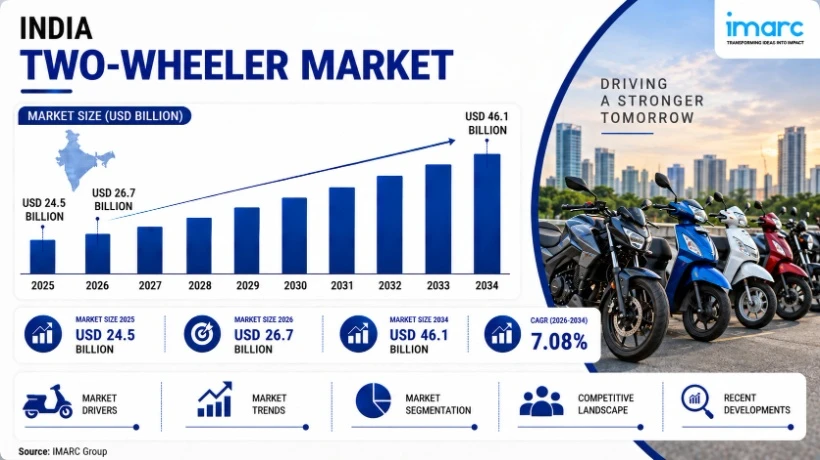
The India two-wheeler market size increased from USD 24.5 Billion in 2025 to USD 26.7 Billion in 2026 and is projected to reach USD 46.1 Billion by 2034, growing at a CAGR of 7.08% during 2026-2034.
India Two-Wheeler Market Overview
India's two-wheeler market stands as a critical driver of personal mobility and economic growth, encompassing types such as motorcycle, scooters, electric two-wheeler, and mopeds, utilizing ICE and electric technologies, with manual and automatic transmissions, across 100-125cc and other engine capacities. The market caters to personal and commercial end-users, distributed through offline and online channels, spanning West and Central India, South India, North India, and East India. The India two-wheeler market size increased from USD 24.5 Billion in 2025 to USD 26.7 Billion in 2026 and is projected to reach USD 46.1 Billion by 2034, growing at a CAGR of 7.08% during 2026-2034.
The market is expanding rapidly due to rising rural disposable incomes, expanding urban commuting needs, and the accelerated adoption of electric mobility. As the primary personal mobility solution for millions, the market features dual growth dynamics: volume growth driven by first-time rural buyers entering the commuter segment, and value growth driven by systematic consumer premiumization toward higher-displacement, feature-rich models. Concurrently, the electric two-wheeler segment is aggressively disrupting the industry, supported by government subsidies, expanding charging infrastructure, and total cost of ownership (TCO) advantages. With legacy original equipment manufacturers (OEMs) defending their massive distribution moats against agile, digitally native EV entrants, the Indian two-wheeler landscape is undergoing unprecedented technological and structural transformation.
Market Snapshot
-
Current Market Size (2025): USD 24.5 Billion
-
Market Size (2026): USD 26.7 Billion
-
Projected Market Size (2034): USD 46.1 Billion
-
CAGR: 7.08%
-
Motorcycle encompasses the dominant type segment at 56.0% share in 2025, serving distinct profiles from rural budget commuters to affluent motorcycle enthusiasts.
-
ICE leads the technology segment at 90.0% share in 2025, heavily entrenched through decades of supply chain localization and trusted brand reliability across all geographies.
-
West and Central India accounts for a leading 34.0% regional share in 2025, anchored by Maharashtra's massive urban consumption base and strong rural demand across Madhya Pradesh and Rajasthan.
What Growth Factors Are Driving India Two-Wheeler Market?
Rising Rural Incomes and Commuter Segment Expansion:
The entry and commuter motorcycle segments remain the volume backbone of the Indian two-wheeler market, driven heavily by rural and semi-urban agricultural economies. In states like Uttar Pradesh, Bihar, Andhra Pradesh, and Telangana, motorcycles serve as the indispensable primary mode of personal transport. Strong agricultural outputs, consecutive positive monsoons, and government rural income support initiatives continue to bring millions of first-time buyers into the market. Legacy OEMs have cultivated unparalleled trust within these demographics, offering highly fuel-efficient, durable models supported by dense, hyper-local service and spares networks that lower the barrier to long-term ownership.
Premiumization and Shift Toward Higher-Displacement Models:
While volume growth stems from commuter segments, market value is growing significantly faster due to rapid consumer premiumization. The executive/mid-segment and premium/super-premium motorcycle categories are expanding as aspirational urban and semi-urban riders seek superior performance, aesthetics, and lifestyle branding. Consumers are increasingly transitioning from 100-110cc commuter bikes to 125-160cc and 200cc+ categories. This shift allows manufacturers to integrate advanced safety and connected features—such as ABS, traction control, riding modes, and Bluetooth instrumentation—commanding higher margins and elevating the overall revenue trajectory of the internal combustion engine (ICE) segment.
Rapid Acceleration of Electric Two-Wheeler Adoption:
The electric two-wheeler segment is undergoing explosive growth, registering an approximate 22.5% CAGR, and is projected to capture 20–25% of the total market share by the end of the decade. This growth is currently concentrated in urban markets where shorter daily commute distances, higher average income levels, and access to home charging strongly support the EV value proposition. As battery costs decline and public charging networks gradually penetrate Tier-2 cities, electric mobility is becoming highly viable. The segment is heavily anchored by scooter formats, which offer immediate torque, low maintenance, and zero tailpipe emissions, appealing particularly to eco-conscious urban professionals.
Request Sample Report – TOC, Charts & Key Insights: https://www.imarcgroup.com/india-two-wheeler-market/requestsample
Government Policy Support
-
FAME-III Subsidies: The continuation of government subsidies under Faster Adoption and Manufacturing of (Hybrid &) Electric Vehicles (FAME) frameworks plays a critical role in sustaining upfront affordability and accelerating electric two-wheeler adoption.
-
BS6 Phase 2 Emission Norms: Stringent environmental mandates have forced the technological modernization of ICE vehicles, requiring fuel injection, catalytic converters, and OBD-2 (On-Board Diagnostics) systems, reducing emissions and enhancing engine efficiency.
-
Production Linked Incentive (PLI) Scheme: Significant fiscal incentives for the domestic manufacturing of advanced automotive technologies (AAT) and ACC battery cells encourage OEMs to localize supply chains and reduce reliance on imported electric powertrain components.
-
State-Level EV Mandates: Favorable state policies in regions like Delhi-NCR and Karnataka (Bengaluru) provide additional road tax exemptions and purchase subsidies, driving localized clusters of high EV penetration.
Evaluate Market Opportunity with the Business Sample Report
What Are the Latest Emerging Trends in India Two-Wheeler Market?
Disruption by EV Entrants and Direct-to-Consumer Models:
The market’s competitive structure is being radically disrupted by pure-play electric vehicle startups. Brands like Ola Electric and Ather Energy have successfully captured significant market share from legacy OEMs by rethinking the entire go-to-market strategy. Ola Electric, securing over 30%+ share in the electric scooter segment, utilizes aggressive pricing and a direct-to-consumer (D2C) sales architecture, bypassing traditional dealership networks. This approach challenges traditional manufacturing and distribution models, forcing legacy players to accelerate their own EV platform development and digital sales capabilities to remain competitive.
Surge in Automatic Scooter Demand for Urban Mobility:
Scooters have evolved into a highly preferred mobility solution for urban and peri-urban commuters, capturing a substantial 28.0% of the market. Models like the Honda Activa anchor this segment, offering unparalleled convenience through automatic transmissions, underbody storage, and superior rider comfort in congested stop-and-go city traffic. The scooter format inherently appeals to a broader demographic, notably driving independent mobility among female commuters and elderly riders, while also serving as the primary vehicle platform for the rapidly electrifying last-mile delivery and gig economy sectors.
Integration of Connected Technologies and IoT Platforms:
Two-wheelers are transitioning from mechanical hardware to smart, connected digital platforms. OEMs are heavily embedding IoT sensors and telematics systems into both premium ICE motorcycles and electric scooters. Features such as turn-by-turn navigation, smartphone call alerts, geo-fencing, remote diagnostics, and over-the-air (OTA) software updates are becoming standard expectations rather than premium add-ons. This digital integration enhances rider safety, prevents theft, and allows manufacturers to build continuous, data-driven relationships with their customers post-purchase.
How will India Two-Wheeler Market Evolve in the Coming Years?
The India two-wheeler market holds robust growth prospects through 2034, driven by the indispensable nature of personal mobility, systemic premiumization, and the rapid electrification of urban transport. The market is projected to grow from USD 24.5 Billion in 2025 to USD 46.1 Billion by 2034 at a steady CAGR of 7.08%. As the EV transition matures, the industry will witness fierce competition between aggressively scaling EV startups and deeply entrenched legacy OEMs leveraging their vast distribution moats. Companies that successfully localize battery supply chains, integrate advanced connected technologies, and cater to the distinct preferences of both rural commuters and affluent urban enthusiasts are strategically positioned to capture dominant market share over the coming decade.
How Is India's Two-Wheeler Market Segmented?
➤ By Type
-
Motorcycle (56.0% market share in 2025)
-
Scooters (28.0% market share in 2025)
-
Electric two-wheeler (11.0% market share in 2025)
-
Mopeds (5.0% market share in 2025)
➤ By Technology
-
ICE (90.0% market share in 2025)
-
Electric (10.0% market share in 2025)
➤ By Transmission
-
Manual (78.0% market share in 2025)
-
Automatic
➤ By Engine Capacity
-
100-125cc (42.0% market share in 2025)
-
Others
➤ By Fuel Type
-
Petrol (47.0% market share in 2025)
-
Electric
-
Others
➤ By End-User
-
Personal (94.0% market share in 2025)
-
Commercial
➤ By Distribution Channel
-
Offline Channels (89.0% market share in 2025)
-
Online Channels
➤ By Region
-
West and Central India (34.0% market share in 2025)
-
South India (29.0% market share in 2025)
-
North India (21.0% market share in 2025)
-
East India (16.0% market share in 2025)
Request Customized Data Tailored to Your Interest
Note: If you require any specific information not covered within this report's scope, we will provide it as part of the customization.
Competitive Landscape — By IMARC GROUP
The India two-wheeler market competitive landscape is one of the world’s most intensely contested, with top players collectively commanding approximately 80–85% of total market volume. The market’s competitive structure is being disrupted by electric vehicle entrants that are challenging the legacy OEMs’ distribution model, manufacturing approach, and product technology architecture simultaneously.
Key players covered in the report include:
-
Hero MotoCorp Limited: The market leader and one of the world’s largest two-wheeler manufacturers. Featuring key models like the Splendor+ (the world's highest-volume single motorcycle platform), XPluse 210, Karizma XMR, and Harley-Davidson X440 T, the company relies on an unmatched pan-India dealer network and absolute rural distribution leadership in North and Central India.
-
Honda Motor Co., Ltd.: A market leader offering the Honda Activa—India’s highest-volume two-wheeler model. The brand is renowned for industry-leading fuel efficiency credentials, strong trust in scooter categories, and a robust premium presence through its CB-series (CB350, CB750 Hornet).
-
TVS Holdings Limited: A strong challenger leveraging its racing heritage to drive premium positioning through the Apache series (RTX, RR 310). With robust South India market presence, manufacturing scale in Tamil Nadu, and the highly successful TVS iQube building its EV platform capability, TVS maintains a highly diversified portfolio.
-
Bajaj Auto Ltd.: A strong challenger recognized for the Pulsar brand, India’s leading premium mid-segment motorcycle platform. Bajaj boasts global reach, a strategic Triumph partnership for India-manufactured global premium motorcycles, and strong brand legacy through the Chetak Electric scooter.
-
Ola Electric: An aggressive new entrant disrupting the market by building a 30%+ electric scooter market share through highly competitive pricing, vertically integrated gigafactory ambitions, and a direct-to-consumer digital sales model.
-
Ather Energy: A pioneering EV entrant specializing in high-performance, technologically advanced electric scooters, focusing heavily on premium build quality, proprietary charging networks, and connected riding experiences.
Note: If you need specific information that is not currently within the scope of the report, we can provide it to you as a part of the customization.
Request Report Customization: https://www.imarcgroup.com/request?type=report&id=3991&flag=E
Frequently Asked Questions (FAQs)
How big is the two-wheeler market in India?
➤ The India two-wheeler market reached USD 24.5 Billion in 2025 and expanded to USD 26.7 Billion in 2026, supported by robust rural agricultural incomes, rapid urban commuter demand, and the escalating shift toward electric mobility.
What is the projected growth rate of the India two-wheeler market?
➤ The market is projected to reach USD 46.1 Billion by 2034, registering a steady compound annual growth rate (CAGR) of 7.08% between 2026 and 2034, propelled by consumer premiumization, advanced safety integrations, and favorable EV subsidies.
What are the key factors driving market growth?
➤ Key drivers include persistent demand from first-time rural buyers, the systemic shift of urban commuters toward higher-displacement premium motorcycles, and the rapid 22.5% CAGR growth of the electric two-wheeler segment driven by startup disruption and government policy support.
About Us:
IMARC Group is a global management consulting firm that helps ambitious changemakers create a lasting impact. The company offers comprehensive market assessment, feasibility studies, incorporation support, regulatory assistance, branding and strategy services, and procurement research.
IMARC Group
134 N 4th St. Brooklyn, NY 11249, USA
Email: sales@imarcgroup.com
Tel: (D) +91 120 433 0800
United States: +1-201-971-6302
Comments
Login to Comment