India Petrochemicals Market Trends Analysis, Size, Share, Growth Drivers and Forecast Report 2026-2034
05 Oct, 2026
22 Views 0 Like(s)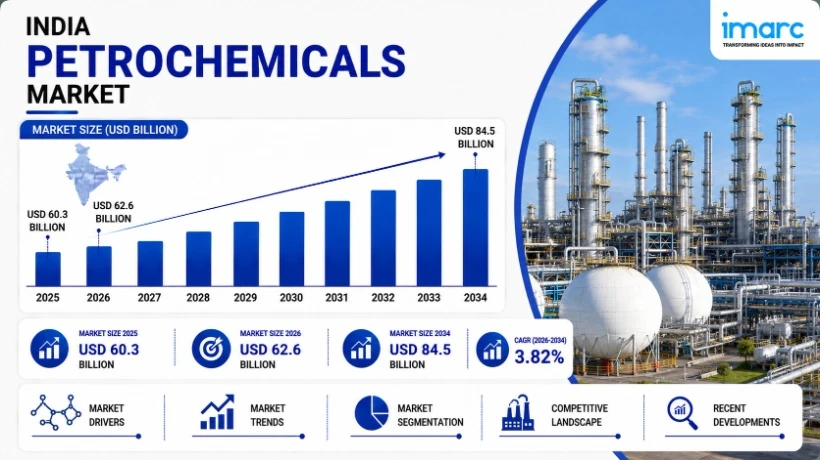
The India petrochemicals market size increased from USD 60.3 Billion in 2025 to USD 62.6 Billion in 2026. Looking forward, IMARC Group expects the market to reach USD 84.5 Billion by 2034, exhibiting a growth rate (CAGR) of 3.82% during 2026-2034.
Market Overview & Summary
The India petrochemicals market size increased from USD 60.3 Billion in 2025 to an estimated USD 62.6 Billion in 2026. Looking forward, the market is projected to reach USD 84.5 Billion by 2034, exhibiting a steady compound annual growth rate (CAGR) of 3.82% during the 2026–2034 forecast period.
The domestic industry serves as a foundational pillar of India's manufacturing ecosystem, supplying critical building blocks for polymers, packaging, synthetic textiles, construction materials, and automotive components. Driven by rapid urbanization, expanding organized retail, and rising per capita plastic consumption, demand for basic petrochemicals and intermediate derivatives continues to climb. To reduce dependency on imports and improve energy efficiency, major public and private refiners are aggressively integrating crude-to-chemicals (COTC) technology, creating massive centralized petrochemical complexes that bolster domestic self-reliance.
Market Size & Forecast
- Market Size (2025): USD 60.3 Billion
- Market Size (2026): USD 62.6 Billion
- Projected Market Size (2034): USD 84.5 Billion
- CAGR (2026 - 2034): 3.82%
- Leading Type: Ethylene
- Leading Application: Polymers
- Leading End Use Industry: Packaging
- Leading Region: West India
India Petrochemicals Market Trends
- Adoption of Crude-to-Chemicals (COTC) Configurations:
Domestic petroleum refiners are systematically transforming conventional fuel refineries into integrated chemical manufacturing facilities. With electric vehicles and alternative fuels poised to dampen long-term growth in liquid transportation fuels (petrol and diesel), oil majors are retrofitting facilities to maximize chemical yields. Deploying advanced crude-to-chemicals (COTC) architectures allows operators to raise chemical production from a historical average of 10–15% up to 40–50% per barrel of crude, ensuring superior long-term gross refining margins and long-term asset relevance.
- Transition Toward Circular Economy and Mechanically Recycled Polymers:
Tightening government enforcement under Extended Producer Responsibility (EPR) guidelines is pushing petrochemical giants toward circular solutions. Primary producers are forming strategic joint ventures with authorized recyclers and commissioning dedicated post-consumer recycled (PCR) polymer compounding units. By blending chemically synthesized virgin resins with high-grade mechanically recycled pellets, manufacturers are able to provide commercial brand owners with eco-compliant packaging materials that meet statutory sustainability thresholds without sacrificing essential mechanical tensile strength or barrier properties.
- Expansion of Specialized Downstream Petrochemical Hubs:
The industry is experiencing a strategic migration toward integrated Petroleum, Chemicals, and Petrochemical Investment Regions (PCPIRs). Clustering basic monomer crackers alongside specialized derivative processors—such as specialty solvent, synthetic rubber, and engineering plastic units—significantly slashes pipeline and bulk inter-facility transportation costs. This localized ecosystem model provides downstream intermediate processors with stable feedstock supplies while reducing import dependence for niche specialty chemicals across electronics, agrochemicals, and automotive manufacturing.
Request Sample Report – TOC, Charts & Key Insights: https://www.imarcgroup.com/india-pet-grooming-market/requestsample
Strategic Market Dynamics
Growth Drivers
- Rapid Expansion Across Modern Packaging and Consumer Goods:
The explosive growth of India's organized food processing, pharmaceuticals, and e-commerce distribution networks serves as a massive primary volume anchor for commodity polymers. Flexible and rigid packaging formats demand enormous volumes of polyethylene and polypropylene resins to manufacture multi-layered barrier films, blow-molded bottles, and protective delivery packaging. As rising middle-class urban populations gravitate toward packaged staples and quick-commerce doorstep deliveries, the non-discretionary procurement of high-clarity, food-grade polymer resins continues to expand. This provides integrated petrochemical manufacturers with insulated, year-round volume demand across nationwide packaging converters and plastic molders.
- Massive Infrastructure Investments and Residential Housing Outlays:
Unprecedented capital expenditure directed toward public water pipelines, agricultural micro-irrigation systems, and urban residential construction acts as a powerful catalyst for petrochemical intermediate consumption. Large-scale infrastructure programs require substantial volumes of polyvinyl chloride (PVC) and high-density polyethylene (HDPE) for long-lasting pressure pipes, electrical conduits, and geomembrane liners. Simultaneously, federal housing initiatives accelerate the consumption of petrochemical-derived solvents, paints, sealants, and waterproofing polyurethane foams. This sustained pipeline of civil engineering projects provides domestic petrochemical producers with reliable, multi-year supply contracts that effectively offset seasonal consumer-facing demand volume fluctuations.
- Automotive Lightweighting and Accelerating Component Polymerization:
The rapid evolution of the domestic automotive sector toward tighter emission standards and electric vehicle architectures is dramatically increasing the polymer content per vehicle. Automakers are actively replacing heavy metal brackets, structural frames, and interior panels with high-performance engineering plastics, polypropylene compounds, and synthetic elastomers. These lightweight materials reduce total vehicle curb weight, directly enhancing battery range in electric vehicles and optimizing fuel economy in conventional engines. Consequently, tier-1 automotive suppliers consistently increase bulk procurement of tailored petrochemical polymers, structurally accelerating long-term market value expansion.
Market Restraints
- High Exposure to Crude Oil and Naphtha Price Volatility:
Domestic petrochemical producers rely heavily on crude oil derivatives—chiefly naphtha—as primary cracker feedstocks. Unpredictable swings in global Brent crude prices, triggered by geopolitical instability and supply-quota adjustments, directly inflate feedstock procurement costs. Because domestic resin manufacturers cannot always immediately pass volatile input price hikes onto highly competitive, margin-sensitive downstream plastic molders, operating margins frequently experience sharp cyclical compression.
- Stringent Environmental Mandates and Single-Use Plastic Restrictions:
The domestic industry faces continuous regulatory headwinds from statutory bans on low-utility, single-use plastic commodities and escalating municipal solid waste disposal restrictions. Compliance with strict central pollution control norms requires substantial capital expenditures in advanced effluent treatment and emissions scrubbing technologies. These regulatory pressures force converters to alter legacy formulations, adding operational complexity and temporarily suppressing volume off-takes in commoditized packaging categories.
Deep-Dive Segment Insights
Type Insights
- Ethylene (Leading Segment)
- Propylene
- Butadiene
- Benzene
- Toluene
- Xylene
- Methanol
- Others
Key Insight: Ethylene commands the leading market share, serving as the essential building block for manufacturing polyethylene (HDPE, LLDPE, LDPE) and ethylene glycol, which are consumed in massive quantities across domestic consumer packaging and textile yarns. Propylene represents the second-largest and fastest-growing basic olefin, heavily driven by strong demand for polypropylene in consumer houseware, appliances, and automotive bumpers.
Application Insights
- Polymers (Leading Segment)
- Paints and Coatings
- Solvents
- Rubber
- Adhesives and Sealants
- Surfactants and Dyes
- Others
Key Insight: The Polymers category dominates application revenues, accounting for more than half of overall petrochemical consumption. Polymers form the base resin for virtually all modern injection-molded, blow-molded, and extruded plastic products. Paints and Coatings and Solvents represent resilient secondary segments, underpinned by continuous architectural repainting cycles and manufacturing process requirements.
End Use Industry Insights
- Packaging (Leading Segment)
- Automotive and Transportation
- Construction
- Electrical and Electronics
- Healthcare
- Others
Key Insight: Packaging leads the end-use landscape, driven by retail food safety requirements, pharmaceutical blister packs, and logistics stretch films. The Construction and Automotive sectors follow as critical growth engines, requiring heavy, corrosion-resistant PVC piping and lightweight polypropylene interior modules, respectively.
Regional Insights
- West India (Leading Segment)
- North India
- South India
- East India
Key Insight: West India captures the dominant regional share, anchored by the massive coastal refining and chemical corridors of Gujarat and Maharashtra. The region houses the world's densest petrochemical processing infrastructure, deep-water port terminals for bulk liquid handling, and extensive downstream plastic-converting clusters. North India holds the second-largest demand share, driven by expansive consumer packaging and automotive manufacturing belts in Delhi-NCR and Haryana.
Recent News and Developments (2025–2026)
- Paradip Petrochemical Complex Expansion (Mid 2025): Indian Oil Corporation announced a massive investment of ₹61,077 crore to expand the Paradip Petrochemical Complex in Odisha. The project involves setting up a PX-PTA unit and a monoethylene glycol (MEG) plant to enhance the petrochemical value chain and reduce domestic supply deficits.
- Advancements in Sustainable Feedstocks (2025-2026): State-owned refiners progressed significant capital investments toward bio-based feedstocks and green polymer grades. In late 2025, major initiatives were launched to produce Sustainable Aviation Fuel (SAF) and bio-based polymers to align with national carbon-reduction targets and capture premium pricing in FMCG packaging.
Note: If you need specific information that is not currently within the scope of the report, we can provide it to you as a part of the customization.
Request Report Customization: https://www.imarcgroup.com/request?type=report&id=30540&flag=E
Frequently Asked Questions (FAQs)
Q1. What is the India petrochemicals market size in 2025 and 2026?
Ans. The India petrochemicals market size was valued at USD 60.3 Billion in 2025 and expanded to an estimated USD 62.6 Billion in 2026.
Q2. What is the projected market size and growth rate by 2034?
Ans. The market is projected to reach USD 84.5 Billion by 2034, registering a compound annual growth rate (CAGR) of 3.82% during the 2026–2034 forecast period.
Q3. Which product type commands the largest market share?
Ans. Ethylene holds the leading position among basic petrochemicals, functioning as the foundational monomer for polyethylene resins, synthetic fibers, and industrial glycols.
Q4. Which end-use industry drives the majority of petrochemical consumption?
Ans. The packaging industry accounts for the largest share of market demand, heavily consuming flexible and rigid polymers for food, pharmaceuticals, and e-commerce distribution.
Q5. Why does West India lead regional production and consumption?
Ans. West India leads due to the high concentration of mega-refineries, chemical manufacturing complexes, and deep-water ports across Gujarat and Maharashtra, which together host the majority of the nation's cracking capacity and downstream conversion units.
About Us:
IMARC Group is a global management consulting firm that helps ambitious changemakers create a lasting impact. The company offers comprehensive market assessment, feasibility studies, incorporation support, regulatory assistance, branding and strategy services, and procurement research.
IMARC Group
134 N 4th St. Brooklyn, NY 11249, USA
Email: sales@imarcgroup.com
Tel: (D) +91 120 433 0800
United States: +1-201-971-6302


Comments
Login to Comment