India Thermal Energy Storage Industry Analysis, Market Dynamics, Size and Research Report 2026–2034
17 Sep, 2026
6 Views 0 Like(s)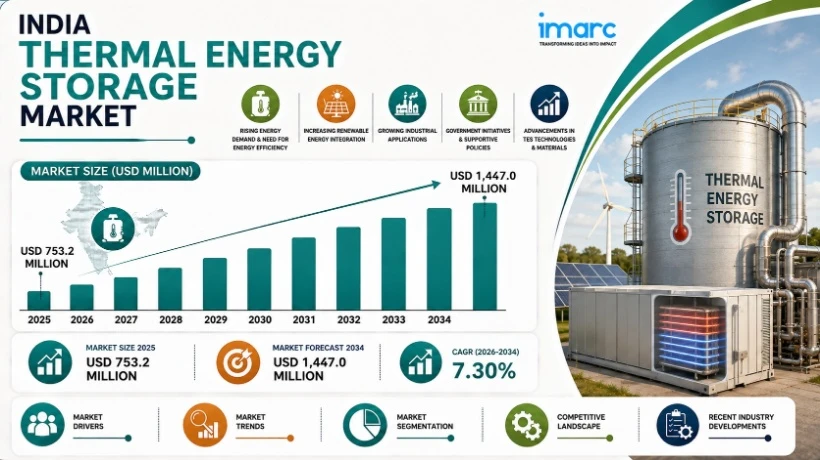
The India thermal energy storage market reached USD 753.2 Million in 2025 and is projected to reach USD 1,447.0 Million by 2034, growing at a CAGR of 7.30% during 2026-2034.
India Thermal Energy Storage Market: Outlook
The report titled "India Thermal Energy Storage Market Size, Share, Trends and Forecast by Storage Type, Application, and Region, 2026–2034" provides a comprehensive analysis of the Indian market, covering its size, growth trends, key drivers, regional insights, and other critical metrics defining the domestic grid stability and industrial thermal management ecosystem.
How Big is the India Thermal Energy Storage Market?
The India thermal energy storage market size reached USD 753.2 Million in 2025. Looking forward, IMARC Group expects the market to reach USD 1,447.0 Million by 2034, exhibiting a steady compound annual growth rate (CAGR) of 7.30% during the 2026–2034 forecast period. The market is undergoing a structural transformation, driven by the massive expansion of variable renewable energy, government mandates for dispatchable grid-scale storage, and urgent industrial decarbonization requirements.
Emerging Trends in the India Thermal Energy Storage Market:
- Molten Salt Storage Scaling in Concentrated Solar Power (CSP): To achieve true baseload renewable power, molten salt thermal storage is advancing rapidly within India’s CSP development pipeline. Projects in high-DNI (Direct Normal Irradiance) regions of Rajasthan are integrating massive dual-tank molten salt systems, enabling 6 to 12 hours of dispatchable solar power after sunset to directly address evening peak electricity demand.
- Solar-Integrated Process Heat for Industrial Decarbonization: Heavy industries are shifting from fossil fuels to hybrid thermal storage. Solar process heat integrated with thermal storage is emerging as a highly scalable decarbonization pathway for temperature-moderate industrial processes. Parabolic trough systems combined with thermal oil storage enable continuous heat supply to food processing, textile dyeing, and dairy operations, fundamentally displacing diesel and LPG consumption.
- Phase Change Material (PCM) Adoption in Building Envelopes: The commercial real estate and cold-chain logistics sectors are aggressively adopting PCM-based latent heat storage. As technology costs decline, PCM integration into building envelopes and district cooling systems is enabling significant peak load reduction and shaving HVAC energy consumption, aligning directly with India's urban energy efficiency goals.
- Smart TES Control and AI-Driven Optimization Platforms: Thermal storage is no longer passive. Artificial intelligence and IoT-enabled control platforms are transforming operation through predictive dispatch optimization, maintenance scheduling, and real-time grid signal response. These digital twins improve the round-trip efficiency of installations, creating lucrative new Software-as-a-Service (SaaS) business models for technology suppliers.
- Thermochemical Heat Storage Commercialization: While sensible heat dominates the market, thermochemical storage is transitioning from R&D to commercial pilot phases. Boasting the highest energy density and near-zero heat loss over long durations, this technology is being fast-tracked to provide seasonal storage capabilities for deep-industrial heating applications.
Request a Sample Copy of this Report: https://www.imarcgroup.com/india-thermal-energy-storage-market/requestsample
Growth Factors Driving the India Thermal Energy Storage Market:
- Grid Intermittency Challenges Exceeding 200 GW: India’s installed renewable energy capacity has crossed the critical 200 GW threshold. This massive influx of variable solar and wind power creates severe grid instability and curtailment issues, driving an absolute, urgent necessity for long-duration thermal storage integration to balance the transmission network.
- Mandates for Firm and Dispatchable Renewable Energy (FDRE): Federal tenders issued by the Solar Energy Corporation of India (SECI) now heavily favor "Round-the-Clock" (RTC) and FDRE power purchase agreements. Thermal Energy Storage (TES) integrated with CSP acts almost identically to conventional thermal plants, allowing independent power producers to meet strict dispatchability criteria and secure premium tariffs without relying on expensive lithium-ion batteries.
- Petrochemical and Manufacturing Energy Demand: The explosive industrial growth in West India (specifically Gujarat and Maharashtra) requires massive amounts of process heat. The volatility of global natural gas prices forces these petrochemical and manufacturing clusters to adopt waste heat recovery and thermal storage tanks to ensure energy security and lower operational overheads.
- Smart City District Cooling Infrastructure Investments: Under the national Smart Cities Mission, Tier-1 urban centers are heavily investing in centralized District Heating and Cooling networks. Chilled water and ice-slurry thermal storage tanks are being integrated into these grids to shift the massive cooling loads of commercial IT parks to off-peak nighttime hours, slashing peak demand charges.
- Agricultural Cold Chain Deficits in North India: North India faces a chronic shortage of reliable cold-chain infrastructure for perishable agricultural produce. The deployment of decentralized, off-grid PCM thermal storage systems for rural cold storage acts as a massive growth vector, preventing food spoilage in regions plagued by erratic rural power supply.
How will the India Thermal Energy Storage Market Evolve in the Coming Years?
The India thermal energy storage market is positioned for robust, highly strategic expansion through 2034. It is rapidly transitioning from niche industrial waste-heat applications into a critical pillar of national grid modernization and heavy-industry decarbonization.
The market size stood at USD 753.2 Million in 2025 and is projected to reach an impressive USD 1,447.0 Million by 2034, compounding at 7.30% annually. While established sensible heat storage (like molten salt and water tanks) will maintain absolute volumetric dominance, the accelerated commercialization of Phase Change Materials (PCM) for district cooling and AI-driven predictive dispatch software will command the highest growth rates, securing substantial project margins for integrated EPCs.
Explore the Full Report with Charts, Table of Contents, and List of Figures: https://www.imarcgroup.com/india-thermal-energy-storage-market
Deep-Dive Segment Insights:
- By Storage Type: The market spans Sensible Heat Storage, Latent Heat Storage, and Thermochemical Heat Storage. Sensible Heat Storage leads the market with a 52.8% share in 2025, anchored by its proven scalability in massive molten salt CSP systems and pressurized hot water tanks. However, Thermochemical Heat Storage represents the fastest-growing segment (at 15.6%), driven by its unparalleled energy density advantages for ultra-long-duration storage.
- By Application: Covered across Power Generation, Process Heating and Cooling, and District Heating and Cooling. Power Generation acts as the definitive market leader, holding a 46.8% share in 2025. This dominance reflects India's critical strategic priority to deploy dispatchable renewable energy (via CSP and thermal ancillary services) to stabilize the national grid. District Heating and Cooling (21.5%) is surging rapidly due to massive urban energy efficiency requirements.
- By Region: Geographically mapped across North India, South India, East India, and West India. West India captures the absolute largest regional share at 34.8% in 2025. This supremacy is heavily fueled by Rajasthan's exceptional solar resources (enabling massive CSP molten salt deployment) and Gujarat's dense petrochemical clusters generating significant process heat storage demand.
Competitive Landscape & Key Company Insights:
The Indian thermal energy storage market exhibits a moderately concentrated landscape, characterized by a virtual duopoly in large-scale government-tendered projects, complemented by specialized global technology providers entering through joint ventures.
Key organized industry participants actively shaping the competitive environment include Bharat Heavy Electricals Limited (BHEL), Thermax Ltd., and Emerson Electric Co.
To secure and defend market share, domestic heavyweights like BHEL leverage their integrated manufacturing capabilities and deep access to government utility tenders to dominate the utility-scale molten salt and thermal power ancillary segments. Conversely, Thermax commands the industrial sector by providing comprehensive waste heat recovery and solar process heat storage solutions to manufacturing clients. Global instrumentation giants like Emerson act as critical enablers, providing the advanced measurement and AI control platforms necessary to optimize round-trip efficiency in these massive thermal installations.
Latest Recent Developments in the India Thermal Energy Storage Market:
- NTPC's Massive Renewable and Storage Capacity Expansion: Solidifying the demand for long-duration storage, NTPC (India's largest power utility) recorded its highest-ever annual capacity addition of approximately 9.6 GW in FY 2025–26, which included 5.5 GW of green energy. To balance this massive influx of variable renewables and hit its 60 GW green target by 2032, NTPC is actively prioritizing the deployment of long-duration storage systems, including pumped storage and thermal integration, to ensure grid security.
- Surge in Standalone and Hybrid Storage Tenders: Throughout late 2025 and 2026, state and federal bodies (like SECI and regional DISCOMs in Rajasthan and Gujarat) released a flurry of massive competitive bidding tenders for Round-the-Clock (RTC) and standalone energy storage systems. While many tenders focus on BESS (Battery Energy Storage Systems), the stringent requirement for 4-to-6 hour continuous dispatchability is increasingly driving Independent Power Producers (IPPs) to evaluate Molten Salt CSP and thermal storage as the most economically viable solution for long-duration bulk power shifting.
- Scale-Up of Decentralized PCM Cold Storage: Addressing critical agricultural losses in North India, the market saw a massive scale-up in the deployment of off-grid, Phase Change Material (PCM) based thermal storage units. Subsidized by state agricultural boards, these decentralized units utilize solar power during the day to freeze PCM panels, ensuring continuous 24-hour cooling for perishable crops without relying on erratic rural electrical grids or expensive diesel generators.
Customization Note: If you require any specific information not covered within this report’s scope, we will provide it as part of the customization.
Request Report Customization: https://www.imarcgroup.com/request?type=report&id=30779&flag=E
Frequently Asked Questions (FAQs)
Q1. What is the current size of the India thermal energy storage market?
The India thermal energy storage market reached USD 753.2 Million in 2025.
Q2. What is the projected market size by 2034 and the CAGR from 2026 to 2034?
The market is projected to reach USD 1,447.0 Million by 2034, expanding at a steady compound annual growth rate (CAGR) of 7.30% during the 2026–2034 forecast period.
Q3. Which storage type holds the dominant market share in India?
Sensible Heat Storage commands the absolute largest share (52.8% in 2025), heavily driven by its proven scalability and integration into massive molten salt CSP projects and industrial pressurized water tanks.
Q4. Which application sector commands the highest demand?
Power Generation leads procurement (46.8% share in 2025), fueled by India's urgent necessity to deploy dispatchable renewable energy to balance a grid that has surpassed 200 GW of variable solar and wind capacity.
Q5. Which region leads the thermal energy storage market in India?
West India acts as the definitive market leader (commanding a 34.8% share in 2025), heavily anchored by Rajasthan’s exceptional solar irradiance for CSP deployment and Gujarat’s massive industrial process heat requirements.


Comments
Login to Comment