Why Robotic Process Automation Is Becoming Essential for Modern Businesses
17 Sep, 2026
11 Views 0 Like(s)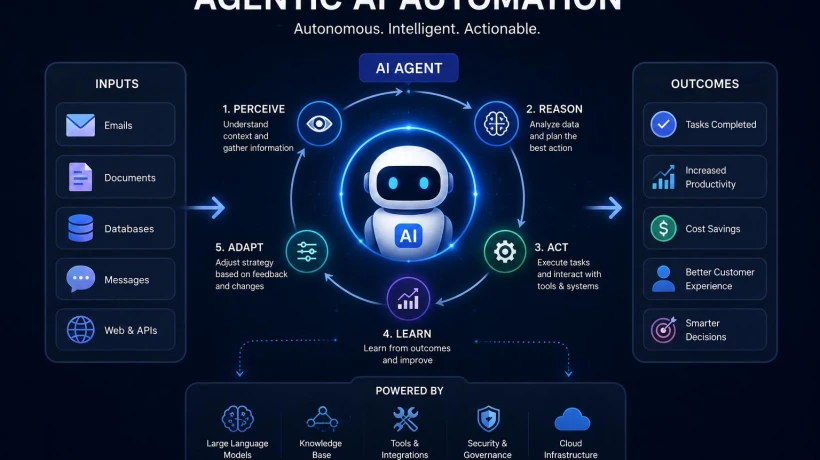
Discover why Robotic Process Automation is essential for modern businesses, helping streamline workflows, reduce manual tasks, improve accuracy, and boost productivity.
Walk into almost any office today and you'll hear the same complaint from employees, whether they work in finance, HR, or customer support: too much time gets swallowed up by repetitive, mind-numbing tasks. Copying data from one system to another. Reconciling spreadsheets. Sending the same status update email for the hundredth time. It's not that people can't do this work — it's that machines can do it faster, cheaper, and without ever getting tired or making a typo at 4:45 on a Friday.
That's the simple idea behind Robotic Process Automation, and it's a big reason why businesses of every size are rethinking how their teams spend their time. What started as a niche back-office tool a decade ago has turned into one of the fastest-growing categories in enterprise software, and it's not slowing down.
What Robotic Process Automation Actually Means
Robotic Process Automation (most people just say RPA) refers to software "bots" that mimic the way a human interacts with digital systems. They click buttons, fill out forms, extract data from PDFs, move files between folders, and pass information between applications that were never designed to talk to each other. No physical robots involved — just software that follows a defined set of rules to complete a task the same way a person would, minus the coffee breaks.
The appeal is obvious once you see it in action. A bot doesn't need a login reminder. It doesn't take sick days. It processes an invoice in seconds instead of minutes, and it does it exactly the same way every single time, which means fewer errors and a lot less rework. For companies drowning in manual, repetitive processes — payroll, invoice matching, claims processing, onboarding paperwork — this kind of automation isn't a nice-to-have anymore. It's becoming table stakes.
Why This Matters More Now Than Ever
A few years ago, automation was something only large enterprises with big IT budgets could afford to explore. That's changed. Cloud-based platforms have made automation dramatically cheaper to deploy, and the return on investment shows up fast — often within months rather than years.
There's also a labor angle that doesn't get talked about enough. Hiring and retaining people for high-volume, low-skill administrative work has gotten harder, and turnover in those roles tends to be high because, frankly, the work is boring. When a business automates the repetitive parts of a job, it frees up employees to focus on the parts that actually require judgment, creativity, or a human touch — customer relationships, problem-solving, decision-making. That shift tends to improve job satisfaction, not threaten it, which is the opposite of what a lot of people assume when they first hear about automation.
Then there's accuracy and compliance. In regulated industries like banking, insurance, and healthcare, a single data-entry mistake can trigger a compliance headache or a costly audit finding. Bots don't get distracted mid-task. They follow the process exactly as configured, and they leave a clean audit trail behind them — something regulators genuinely appreciate.
The Role of an RPA Tool in Making This Practical
None of this works without the right software underneath it, which is where an RPA tool comes in. These platforms give business users — not just developers — the ability to design, test, and deploy bots using visual workflows instead of raw code. You drag steps into a sequence, tell the bot which application to open, which fields to fill, and what conditions should trigger which action, and the platform handles the rest.
The best RPA tool options today also include features like process discovery (which analyzes how employees actually work to identify automation candidates), centralized bot management dashboards, and built-in analytics so teams can see exactly how much time and money a given automation is saving. That visibility matters — it's a lot easier to get budget approved for the next automation project when you can point to hard numbers from the last one.
Among the platforms leading this space, RPA UiPath has become one of the most recognized names, and for good reason. UiPath built its reputation on a relatively easy learning curve combined with enterprise-grade scalability, which is a hard balance to strike. Small teams can start automating a single process with a free or low-cost license, while large enterprises can run thousands of bots across departments with centralized governance and security controls.
What makes RPA UiPath particularly interesting right now is how the platform has evolved beyond simple task automation. It now incorporates document understanding (so bots can read and interpret unstructured documents like invoices or contracts), process mining tools, and increasingly, AI-driven decision-making capabilities layered on top of the traditional rule-based bots. That evolution reflects a broader shift happening across the entire automation industry.
From Rule-Following Bots to Agentic AI Automation
Traditional RPA is powerful, but it has a well-known limitation: it's rigid. A bot built to follow a specific sequence of steps will break the moment something unexpected happens — a website layout changes, a form field moves, or a document arrives in a format the bot wasn't trained to recognize. It has no ability to reason through the exception; it just stops and waits for a human to fix it.
This is exactly the gap that Agentic AI Automation is starting to close. Instead of bots that blindly follow instructions, agentic systems can actually reason about a goal, break it into steps, make decisions along the way, and adapt when something doesn't go according to plan. Think of the difference between a GPS that recalculates your route the instant you miss a turn, versus a set of paper directions that become useless the second you make a wrong turn.
Agentic AI Automation combines the structured reliability of traditional RPA with the flexibility of large language models and decision-making algorithms. Instead of just executing a fixed script, an AI agent can read an email, understand its intent, decide which system to check, pull the relevant data, and determine the appropriate next action — all without a human mapping out every possible branch in advance. It's a meaningful leap from "automate this exact task" to "handle this general kind of problem."
This matters for businesses because so much real-world work isn't perfectly predictable. Customer inquiries come in every possible phrasing. Invoices arrive in inconsistent formats. Approval workflows have edge cases nobody thought to document. Agentic systems are built to handle that messiness in a way that rigid, rule-based bots simply can't.
Vendors across the industry, UiPath included, are racing to build agentic capabilities directly into their platforms, often blending traditional bots with AI agents so that the reliable parts of a process stay rule-based and predictable, while the judgment-heavy parts get handled by an intelligent agent. That combination — sometimes called a "hybrid" automation model — is quickly becoming the standard architecture that forward-thinking automation teams are designing around.
Where This Is Making the Biggest Difference
A few industries have moved especially fast with automation, and looking at them gives a good sense of where the broader trend is headed.
Financial services was an early adopter, using bots to handle account reconciliation, fraud checks, and regulatory reporting — areas where accuracy and auditability are non-negotiable. Healthcare organizations use automation for insurance claims processing, patient scheduling, and billing, freeing clinical staff to focus on patient care instead of paperwork. Retail and logistics companies lean on automation for inventory tracking, order processing, and supply chain coordination, particularly during high-volume periods like holiday shopping seasons. Even smaller businesses are getting in on this now, using lightweight automation to handle invoicing, customer follow-ups, and data entry without needing to hire additional administrative staff.
What ties all of these together is a simple pattern: wherever there's a high volume of repetitive, rules-based work, there's an opportunity for automation to save time and reduce errors — and increasingly, wherever there's a need for judgment and adaptability layered on top of that repetitive work, agentic systems are stepping in to fill the gap.
Getting Started Without Overcomplicating It
Businesses that see the most success with automation tend to start small. Rather than trying to automate an entire department on day one, they pick a single, well-defined process — something high-volume, rule-based, and painful enough that fixing it delivers a visible win. Invoice processing, data migration between two systems, or routine report generation are common starting points because they're contained, measurable, and low-risk.
From there, the pattern usually looks like this: map out exactly how the process works today, identify where the current bottlenecks and errors happen, build and test a bot using a chosen platform, and run it alongside the existing manual process for a short pilot period before fully switching over. It's tempting to move fast, but a rushed automation built on a poorly understood process will just make mistakes faster than a human would. Getting the process mapping right up front pays off later.
It's also worth being honest about what automation won't fix. If an underlying process is broken or poorly designed, automating it just means you get the wrong outcome faster. The most successful automation initiatives usually involve a bit of process redesign before any bot gets built.
Looking Ahead
The direction of travel here is pretty clear. Automation is moving from narrow, task-specific bots toward broader, more intelligent systems capable of handling ambiguity and making decisions — not replacing every human judgment call, but taking on far more of the routine cognitive load than rule-based bots ever could. Businesses that treat automation as a one-time project tend to fall behind; the ones that treat it as an ongoing capability, continuously finding new processes to streamline, are the ones seeing compounding returns.
For any business still relying entirely on manual processes for repetitive administrative work, the case for change keeps getting stronger. The tools are more accessible than they used to be, the learning curve has flattened, and the combination of dependable rule-based automation with more adaptive, intelligent agents means there's now a practical starting point for almost any kind of repetitive work, no matter how big or small the business is.
The businesses that get ahead of this shift now — rather than waiting until competitors have already automated the boring stuff — are the ones that will have more time, more accuracy, and more room to focus on the work that actually needs a human mind behind it.



Comments
Login to Comment