India Industrial Robotics Market Size, Growth Opportunities, Demand Analysis and Industry Forecast 2026–2034
17 Sep, 2026
5 Views 0 Like(s)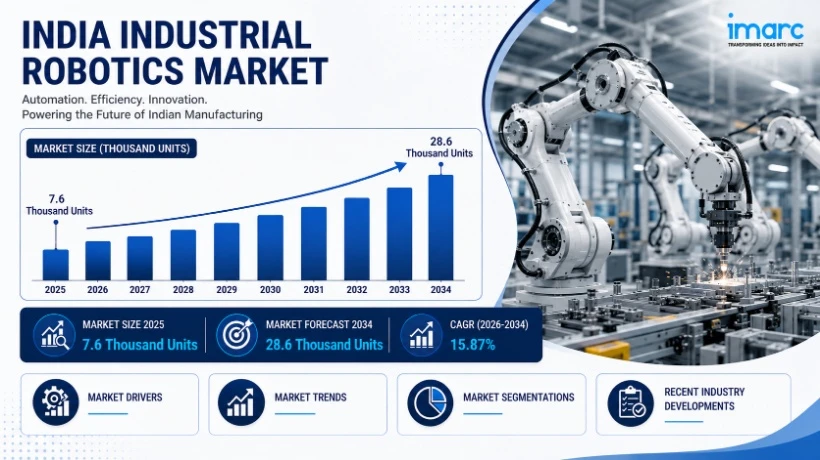
India industrial robotics market size reached 7.6 Thousand Units in 2025. Looking forward, IMARC Group expects the market to reach 28.6 Thousand Units by 2034, exhibiting a growth rate (CAGR) of 15.87% during 2026-2034.
India Industrial Robotics Market: Industry Report 2026–2034
The India industrial robotics industry size reached 7.6 Thousand Units in 2025 and is projected to reach 28.6 Thousand Units by 2034, exhibiting a compound annual growth rate (CAGR of 15.87%) during the 2026–2034 forecast period. The industry is accelerating rapidly as manufacturers adopt automation to improve precision, productivity, and consistency. Driven by Industry 4.0 initiatives, rising labor costs, expanding automotive and electronics production, and government support for manufacturing competitiveness, industrial robots are becoming a strategic necessity rather than an optional investment across key industrial sectors.
What Is the Size and Growth Forecast of the India Industrial Robotics Market?
The market is exhibiting highly resilient, continuous expansion, fundamentally anchored by the need for higher productivity, consistent quality, and reduced dependence on manual labor in manufacturing operations.
- Market Size in 2025: 7.6 Thousand Units.
- Market Forecast in 2034: 28.6 Thousand Units.
- Compound Annual Growth Rate (CAGR): 15.87% during the 2026–2034 forecast period.
- Underpinning Momentum: Rapid industrial expansion under Make in India and PLI schemes, rising adoption of smart manufacturing, increasing demand for precision in automotive and electronics, and growing acceptance of collaborative and articulated robots ensure strong volume growth across multiple end-use industries.
What Are the Latest Emerging Trends in the India Industrial Robotics Market?
- Rising Adoption of Collaborative Robots: Manufacturers are increasingly deploying collaborative robots that work safely alongside human operators. These systems offer flexibility for small-batch production, easier programming, and lower integration costs, making automation accessible even to mid-sized factories seeking incremental productivity gains.
- Integration of AI and Vision Systems: Advanced robots now incorporate artificial intelligence and machine vision for real-time decision making, quality inspection, and adaptive handling. This enhances accuracy in complex tasks such as assembly, welding, and material sorting across diverse production environments.
- Localization of Manufacturing and Components: Domestic assembly and component development are gaining momentum to reduce import dependence and costs. Local production of actuators, sensors, and complete systems is expected to improve affordability and after-sales support for Indian industrial users.
- Expansion Beyond Automotive into New Sectors: While automotive remains a core user, robotics adoption is accelerating in electronics, pharmaceuticals, food processing, and metals. Multi-industry demand is broadening the installed base and supporting higher annual installation volumes.
- Focus on Flexible and Modular Automation: Companies prefer modular robotic cells that can be reconfigured for different products. This flexibility supports mixed-model production and helps manufacturers respond quickly to changing market requirements without large-scale line redesigns.
Request a Sample Copy of this Report: https://www.imarcgroup.com/india-industrial-robotics-market/requestsample
What Growth Factors Are Driving the India Industrial Robotics Market?
- Strong Push from Automotive and Electronics Manufacturing: High-volume automotive production and expanding electronics assembly under PLI schemes require precise, repeatable automation. Robots deliver consistent quality and throughput needed for competitive global supply chains.
- Rising Labor Costs and Skill Shortages: Increasing wages and difficulty in finding skilled workers for repetitive or hazardous tasks make robotic solutions economically attractive. Automation helps maintain output while reducing long-term operational risks and variability.
- Government Support for Manufacturing Competitiveness: Initiatives promoting Industry 4.0, smart factories, and domestic manufacturing encourage capital investment in robotics. Policy support and incentives improve the business case for automation across industrial clusters.
- Demand for Higher Quality and Consistency: Global customers and export markets demand tighter tolerances and lower defect rates. Industrial robots provide the precision and process control required to meet these quality standards reliably.
- Growth of MSME Automation Interest: Smaller manufacturers are beginning to adopt entry-level and collaborative robots. Improved affordability, simpler interfaces, and demonstration projects are lowering barriers to first-time automation investments.
What Are the Key Challenges Facing the India Industrial Robotics Market?
- High Initial Capital Investment: Advanced robotic systems and integration costs remain significant for many companies, especially smaller firms. The payback period can deter adoption despite long-term productivity benefits.
- Shortage of Skilled Integration and Maintenance Talent: Limited availability of engineers trained in robot programming, system integration, and maintenance slows deployment and increases reliance on external service providers.
- Complex Integration with Existing Production Lines: Retrofitting robots into older factories often requires extensive line modifications, process redesign, and temporary production disruption, raising project complexity and cost.
- Perception of Job Displacement: Concerns about workforce impact can create internal resistance. Successful projects require careful change management and clear communication about productivity and new skill opportunities.
Explore the Full Report with Charts, Table of Contents, and List of Figures: https://www.imarcgroup.com/india-industrial-robotics-market
Deep-Dive Segment Insights
The market is meticulously segmented to address diverse application needs, robot configurations, and industry requirements.
By Type
- Articulated Robots, Cartesian Robots, SCARA Robots, Cylindrical Robots, Parallel Robots, and Others: Articulated robots dominate due to their flexibility and wide range of motion for welding, assembly, and material handling tasks across major manufacturing sectors.
By Function
- Soldering and Welding, Materials Handling, Assembling and Disassembling, Painting and Dispensing, Milling, Cutting and Processing, and Others: Welding and materials handling remain core high-volume applications, while assembly and precision processing are expanding rapidly with electronics and automotive growth.
By End Use Industry
- Automotive, Electrical and Electronics, Chemical, Rubber, and Plastics, Machinery and Metals, Food and Beverages, Precision and Optics, Pharmaceutical, and Others: Automotive continues to lead installations, with electrical and electronics emerging as a high-growth segment driven by domestic manufacturing expansion.
By Region
- North India, West and Central India, South India, and East and Northeast India: West and South India currently show stronger adoption due to concentrated automotive, electronics, and industrial clusters, while other regions are gradually increasing deployments.
Competitive Landscape & Key Player Positioning
The market research report has also provided a comprehensive analysis of the competitive landscape in the market. Competitive analysis such as market structure, key player positioning, top winning strategies, competitive dashboard, and company evaluation quadrant has been covered in the report.
Recent Developments
- 2026: Indian robotics startups raised significant early-stage funding, with combined seed rounds exceeding previous years, supporting development of cost-effective industrial and humanoid solutions for manufacturing applications.
- 2025–2026: Global robot manufacturers and domestic integrators expanded local presence and partnerships to support rising demand from automotive, electronics, and general industry customers.
- Ongoing: Focus on indigenous component development and local assembly is increasing to reduce costs and improve service responsiveness for industrial robot users across India.
- Policy Support: Government programs and innovation challenges continue to encourage hardware localization and prototype development, strengthening the domestic robotics ecosystem.
- Market Momentum: Annual industrial robot installations remain on a strong upward trajectory, positioning India among the faster-growing markets globally for factory automation.
Customization Note: If you require any specific information not covered within this report’s scope, we will provide it as part of the customization.
Request Report Customization: https://www.imarcgroup.com/request?type=report&id=21380&flag=E
Frequently Asked Questions (FAQs)
Q1. What is the current size of the India industrial robotics market?
The India industrial robotics market size reached 7.6 Thousand Units in 2025.
Q2. What is the projected market size by 2034 and the growth rate?
The market is projected to reach 28.6 Thousand Units by 2034, exhibiting a robust compound annual growth rate (CAGR of 15.87%) during the 2026–2034 forecast period.
Q3. Which robot types are covered in the market?
The market is segmented into articulated robots, cartesian robots, SCARA robots, cylindrical robots, parallel robots, and others, with articulated robots widely used for their versatility.
Q4. Which end-use industries drive demand?
Key end-use industries include automotive, electrical and electronics, chemical, rubber and plastics, machinery and metals, food and beverages, precision and optics, pharmaceutical, and others.
Q5. Which regions are analyzed in the report?
The market is analyzed across North India, West and Central India, South India, and East and Northeast India.


Comments
Login to Comment