How AI-Powered Banking CRM Analytics Improve Customer Retention and Reduce Churn
22 Oct, 2026
9 Views 0 Like(s)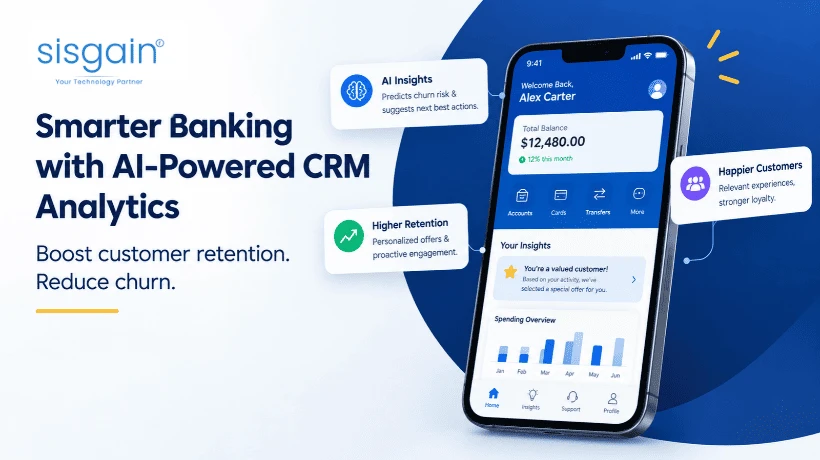
See how AI-powered banking CRM analytics predicts churn, lifts retention, and fits UAE compliance. Scope your project with SISGAIN, Dubai.
Key Takeaways
-
AI-powered banking CRM analytics flag at-risk customers before they close accounts, not after.
-
Banking churn averages 15-20% a year, so small retention gains compound fast.
-
Predictions only pay off when they trigger action inside your CRM: calls, offers, alerts.
-
UAE banks must design for PDPL, CBUAE guidance, and data residency from day one.
-
Scoping data, integrations, and compliance first is cheaper than rebuilding later.
Your Best Customers Leave Quietly
Your highest-value customer rarely complains before leaving. They stop using the card, move their salary elsewhere, and close the account on a Tuesday. Your relationship manager is the last to know.
AI-powered banking CRM analytics closes that gap. If you lead retail banking, digital transformation, or IT at a bank in Dubai or the wider UAE, and you need to understand this capability before scoping a project, this guide explains how it works, what it needs, and what to decide first. It also sits alongside the mobile banking app development services most banks are investing in, because retention is won across every channel, not only inside the CRM.
What Is AI-Powered Banking CRM Analytics?
AI-powered banking CRM analytics combines customer data, machine learning, and CRM workflows to predict who is likely to leave, why, and which action will keep them. A standard CRM records what happened. An AI layer estimates what happens next and pushes the next step to your team.
Models read transactions, product usage, service interactions, and payment behavior, then assign each customer a churn-risk score. Vendors report accuracy of roughly 85-95% for well-trained models, though results depend on data quality and should be validated on your own customer base.
Why Churn Costs UAE Banks More Than They Measure
Industry benchmarks put average banking churn at 15-20% annually. Replacing a lost customer is widely cited as costing 5 to 25 times more than keeping one, and trimming churn by 5% is often quoted as lifting profit by up to 95%. Treat these as directional, not guarantees.
The UAE adds pressure. Customers switch easily between traditional and digital banks, expectations are high, and dissatisfaction surfaces quickly on public channels. Analysts now describe churn in UAE retail banking as a survival issue. Competition from agile players, covered in our fintech companies 2026 growth guide, makes this harder to ignore.
|
Capability |
Traditional banking CRM |
AI-powered banking CRM analytics |
|
Churn detection |
After a complaint or closure |
Before disengagement becomes an exit |
|
Segmentation |
Static (age, balance, product) |
Dynamic, behavior-based |
|
Offers |
Batch campaigns |
Next-best-action, near real-time |
|
Service |
Reactive tickets |
Proactive outreach and alerts |
|
Reporting |
Monthly dashboards |
Live dashboards showing churn drivers |
5 Ways AI-Powered CRM for Banks Reduces Churn

1. Churn prediction scoring. Companies using machine-learning prediction report 15-25% lower attrition than rule-based approaches, according to Gartner figures cited by StealthAgents. A 2025 journal study at a retail bank paired a model with CRM automation and reported a 73.68% success rate for proactive interventions in an A/B test. This is where customer churn prediction for banks stops being theory.
2. Next-best-action personalization. Research from early 2026 points to revenue uplifts of up to 6% for institutions that have operationalized AI personalization. Offers match life events and behavior, not broad segments.
3. Complaint and sentiment analytics. Feedback, call notes, and complaints are early-warning signals. Scoring them alongside transactions shows which unhappy customers are also high value.
4. A single 360-degree customer view. Dubai Islamic Bank moved from worksheets, emails, and partial in-house tools to a banking CRM with shared lead pools and a unified front end. Models are only as good as the data they see. Most banking AI projects stall because data stays siloed, which is why dependable CRM integration services in the UAE matter as much as the model.
5. Automated retention workflows. A risk flag should create a task, a call, or a WhatsApp message automatically, since WhatsApp is the dominant channel in the region. A churn model that cannot push at-risk customers into outreach adds work instead of removing it.
For a wider playbook beyond analytics, read these banking CRM strategies built for Dubai banks.
The practical gain is speed and focus. Instead of reviewing thousands of accounts by hand, relationship managers open a ranked list each morning: who is slipping, what changed, and what to offer. Branches, call centers, and digital teams then work from the same signal, so a customer is not contacted three times with three different messages. That consistency is what turns analytics into trust.
Compliance Comes First: PDPL, CBUAE, and Data Residency
Any bank deploying bank customer retention solutions on AI must treat compliance as architecture, not paperwork.
-
PDPL (Federal Decree-Law 45/2021) governs how personal data is collected, used, and transferred. Data used in AI systems must be legitimate, proportionate, and accurate.
-
CBUAE guidance covers AI use by licensed financial institutions, with published expectations on governance and data security from February 2026.
-
DIFC and ADGM operate their own data regimes, so a group with free-zone entities needs a mapped approach.
-
Data residency means asking where model inference happens, not only where data is stored. Calling a model hosted abroad can count as a cross-border transfer. Hyperscaler regions in the UAE exist, but confirm residency terms with your legal team.
Plan the same discipline for connected core, finance, and risk platforms. Teams that also run ERP software development services alongside the CRM avoid duplicate customer records and reconciliation gaps.
What to Scope Before You Build
Most delays come from unanswered questions, not weak technology. Use this checklist in your first workshop.
|
Scoping area |
Question to answer |
Why it matters |
|
Data sources |
Where do transactions, service logs, and digital behavior live? |
Model quality depends on complete data. |
|
Integration |
Which core, call center, WhatsApp, and app systems must connect? |
Predictions must trigger action. |
|
Compliance |
Where is data hosted and processed? Who audits the model? |
PDPL and CBUAE alignment |
|
First use case |
Churn, cross-sell, or complaint handling? |
One measurable win builds support |
|
Success metrics |
Which retention KPIs will you track? |
Proves ROI to leadership |
Track customer retention rate, churn rate, and customer lifetime value from day one. If retention nudges must reach customers inside your app, work with a mobile app development company that can ship the app and CRM as one experience. Our digital banking software development 2026 guide covers the wider platform picture.
Choosing Banking CRM Software in the UAE
You have two paths. Packaged platforms such as Salesforce Financial Services Cloud or Microsoft Dynamics 365 give speed and ecosystem. A custom build gives control over data flows, residency, and workflows unique to your products. Many banks combine both: a packaged core with custom analytics and integrations.
Whichever route fits, evaluate banking CRM software in the UAE on five points: native analytics, open APIs, audit trails, in-country hosting options, and the vendor's banking delivery record. A custom CRM development company in the UAE should show how it handles integration and compliance, not just screens.
Start With a Scoping Conversation
SISGAIN helps banks and financial institutions across Dubai and the UAE turn this capability into a clear scope: data audit, integration map, compliance checkpoints, and a prioritized first use case. If you want a realistic view of effort and outcomes before committing to a budget, book a free scoping consultation with SISGAIN and bring your hardest retention question.

Frequently Asked Questions
1. What is CRM in banking?
Banking CRM centralizes customer data, interactions, and sales activity in one system. It helps teams personalize service and track every relationship.
2. How does AI reduce customer churn in banks?
AI scores each customer's exit risk from behavior and triggers retention actions. Teams act earlier, with offers that fit.
3. What is a good churn rate for a bank?
Benchmarks average 15-20% a year, and lower is better. Compare against your own segments and products.
4. How accurate are churn prediction models?
Vendors report 85-95% for trained models. Validate your own data before relying on it.
5. What data does a churn model need?
Transactions, product holdings, service interactions, digital usage, and complaints. Behavioural data beats static demographics.
6. Can AI CRM integrate with our core banking system?
Yes, through APIs and middleware, though legacy cores may need adapters. Integration scope should be fixed during discovery.
7. Is AI-powered CRM compliant with UAE PDPL and CBUAE rules?
It can be if hosting, consent, explainability, and audit controls are designed in. Confirm specifics with legal counsel.
8. Which CRM is best for banks in the UAE?
It depends on size, systems, and residency needs. Compare packaged platforms with a custom build.
9. Custom or off-the-shelf banking CRM?
Off-the-shelf is faster to launch. Custom suits complex integrations, residency demands, and unique products.
10. Which KPIs measure retention success?
Customer retention rate, churn rate, and customer lifetime value. Add complaint resolution time and product-per-customer ratio.


Comments
Login to Comment