Gravure Cylinder Engraver for Precision Cylinder Manufacturing
18 Sep, 2026
5 Views 0 Like(s)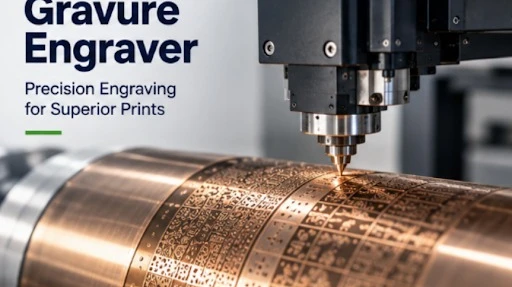
Explore Anchor India Automations' electromechanical gravure engraving systems designed for precise cell formation and repeatable gravure cylinder manufacturing.
Gravure Cylinder Engraver for Precision Cylinder Manufacturing
Gravure printing is used in a range of industrial printing applications, including flexible packaging, decorative materials, transfer printing, and other processes that require detailed image reproduction. A gravure printing cylinder contains a pattern of small engraved cells that hold and transfer ink to the printing substrate.
The geometry, depth, and consistency of these cells influence how ink is transferred during printing. For this reason, cylinder engraving is an important stage in gravure cylinder manufacturing, requiring equipment capable of producing controlled and repeatable engraving patterns.
Anchor India Automations provides electromechanical gravure engraving systems designed to cut cell geometry directly into the copper layer of gravure cylinders. The equipment combines an engraving head with servo-controlled mechanical transmission to support precision and repeatability during cylinder engraving.
Understanding Gravure Cylinder Engraving
Gravure printing works by transferring ink from engraved cells on a cylinder onto a substrate. The cylinder surface is prepared with a suitable metallic layer, and the required image pattern is engraved into that surface.
During printing, the engraved cells carry ink, while the surrounding surface is managed through the inking and doctor blade process. The size, shape, and distribution of the cells contribute to the amount of ink transferred and the appearance of the printed image.
Gravure engraving equipment must therefore maintain appropriate mechanical movement and engraving control to produce the intended cell pattern.
Electromechanical Engraving Technology
Electromechanical gravure engraving uses a controlled engraving mechanism to create cells in the cylinder surface. The engraving head performs the cutting action, while the mechanical system coordinates movement along the cylinder.
Anchor India Automations' gravure engraving system uses a German-made engraving head and full servo-controlled mechanical transmission. These components are designed to support controlled movement and repeatable engraving operations.
Servo-controlled transmission allows the machine's mechanical movements to be coordinated according to the engraving requirements. This is important when producing detailed patterns that require accurate positioning and consistent spacing.
The engraving process must also be configured according to the cylinder specifications, copper surface condition, image requirements, and selected engraving parameters.
Helical and Polar-Line Engraving Modes
Gravure cylinder engraving may involve different engraving modes depending on the image structure and production requirements.
The system supports helical and polar-line engraving modes. These modes provide different approaches to arranging the engraved cells across the cylinder surface.
The selected mode depends on the application, the intended image, and the production workflow. Operators and production teams should select appropriate settings based on the job requirements and the capabilities of the engraving system.
Consistent mechanical movement and controlled engraving parameters are important for maintaining the intended cell arrangement throughout the cylinder.
Applications Across Printing and Decorative Industries
Gravure engraving is used in applications where the cylinder must reproduce detailed images or patterns. These include plastic packaging, decorative printing, trademarks, transfer printing, and embossing-related applications.
In packaging production, engraved cylinders may be used to reproduce graphics, text, and other visual elements on flexible materials. Decorative applications may involve repeating patterns or designs that require consistent image reproduction.
Transfer printing and embossing-related applications can also require carefully prepared cylinders, depending on the production process.
Each application may have different requirements for image detail, cell structure, cylinder dimensions, and surface preparation. Equipment selection should take these factors into account.
Supporting Detail Reproduction and Cell Consistency
Consistency in engraved cell geometry is important for predictable ink transfer. Variations in cell dimensions or spacing can influence the appearance of printed images and may contribute to differences in colour density or image detail.
A precision engraving system is designed to support repeatable mechanical movement and controlled cell formation.
The combination of a dedicated engraving head and servo-controlled transmission can help support the production of engraving patterns according to the selected parameters.
However, final print quality also depends on other factors, including ink characteristics, cylinder preparation, substrate properties, printing conditions, and press setup.
Modernizing Cylinder Manufacturing Workflows
Gravure cylinder manufacturers may evaluate engraving equipment when updating production processes or seeking more consistent mechanical control.
Automated and servo-controlled machinery can support structured production workflows by reducing dependence on manual mechanical adjustments. Repeatable settings can also help operators reproduce established engraving procedures across similar jobs.
The machine should be assessed according to cylinder size, engraving requirements, production volume, workflow compatibility, and the technical support available for operation and maintenance.
Anchor India Automations' Gravure Engraving Systems
Anchor India Automations offers gravure engraving systems for industrial cylinder manufacturing. Its equipment is designed to support direct cell engraving into the copper layer, with a German-made engraving head and servo-controlled mechanical transmission.
Manufacturers researching gravure engraving machinery can review the official product information to understand the system's features and determine whether it meets their technical requirements.
Conclusion
Gravure cylinder engraving is a precision process that influences the structure of the cells used for ink transfer. Controlled mechanical movement, appropriate engraving modes, and repeatable operating parameters are important considerations when selecting engraving equipment.
For manufacturers working with packaging, decorative printing, transfer printing, and related applications, understanding the engraving system's capabilities can help guide equipment evaluation.
Learn more about Anchor India Automations' gravure engraver at https://anchorindiaautomations.com/solutions/gravure-engraver.php
Comments
Login to Comment