Electronic Medical Record Market
27 Oct, 2026
10 Views 0 Like(s)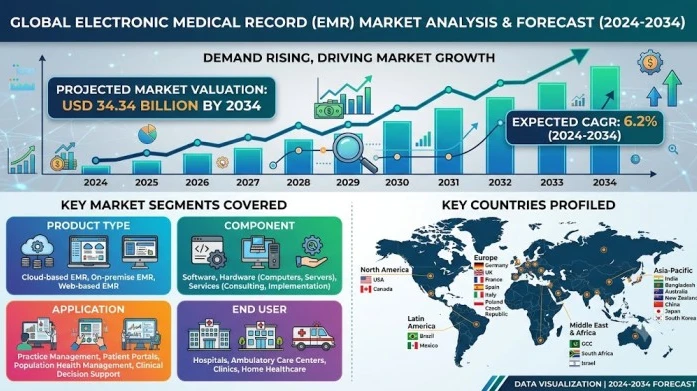
Electronic Medical Record Market to Reach USD 34.34 Billion by 2034 at 6.2% CAGR; China Leads at 9.5%, USA Trails at 4.5%
According to Future Market Insights (FMI), the global electronic medical record (EMR) market is valued at USD 18.82 billion in 2024 and is projected to reach USD 34.34 billion by 2034, expanding at a 6.2% CAGR during the 2024–2034 forecast period. Demand is supported by the digitization of healthcare delivery, the need for efficient patient data management, and efforts to improve clinical workflows and information exchange across care settings. FMI identifies interoperability enhancements, artificial intelligence integration, and cloud-based EMR solutions as important areas shaping future market development.
👉 Get Detailed Market Forecasts, Competitive Benchmarking, and Pricing Trends:
https://www.futuremarketinsights.com/reports/sample/rep-gb-387
Global Segment Leaders
· Product Type — Hospital EMR: 89.4% share in 2024. Hospital EMR systems lead the market because hospitals require comprehensive platforms to manage patient information, support complex clinical workflows, and meet healthcare documentation and regulatory requirements.
· Component — EMR Software: 66.5% share in 2024. EMR software holds the leading component share because it enables healthcare providers to digitize, store, retrieve, and analyze patient information while supporting clinical documentation, interoperability, and decision-making.
FMI also segments the market by application into client-server setup EMR, hybrid-server setup EMR, and cloud-based EMR. End-user categories include hospitals, specialized clinics, general physician clinics, and ambulatory surgical centers. The published report page does not provide the leading share for each of these additional categories.
Country-Level Performance
· China – 9.5% CAGR: Healthcare reform, digital transformation initiatives, and the integration of artificial intelligence and telemedicine are supporting EMR adoption.
· India – 6.8% CAGR: Increasing healthcare digitization, demand for streamlined clinical workflows, and government initiatives supporting digital healthcare infrastructure are contributing to market growth.
· Germany – 5.9% CAGR: Demand for digitized patient records, improved care coordination, and compliance with data-protection requirements is supporting adoption.
· France – 5.2% CAGR: Government initiatives to modernize healthcare delivery and improve information sharing across care settings are encouraging EMR implementation.
· United States – 4.5% CAGR: Established EMR usage, regulatory incentives, electronic prescribing, clinical documentation, and value-based care initiatives continue to support demand.
The country table is sorted from highest to lowest CAGR, using the country-level growth rates published by FMI.
Regional Context
Fast-growing markets: China leads the five profiled countries with a projected CAGR of 9.5%, reflecting healthcare modernization and the increasing use of digital technologies. India follows at 6.8%, supported by demand for affordable and accessible digital healthcare infrastructure. Germany and France are forecast to grow at 5.9% and 5.2%, respectively, as providers focus on care coordination, information exchange, and regulatory compliance.
Mature market: The United States records the lowest CAGR among the five profiled countries at 4.5%. FMI describes a market in which EMRs are already widely used across hospitals, clinics, and private practices. Future demand is linked to interoperability, electronic prescribing, clinical documentation, and continued efforts to support value-based care.
The full report covers North America, Latin America, Western Europe, Eastern Europe, South Asia and Pacific, East Asia, and the Middle East and Africa. It profiles countries including the United States, Canada, Brazil, Mexico, Germany, the United Kingdom, France, Spain, Italy, India, Australia, China, Japan, and South Korea, among others.
Market Drivers, Challenges, and Opportunities
Healthcare digitization and workflow efficiency: Healthcare providers increasingly rely on digital systems to centralize patient information, streamline documentation, and improve access to clinical records. EMRs can support coordinated care by making relevant patient information more readily available to authorized healthcare professionals.
Interoperability and technology development: FMI identifies interoperability improvements, AI integration, enhanced security features, and cloud-based solutions as areas of opportunity. Vendors that help healthcare organizations exchange information across care settings while improving usability may be better positioned to address evolving provider needs.
Data privacy and cybersecurity: Patient-data privacy and security remain significant challenges. Healthcare organizations must manage data-breach risks and comply with applicable regulations, including the Health Insurance Portability and Accountability Act (HIPAA) in the United States. These requirements create a need for continued investment in cybersecurity, access controls, and compliance processes.
Competitive Landscape
FMI profiles Cerner Corp., McKesson Corporation, Medical Information Technology Inc. (MEDITECH), Epic Systems Corporation, NextGen Healthcare Information Systems, LLC, Greenway Health, LLC, and GE Healthcare, among other companies identified in the report's competitive analysis.
Competition centers on product innovation, interoperability, user experience, regulatory compliance, and the ability to tailor solutions to different healthcare settings.
Access Full Report: https://www.futuremarketinsights.com/reports/electronic-medical-records-market
Recent developments cited on the FMI report page include:
· WellSky and Experience Care — August 2023: WellSky acquired Experience Care, whose NetSolutions electronic health record platform served 150 long-term care clients across 850 facilities. The acquisition was intended to strengthen data-driven care and operational efficiency in long-term care.
· NextGen Healthcare and APMA — July 2023: NextGen Healthcare collaborated with the American Podiatric Medical Association (APMA) to offer specialized podiatry blueprints within its NextGen Office EHR platform, addressing the documentation and workflow needs of foot-health practices.
Related Reports:
· https://sites.google.com/view/healthcarewellnessinsights/ai-driven-cardiac-diagnostics-market_1
· https://sites.google.com/view/healthcarewellnessinsights/diabetes-related-pad-management-market
ABOUT FUTURE MARKET INSIGHTS
Future Market Insights, Inc. (FMI) is an ESOMAR-certified market research and consulting firm headquartered in Delaware, USA, with offices in the United Kingdom, the United Arab Emirates, and India. FMI delivers syndicated and custom research across healthcare, pharmaceuticals, food and beverage, chemicals, technology, packaging, consumer goods, and industrial sectors. Its research helps organizations assess market opportunities, understand industry developments, and make informed strategic decisions.
MEDIA CONTACT
Contact Person: Media Relations Team
Designation: Corporate Communications
Email: sales@futuremarketinsights.com
Phone: +1-347-918-3531
Website: https://www.futuremarketinsights.com/


Comments
Login to Comment