Computer Vision Emerges as a Major Force in AI-Based Pathology Analysis
31 Aug, 2026
469 Views 0 Like(s)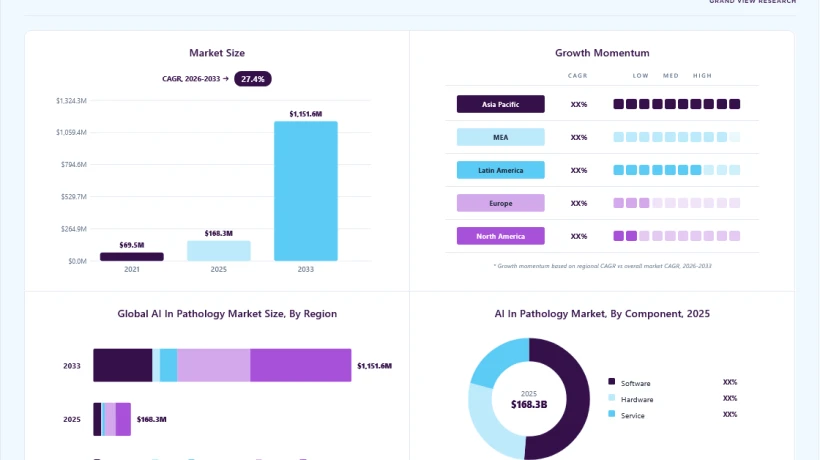
The global AI in pathology market size was valued at USD 168.3 million in 2025 and is projected to grow from USD 211.2 million in 2026 to USD 1,151.6 million by 2033, at a CAGR of 27.4% from 2026 to 2033.
The AI in pathology market is rapidly transforming pathology workflows as healthcare organizations and life sciences companies adopt artificial intelligence to analyze digital pathology images, improve diagnostic efficiency, and support precision medicine. The market was valued at USD 168.3 million in 2025 and is estimated to reach USD 211.2 million in 2026. It is projected to expand to USD 1,151.6 million by 2033, registering a CAGR of 27.4% from 2026 to 2033. North America accounted for 40.3% of market revenue in 2025, while Asia Pacific is expected to record the fastest CAGR during the forecast period.
Key Metrics
The rapid expansion of the AI in pathology market is being supported by increasing demand for precision medicine, rising chronic disease prevalence, pathology infrastructure digitization, technological advancements, supportive regulatory progress, and growing industry partnerships. AI can integrate histopathological image analysis with genomic information, helping support more precise disease subtyping, prognosis, biomarker discovery, and treatment-related decision-making.
Software represented the leading component, accounting for 51.2% of the market in 2025. Machine learning was the largest technology segment with a 35.7% share, while drug discovery and research pathology led applications with 36.3%. Life sciences companies represented the largest end-use segment with a 47.5% share in 2025.
The growing adoption of digital pathology is also encouraging investment in AI platforms capable of analyzing large volumes of whole-slide images. Automation of tissue segmentation, cell counting, measurement, biomarker analysis, and other repetitive activities can reduce manual workload and support pathologists in handling increasingly complex diagnostic requirements.
Market Growth Drivers
Precision medicine remains a major growth catalyst because AI-based pathology can combine tissue-level information with genomic and other molecular data. This enables more detailed disease characterization and supports research into patient-specific treatment strategies. Increasing demand for faster and more consistent pathology analysis is further strengthening adoption.
The growing prevalence of chronic diseases and cancer is creating additional pressure on pathology services. As case volumes and diagnostic complexity increase, AI-enabled platforms can help laboratories process digital slides more efficiently. The shortage of skilled pathologists is another factor encouraging hospitals and diagnostic laboratories to explore computational pathology solutions.
Healthcare digitization programs, telepathology adoption, and increasing funding for AI research are also expanding the market. Partnerships between technology companies, pharmaceutical organizations, healthcare providers, and pathology specialists are helping move AI solutions from research environments toward practical clinical and drug-development workflows.
Key Industry Segments
Software is expected to remain a major growth area because AI algorithms and platforms provide the intelligence required to interpret digital pathology data. Image analysis and pattern recognition can identify and quantify cellular and tissue-level characteristics, supporting applications such as tumor grading, biomarker quantification, immune-cell profiling, and disease-specific tissue analysis.
Machine learning held the largest technology share in 2025, while computer vision-based image analysis is projected to record the fastest CAGR from 2026 to 2033. Computer vision can automatically interpret histopathology slides and identify, segment, and quantify complex tissue structures, supporting cancer detection, grading, and biomarker analysis.
Drug discovery and research pathology led the application segment in 2025. AI platforms can process large pathology datasets to evaluate drug efficacy, toxicity, mechanisms of action, biomarkers, and patient stratification. Meanwhile, disease diagnosis and classification is projected to grow at the fastest CAGR as AI supports more efficient identification and classification of complex disease states.
Life sciences companies held the largest end-use share in 2025 because they increasingly use AI pathology for drug discovery, biomarker identification, translational research, companion diagnostics, and personalized medicine. Hospitals and diagnostic laboratories are expected to register the fastest CAGR through 2033 as they adopt digital slide management, AI image analysis, and automated reporting.
Regional Adoption in India
India is emerging as an important growth market for AI in pathology, with adoption expanding rapidly due to technological innovation, government health initiatives, and the need for faster and more accurate diagnosis. The shortage of trained pathologists is encouraging greater interest in AI-powered digital pathology solutions that can support scalable diagnostic workflows.
FAQs
How big is the AI in pathology market?
The AI in pathology market was valued at USD 168.3 million in 2025, is estimated at USD 211.2 million in 2026, and is projected to reach USD 1,151.6 million by 2033, growing at a CAGR of 27.4% from 2026 to 2033.
What trends are shaping the AI in pathology market?
Major trends include digital pathology adoption, machine learning, computer vision-based image analysis, cloud-based pathology platforms, multi-omics integration, telepathology, AI-assisted diagnosis, workflow automation, and increasing collaboration between healthcare, technology, and life sciences companies.
Key AI In Pathology Companies:
· Leica Biosystems Nussloch GmbH (subsidiary of Danaher)
· Koninklijke Philips N.V.
· F. Hoffmann-La Roche Ltd.
· PathAI
About us:
Grand View Research, a market research and consulting company, provides syndicated research reports, customized research reports, and consulting services. Grand View Research database is used by the world's renowned academic institutions and Fortune 500 companies to understand the global and regional business environment. Our database features thousands of statistics and in-depth analysis on 46 industries in 25 major countries worldwide.
Comments
Login to Comment