Read the XBG Model Table for Lamella Clarifiers Line by Line
15 Oct, 2026
7 Views 0 Like(s)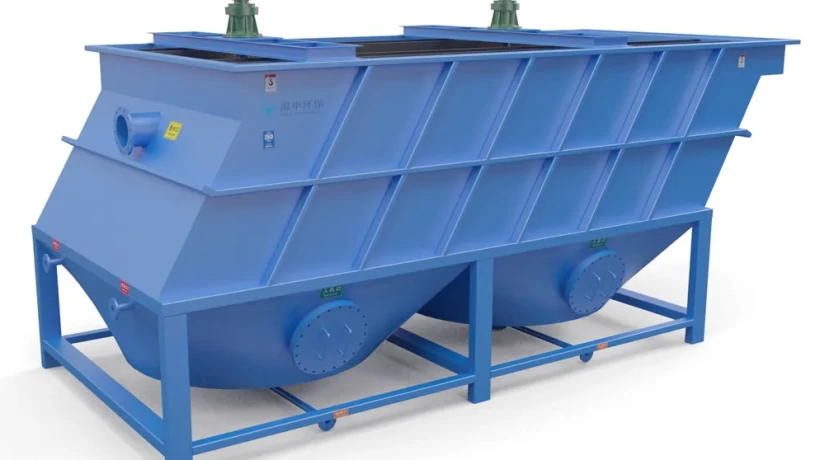
Ask for the number of plates, plate size, angle and spacing, the projected area and the overflow rate on it for each model. Then compare bids on that basis, starting with Wuxi Yosun’s lamella clarifier page, since the model table is only useful for sizing lamella clarifiers once you know what the plates contribute.
Read a lamella clarifiers model table by dividing flow by floor area and power by flow. Wuxi Yosun’s XBG table shows footprint loading rising from 1.2 m/h at XBG-005 to 4.7 m/h at XBG-100, so the claimed 2 to 4 times a plain clarifier holds from about XBG-040 upward and tops out near 2.8. Check your size, not the headline.
Understand What the Table Lists
Wuxi Yosun’s product page lists eleven XBG models from XBG-005 to XBG-100, with capacity in m³/h, pipe sizes, length, width and height in millimeters, and a 0.37 kW sludge scraper on every unit. It also states that the surface load is 2 to 4 times that of a traditional clarifier.
Two numbers per row are enough to test that claim. Multiply length by width to get the floor area, then divide capacity by it.
Divide Flow by Floor Area
The smallest unit, XBG-005, measures 2.55 by 1.60 meters, which is 4.08 m². At 5 m³/h that is 1.23 meters per hour. XBG-010 gives 6.03 m² and 1.66, XBG-020 gives 7.0 m² and 2.86, XBG-050 gives 13.0 m² and 3.84, and XBG-100 gives 21.2 m² and 4.73.
These are footprint figures that include inlet, outlet and scraper zones, so they understate the loading on the plate pack itself. They are still the honest way to compare tanks.
Compare With a Plain Primary Tank
A lecture on primary tanks gives 30 to 50 m³/m²·d at average flow, and 40 m³/m²·d is 1.67 meters per hour. Against that yardstick, XBG-005 at 1.23 is 0.7 times, XBG-010 at 1.66 matches it, and XBG-020 at 2.86 is 1.7 times.
From XBG-040 at 3.57 meters per hour the ratio passes 2, and it reaches 2.8 at XBG-100. The table shows no model near 4 times.
Lamella Clarifiers Beat Plain Tanks Only at Scale
Put the results plainly. In this table, lamella clarifiers reach the lower end of the 2 to 4 times claim from about 40 m³/h up and 2.8 times at 100 m³/h, and the smallest unit is no more compact per unit flow than a plain tank.
That fits geometry. Inlet and outlet zones and a sludge pit take a fixed share of space, and a small pack has little room left for plates. I’d ask for the plate area of the model I intend to buy.
Compare Heights and Skids
Heights run 2.9 to 3.0 meters across the table, so volume grows with floor area and the larger units hold more water for the same flow. XBG-100 occupies about 7.05 by 3.0 by 3.0 meters.
For a given flow, a deeper unit gives a longer path and more storage, though the plates, not the depth, set the removal. When siting, check overhead clearance for the scraper drive and the lifting path for plates.
Reconcile the Data Sheet
If a data sheet lists capacity as a range in one place and a model table ends below the top of that range elsewhere, ask which is current. The same goes for a power figure that differs from the table’s per-unit value and for an hourly productivity that does not match any model.
None of that is unusual on supplier sites, and it is easy to fix with a short email. I’d put the confirmed numbers in the purchase order.
Compute Specific Power
The 0.37 kW scraper on XBG-100 works out to 0.0037 kW per m³/h. On XBG-005 it is 0.074. Specific power drops as the unit grows, because the same small motor serves more flow.
Compared with the figures in other Wuxi Yosun tables, about 0.07 kW per m³/h for the largest vortex flotation unit and 0.185 for a 100 m³/h pressurized flotation unit, plates look very light on power. Flocculation mixers and dosing pumps come on top.
Ask for Plate Area and Overflow Rate
Ask for the number of plates, plate size, angle and spacing, the projected area and the overflow rate on it for each model. Then compare bids on that basis, starting with Wuxi Yosun’s lamella clarifier page, since the model table is only useful for sizing lamella clarifiers once you know what the plates contribute.
Frequently Asked Questions
Q: How many times smaller is an XBG unit than a plain tank?
A: On floor area, about 0.7 times at XBG-005, parity at XBG-010, 2.1 times at XBG-040 and 2.8 times at XBG-100, against a 1.67 m/h plain tank.
Q: Why is the small model less compact?
A: Inlet, outlet and sludge zones take a fixed share of the floor, so a small pack has less room for plates.
Q: How much power does the scraper use?
A: 0.37 kW on every model in the table, which is 0.0037 kW per m³/h at 100 m³/h.
Q: What should I ask before ordering?
A: Plate count, size, angle, spacing, projected area and the overflow rate on that area.

Comments
Login to Comment