Beard Hair Transplant in Dubai Results Explained
06 Oct, 2026
24 Views 0 Like(s)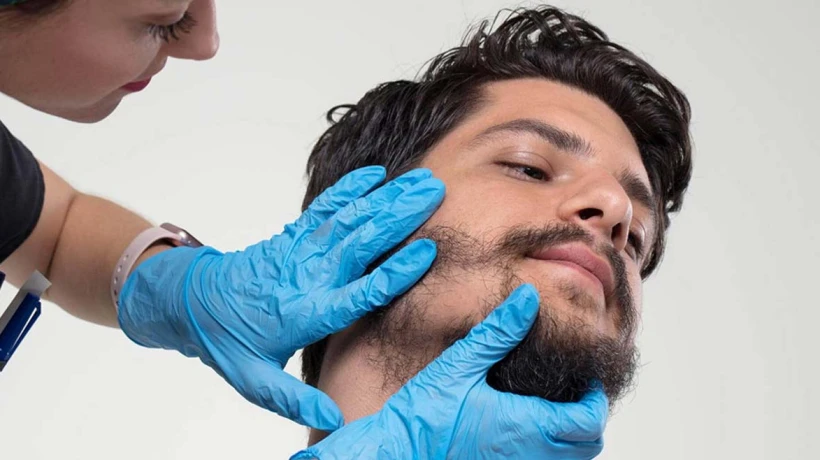
See what to expect after Beard Hair Transplant in Dubai, including early healing, shedding, new growth, density changes, and final maturation.
The results of a Beard Hair Transplant in Dubai develop gradually as transplanted follicles heal, enter their natural growth cycles, and begin producing new facial hair. Early redness or shedding does not represent the final outcome; visible improvement develops over several months, with fuller maturation generally taking considerably longer.
Patients often expect the beard to look finished as soon as the procedure is complete.
Hair follicles do not work that way. The final appearance is a biological process rather than an immediate cosmetic change.
What the Beard Looks Like Immediately After Treatment
The first stage is primarily about healing.
Small recipient sites may be visible, and the skin can appear red or slightly swollen. Tiny crusts may develop around implanted follicles as the skin begins to recover.
The appearance during this period should not be used to judge the final density.
Why early appearance can be misleading
The transplanted follicles are still adapting to their new environment.
The visible hair shafts may remain temporarily, while the underlying follicles progress through their natural cycle. Some hairs can then shed before new growth begins.
The Early Recovery Stage
During the first days and weeks, the focus is protecting the recipient area.
Patients generally receive individualized instructions about washing, sleeping, exercise, sun exposure, and facial grooming.
Dubai's climate can make this stage more noticeable.
Heat, humidity, and intense sunlight can increase discomfort if the healing skin is not protected appropriately. Time outdoors and strenuous activity should be managed according to the clinical instructions.
Temporary Shedding After Beard Transplantation
Temporary shedding can be one of the most surprising stages.
A transplanted hair may fall out even though the follicle remains viable beneath the skin.
This is often referred to as shock loss or shedding associated with the transplantation cycle. It does not automatically indicate that the follicle has been permanently lost.
The important distinction is between the visible hair shaft and the follicle itself.
When New Beard Growth Begins
New growth does not appear uniformly in every patient.
Individual follicles have their own biological timing. Some areas may show early changes while others appear slower.
This can make the beard look uneven temporarily.
Patience is important during this stage because the final density cannot be judged from the earliest new hairs.
Why Results Develop Over Several Months
Hair growth occurs through cycles.
A follicle moves through phases of active growth, transition, and rest. Transplantation relocates the follicle but does not eliminate these biological stages.
As the follicles establish themselves, new hairs gradually emerge and become more noticeable.
The Tajmeels service information notes that visible improvement develops over several months, with fuller results generally developing within approximately 6–12 months.
Individual timelines can vary.
What Determines the Final Beard Appearance?
Several variables contribute to the result:
Graft quality
Healthy, appropriate follicular units provide the foundation for restoration.
Implantation direction
The hair must emerge at an angle that blends with surrounding facial growth.
Density
The number and distribution of grafts influence visual fullness.
Existing beard
Native hair provides the surrounding framework into which transplanted follicles must blend.
Facial anatomy
The beard should complement the jawline, chin, cheeks, and overall facial proportions.
Individual healing
Biological response varies between patients.
Natural Results Are About Blending
A successful beard transplant should not look like two separate hair populations.
The transplanted follicles need to transition into existing beard growth without an obvious boundary.
This is especially important around the cheek line and areas where the beard changes direction.
Why a perfectly straight beard line may not be ideal
Natural facial hair is rarely arranged as a ruler-straight border.
The appropriate design depends on facial anatomy and the patient's preferred grooming style. Some patients benefit from a more defined edge, while others need a softer transition.
Read More : can sideburn hair transplant in dubai fix uneven sideburns
What Happens to Beard Density Over Time?
The initial density after transplantation is not necessarily the final density.
As new hairs emerge, the beard gradually develops greater visual coverage.
Hair caliber can also influence how dense the beard appears. Fine new hairs may initially look lighter or less substantial before maturing.
This is why results are assessed over time rather than during the first few weeks.
Can the Beard Be Groomed Normally Later?
Once the follicles and skin have appropriately healed, transplanted beard hair can be incorporated into normal grooming.
It can be trimmed, shaped, or shaved according to the patient's preferred style.
The exact timing for resuming grooming should be confirmed with the treating clinic.
What Results Can Patients With Patchy Beards Expect?
Patients with localized gaps may see improvement in the continuity of the beard rather than a complete transformation of every facial area.
If existing beard density is already strong in surrounding areas, relatively selective restoration may produce a meaningful visual improvement.
The goal is to fill clinically relevant deficiencies without making the transplanted regions look unusually dense.
What About Facial Scars?
Scar-related beard loss can behave differently from genetically sparse growth.
Scar tissue may have altered skin structure and blood supply. The clinician needs to assess the area before determining whether transplantation is appropriate.
When suitable, carefully placed grafts may improve hair coverage across selected scarred regions.
Common Patient Expectations
“I will have a full beard immediately.”
The procedure places follicles, not instant mature beard density. Growth develops progressively.
“Shedding means the transplant did not work.”
Not necessarily. Early shedding can occur while transplanted follicles remain beneath the skin.
“The final result can be judged after a few weeks.”
Usually not. Hair growth cycles require considerably more time before the result can be evaluated properly.
Results and Dubai's Lifestyle
Patients with demanding schedules often want to know when the beard will look socially presentable.
The early appearance can include redness or small crusts, so treatment should ideally be planned around important professional events, weddings, photography sessions, and international travel.
The recovery period varies, but careful planning can make the process easier to integrate into a busy Dubai lifestyle.
A Practical Beard Transplant Timeline
- Procedure day: Follicles are extracted and implanted according to the treatment design.
- Early days: The recipient skin begins healing, with temporary redness or swelling possible.
- Early weeks: Crusting and other temporary changes settle as the skin recovers.
- Following weeks: Some transplanted hairs may shed as follicles transition through their growth cycle.
- Following months: New beard hairs gradually begin emerging.
- Progressive maturation: Density and hair characteristics become increasingly visible.
- Around the later maturation period: Fuller results can generally be assessed, with individual variation.
How Results Should Be Evaluated
Photographs taken under different lighting conditions can make facial hair appear dramatically different.
Dubai's bright outdoor sunlight, indoor office lighting, and camera flash can each change the perceived density of a beard.
For a meaningful comparison, photographs should ideally be taken under consistent conditions.
What Makes a Good Long-Term Result?
A good result is not necessarily the densest possible beard.
It is one that looks appropriate for the patient's facial proportions, blends with native hair, follows natural growth direction, and remains compatible with the patient's preferred grooming style.
The treatment should enhance facial definition without making the transplant obvious.
Clinic note: Beard transplant results should be judged progressively. Early healing and temporary shedding are part of the process and should not be confused with the mature appearance of the transplanted follicles.
Plan Your Beard Restoration With Tajmeels Clinic
Tajmeels Clinic focuses on individualized facial hair restoration, taking donor characteristics, existing beard density, facial proportions, graft selection, and natural hair direction into account.
Explore Beard Hair Transplant in Dubai to understand the treatment and arrange a consultation based on your specific beard restoration goals.

Comments
Login to Comment