Why Cellular Heterogeneity Matters for Single-cell Analysis Market Growth
07 Oct, 2026
12 Views 0 Like(s)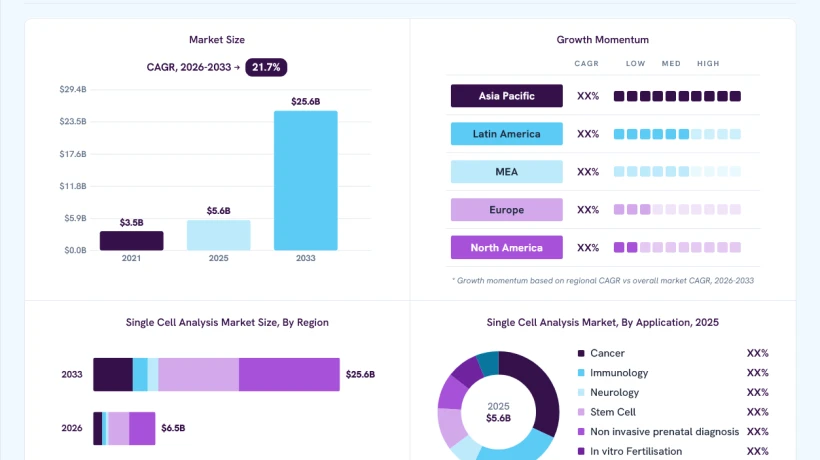
The global single-cell analysis market size was valued at USD 5.6 billion in 2025 and is projected to grow from USD 6.5 billion in 2026 to USD 25.6 billion by 2033, at a CAGR of 21.7% from 2026 to 2033.
As researchers move from studying broad cell populations toward understanding individual cellular behavior, single-cell analysis is becoming increasingly important across modern life sciences. The single-cell analysis market was valued at USD 5.6 billion in 2025 and is estimated to reach USD 6.5 billion in 2026, with the market projected to reach USD 25.6 billion by 2033, registering a CAGR of 21.7% from 2026 to 2033. Expanding applications in disease diagnosis, drug discovery, sequencing, precision medicine, and cellular research are creating strong demand for advanced single-cell technologies.
Understanding Cellular Heterogeneity Becomes a Research Priority
Traditional biological analysis can overlook differences between individual cells. Single-cell technologies provide researchers with the ability to examine genomic, transcriptomic, proteomic, and metabolomic profiles at the individual-cell level. This helps reveal cellular heterogeneity and provides deeper insights into biological pathways and disease mechanisms.
The expanding role of single-cell analysis in oncology, immunology, and precision medicine is particularly important. By identifying differences among cells within the same tissue or tumor, researchers can investigate disease progression, treatment responses, and potential biomarkers with greater detail.
Sequencing Innovation Expands the Scale of Analysis
Rapid progress in sequencing technology is one of the central forces behind market expansion. Modern sequencing platforms provide greater throughput, allowing researchers to examine thousands or even millions of individual cells within a single experiment.
This higher analytical scale is opening opportunities across research and diagnostics while helping scientists investigate biological complexity with greater resolution. Technological developments in cell isolation are also improving sensitivity and enabling the identification of rare cell populations and low-abundance molecules.
Cancer Research Remains a Major Application Area
Cancer accounted for the largest application share, representing 31.9% of revenue in 2025. Single-cell analysis can help researchers identify genetic variation, mutation patterns, cellular populations, and other characteristics associated with cancer.
The technology is also becoming increasingly relevant to immuno-oncology and personalized treatment strategies. Researchers can use single-cell approaches to investigate how different cell types respond to therapies and understand the biological mechanisms associated with treatment outcomes.
Meanwhile, immunology is expected to register the fastest CAGR during the forecast period. Detailed profiling of immune-cell populations enables researchers to investigate gene expression, protein expression, epigenetic modifications, and immune-cell development.
Consumables Lead the Product Landscape
Consumables represented the largest product category, accounting for 55.0% of revenue in 2025. The category includes reagents, kits, microplates, and other essential materials required for single-cell experiments.
Growing adoption of personalized medicine, biotechnology advances, and demand for detailed cellular analysis are supporting recurring consumption of these products. Instruments are also expected to experience significant growth as smart technologies, next-generation sequencing, PCR, and integrated laboratory systems expand their role in research and clinical workflows.
Data Analysis Is Becoming Central to Single-cell Workflows
The growing volume and complexity of single-cell datasets are creating increasing demand for sophisticated computational solutions. Data analysis accounted for 38.2% of revenue in 2025, making it the largest workflow segment.
At the same time, downstream analysis is expected to witness the fastest growth from 2024 to 2033. As sequencing generates increasingly detailed datasets, researchers require advanced bioinformatics tools to interpret information and extract meaningful biological insights.
The integration of artificial intelligence is adding another layer of opportunity. AI-powered tools can help accelerate data interpretation, biomarker discovery, target identification, and precision drug development, particularly when combined with multiomics approaches.
Drug Discovery and Multiomics Create New Growth Pathways
The growing number of drug discovery activities is an important market driver. Pharmaceutical and biotechnology companies increasingly use cell-based technologies to evaluate therapeutic candidates, investigate mechanisms of action, and assess compound efficacy and toxicity.
The combination of single-cell multiomics with AI and advanced bioinformatics is creating further opportunities. By combining genomic, transcriptomic, proteomic, epigenomic, and metabolomic information, researchers can develop a more comprehensive understanding of cellular behavior and therapeutic response.
High Costs Remain a Barrier to Wider Adoption
Despite strong technological momentum, the market faces challenges related to the high cost of instruments, consumables, sequencing workflows, and specialized laboratory infrastructure. Complex experimental procedures and the need for skilled personnel can further increase the total cost of ownership.
Large-scale datasets also require sophisticated computational capabilities and bioinformatics expertise. These factors can restrict adoption among smaller research organizations and institutions with limited resources.
What Lies Ahead for Single-cell Analysis
The market's outlook remains strongly connected to precision medicine, cancer research, cell and gene therapy, biomarker discovery, and pharmaceutical R&D. Academic and research laboratories represented the largest end-use segment, accounting for 71.1% of revenue in 2025, demonstrating the importance of research institutions in technology adoption.
With the market forecast to reach USD 25.6 billion by 2033, continued innovation in sequencing, microfluidics, cell isolation, multiomics, automation, and AI-driven bioinformatics is expected to expand the capabilities and applications of single-cell analysis.
As healthcare organizations expand their focus on location-based planning and market intelligence, accurate facility data is becoming increasingly valuable. The U.S. Healthcare Facility Mapping & Intelligence Platform provides structured insights into healthcare facilities across the U.S., supporting organizations in facility mapping, geographic analysis, market assessment, and strategic planning.
Key Single-cell Analysis Companies:
· Thermo Fisher Scientific, Inc
· QIAGEN NV
· Bio-Rad Laboratories, Inc.
· Illumina, Inc.
About us:
Grand View Research, a market research and consulting company, provides syndicated research reports, customized research reports, and consulting services. Grand View Research database is used by the world's renowned academic institutions and Fortune 500 companies to understand the global and regional business environment. Our database features thousands of statistics and in-depth analysis on 46 industries in 25 major countries worldwide.
Comments
Login to Comment