Why Telecom Back-Office Operations Matter More Than Ever
10 Jun, 2026
1403 Views 0 Like(s)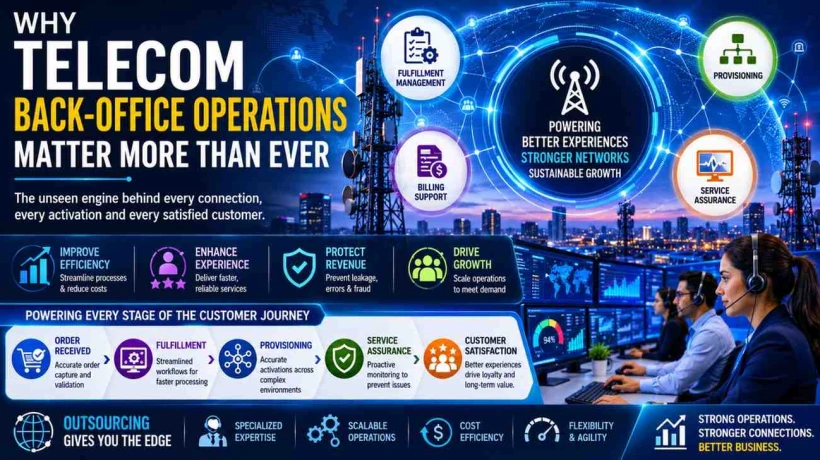
Why Telecom Back-Office Operations Matter More Than Ever in 2026
When people think about the telecommunications industry, they often focus on network coverage, customer service, and emerging technologies such as 5G. However, behind every successful customer interaction lies a complex network of operational processes that keep services running smoothly. These critical functions form the backbone of telecom operations and are increasingly driving business performance.
As customer expectations rise and service environments become more complex, telecom back office outsourcing has become a strategic priority for many communications service providers. Organizations are recognizing that fulfillment, provisioning, billing support, and service assurance directly influence customer satisfaction, operational efficiency, and profitability.
In today's competitive market, back-office performance is no longer just an operational concern. It has become a business-critical factor that affects long-term growth and customer loyalty.
The Back Office Powers Every Customer Experience
Customers rarely see the operational activities that occur behind the scenes. They place an order, expect activation, receive a bill, and use their services without considering the processes required to support those experiences.
However, every stage of the customer journey depends on effective back-office execution.
When an order is processed accurately, services are activated on time. When billing systems function properly, customers receive correct invoices. When telecom service assurance teams monitor network performance effectively, issues are identified and resolved before customers are impacted.
Conversely, operational failures often become customer experience problems.
A delayed order can postpone service activation. Billing inaccuracies can create frustration and disputes. Service disruptions can damage customer trust and increase churn risk.
As a result, telecom providers are placing greater emphasis on strengthening their operational foundations.
Fulfillment Performance Drives Revenue Growth
One of the most important responsibilities of the telecom back office is fulfillment management.
Fulfillment encompasses the activities required to move a customer order from submission to activation. This process often involves multiple systems, teams, and workflows that must operate in coordination.
When fulfillment processes are inefficient, activation timelines suffer. Orders become delayed, revenue recognition is postponed, and customer satisfaction declines.
For providers managing large order volumes, even minor inefficiencies can have significant financial consequences.
Effective fulfillment operations help organizations accelerate service delivery while improving activation accuracy. Faster activations enable providers to generate revenue sooner and reduce the operational costs associated with order fallout and exception management.
In a highly competitive industry, fulfillment efficiency has become a key driver of both customer experience and profitability.
Provisioning Accuracy Impacts Service Delivery
Provisioning serves as another essential component of telecom operations.
Modern telecom services require increasingly sophisticated activation processes. Broadband services, enterprise connectivity solutions, cloud communications, and 5G-enabled offerings often involve multiple systems and technical dependencies.
A single provisioning error can delay service activation, create customer frustration, and increase support costs.
As service complexity continues to grow, providers need operational models capable of managing large volumes of activations without sacrificing quality.
Telecom back office outsourcing allows organizations to access specialized expertise and scalable resources that support efficient provisioning operations. Dedicated teams help reduce errors, improve workflow consistency, and maintain activation performance as demand increases.
This operational stability contributes directly to better customer outcomes.
Billing Support Protects Revenue and Trust
Billing remains one of the most visible operational functions from a customer's perspective.
Even when network performance is excellent, billing errors can quickly undermine customer confidence. Incorrect charges, delayed invoices, and unresolved disputes often result in negative customer experiences.
Beyond customer satisfaction, billing accuracy directly affects financial performance.
Revenue leakage, delayed payments, and dispute management all create operational and financial challenges for service providers. Strong billing support processes help organizations maintain accurate invoicing while reducing administrative burdens.
By improving billing operations, providers can strengthen customer trust while protecting revenue streams.
Many telecom organizations now view billing support as a strategic capability rather than a purely administrative function.
Service Assurance Helps Prevent Customer Churn
Customer expectations for reliability continue to increase.
Whether supporting consumers or enterprise clients, telecom providers must ensure services perform consistently and meet agreed-upon standards. This responsibility falls largely within telecom service assurance operations.
Service assurance teams monitor network performance, identify potential issues, and coordinate resolution efforts before customers experience significant disruptions.
Without effective service assurance, providers often become reactive rather than proactive. Problems are addressed only after customers report them, leading to increased support interactions and declining satisfaction levels.
Strong service assurance capabilities help minimize downtime, improve service quality, and protect customer relationships.
In many cases, proactive issue resolution can prevent customer churn before it begins.
Why Outsourcing Is Becoming a Strategic Advantage
The increasing complexity of telecom operations has made it difficult for many providers to manage every function internally.
Growing service portfolios, evolving technologies, and rising customer expectations require specialized expertise and scalable operational models. Consequently, telecom back office outsourcing is becoming an increasingly attractive option.
Outsourcing enables providers to focus on strategic growth initiatives while experienced partners manage critical operational functions. Specialized teams bring industry knowledge, proven processes, and operational flexibility that support performance improvement.
Providers gain access to resources that can scale with business demands without requiring substantial internal investments.
This approach not only improves efficiency but also helps organizations maintain service quality during periods of rapid growth and transformation.
Conclusion
The importance of telecom back-office operations has never been greater. Fulfillment, provisioning, billing support, and service assurance influence nearly every aspect of customer experience and business performance. While these functions often operate behind the scenes, their impact is highly visible in customer satisfaction, operational efficiency, and profitability.
As the telecommunications industry continues to evolve, providers must ensure their operational foundations are strong enough to support future growth. Organizations that invest in effective back-office operations or leverage telecom back-office outsourcing solutions will be better positioned to improve service delivery, protect revenue, and create lasting competitive advantages.


Comments
Login to Comment