Why Students Struggle to Adapt to Hybrid Learning Models?
23 Feb, 2026
6776 Views 0 Like(s)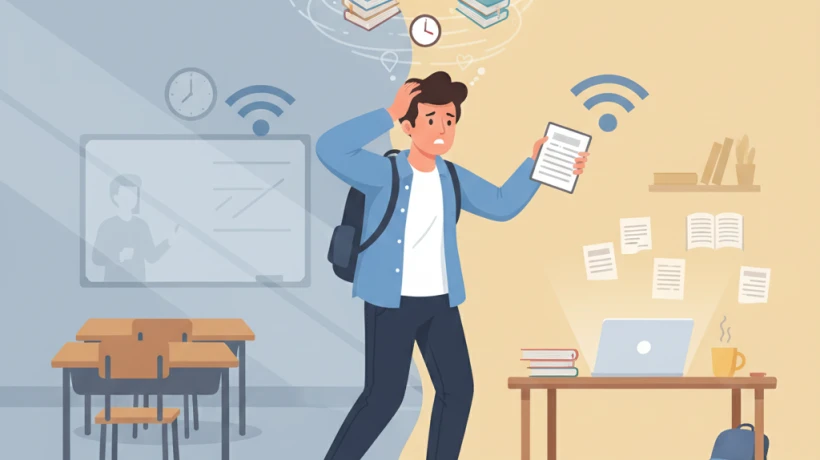
. Many people struggle to stay as focused at a dining table as they do in a lecture hall, feeling torn between two different worlds.
The sudden change from traditional classrooms to hybrid learning models has significantly changed the educational landscape, creating a complex environment. Although the models lead to positive future directions in education, they also come up with challenges for students, which we cannot ignore. Many people struggle to stay as focused at a dining table as they do in a lecture hall, feeling torn between two different worlds.
This post will go over the various reasons why students find it difficult to adjust to these models, from the breakdown of social ecosystems to the cognitive strain of using inconsistent technology, and how these obstacles affect academic achievement.
Fragmented Focus Factor
One of the main challenges is the environment's continual change, which interferes with cognitive "flow." The actual classroom serves as a psychological anchor for in-depth work in a conventional context. Students in a hybrid paradigm have to continually shift their attention between the regimented school environment and the high-stimulation home environment.
This back-and-forth movement frequently results in a "switching cost," whereby the effort to adapt to various learning environments depletes mental resources.
The Erosion of Social Capital
Despite the social nature of education, hybrid models often overlook the informal interactions that facilitate peer-to-peer learning. It is challenging to duplicate the "hallway conversations" and impromptu study groups that take place on-site in a prearranged video slot.
Students' intrinsic motivation suffers when they feel alone or cut off from their community. The digital interface feels more like a barrier than a bridge to vital information when there is a lack of a strong sense of belonging.
The Myth of Digital Literacy
It's a common misconception that "digital natives" are predisposed to online learning, but using a learning management system differs greatly from browsing social media. Many pupils lack the sophisticated organizing abilities needed to handle asynchronous files, digital submission portals, and several passwords.
The curriculum may be overshadowed by this technological friction, which makes even the act of beginning an assignment seem like a huge uphill fight.
The Vanishing Boundary of Home
The crucial distinction between work and relaxation vanishes entirely when the bedroom is used as a classroom. Many students view the house as a place to unwind or, on the other hand, as a place where family responsibilities are hectic.
Students sometimes struggle to "switch off" after school hours in the absence of an obvious physical boundary, which can result in burnout. On the other hand, because their brain links their workstation to gaming, they might not be able to "switch on" during class.
Inconsistent Instructional Quality
Teachers are frequently required by hybrid models to master two distinct media at the same time, which is a demanding task. Sometimes the distant part seems like an afterthought, whereas the in-person encounter is deep and involved.
Students feel like "second-class citizens" on their faraway days as a result of this discrepancy. Students find it difficult to establish a consistent and predictable academic rhythm when the quality of instruction varies greatly depending on the day of the week.
The Executive Function Gap
Executive skills like self-control, time management, and prioritizing are highly valued in hybrid learning. An external scaffold for conduct is provided in a 100% in-person model by the teacher's physical presence and the school bell.
The scaffolding is taken down for half the week in a hybrid model. Because they lack the internal framework to match the absent external one, students who struggle with organization frequently find themselves drowning in a sea of deadlines.
High Stakes-Pressure
The intense pressure of constant assessments often pressures students, which drives them to seek professional assistance. Stress of loomping deadline and continuous online exams, especially for difficult subjects like maths and science, often leads the students to go for “Pay someone to take my online algebra exam.” Along with taking professional help, building robust confidence via consistent practice is also important.
Through the use of interactive educational software and available tutoring services, students may transform a challenging topic into a pleasant and manageable component of their hybrid schedule.
Mastering Virtual Assessments
For students who are used to the comfortable presence of an instructor in a physical classroom, proctored situations can be especially frightening. In this case students can get guidance from experts or go for “Take my proctored exam for me”.
Along with that by participating in simulated proctoring sessions that demystify the technology, students can succeed. Early software familiarization allows students to concentrate solely on demonstrating their knowledge rather than worrying about the platform's technical details.
Adapting to Future Trends in Education
In order to better serve today's students, educational institutions are identifying more effective future directions in education as they examine present challenges. This entails going beyond simple video conversations to immersive, AI-powered systems that offer more tailored feedback.
By developing these models, educators want to build a more robust system that allows students to flourish through more adaptable and engaging technology frameworks, rather than merely surviving the hybrid shift.
(helpwithdissertation,2021)
The Accountability Vacuum
For many students, the actual presence of authoritative individuals automatically increases accountability. A student is less likely to have a distracting tab open when a teacher is circulating the aisles. The allure of the limitless internet is just a click away in a hybrid environment.
Many students slip into a habit of passive participation in the absence of the "eyes-on" approach of the conventional classroom, where they are logged in but nevertheless psychologically disengaged.
Conclusion:
Learning new software is only one aspect of adjusting to hybrid learning; another is a fundamental change in how students absorb knowledge and preserve their mental health. As time goes on, it becomes evident that hybrid models need to close the gap between human connection and digital ease in order to be successful.
To keep pupils from slipping through the cracks, schools must place a high priority on teaching self-regulation skills and guaranteeing fair access to technology. In order to ensure that the flexibility of the future does not come at the expense of academic and emotional stability, educators and parents should help students as they traverse this brave new world of learning.

Comments
Login to Comment