Who needs to register for VAT in the UAE?
27 Aug, 2026
505 Views 0 Like(s)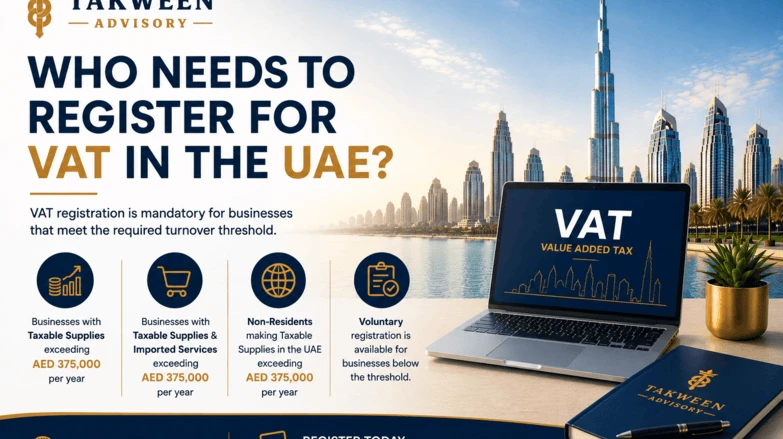
Learn who needs to register for VAT in the UAE, including mandatory and voluntary thresholds, registration steps, required documents, and key VAT compliance requirements.
VAT registration is an important tax requirement for businesses operating in the UAE. Whether a business must register depends mainly on its taxable supplies, imports, and expected turnover. Understanding the registration rules can help business owners avoid compliance problems and know when they need to start charging VAT.
For entrepreneurs searching for How To Do VAT Registration In UAE, it is important to understand the difference between mandatory and voluntary registration. A business may be required to register once it reaches the mandatory threshold, while smaller businesses may be able to register voluntarily if they meet the relevant conditions.
What Is VAT Registration in the UAE?
VAT registration is the process of registering a business with the UAE tax authority for Value Added Tax purposes.
Once registered, the business receives a Tax Registration Number and becomes responsible for meeting applicable VAT obligations. These can include charging VAT on taxable supplies, keeping proper financial records, issuing tax invoices, filing VAT returns, and paying VAT due.
VAT registration is separate from obtaining a trade license. A company can have a valid business license without being VAT registered if it does not meet the registration requirements.
Who Must Register for VAT in the UAE?
A business generally needs to register for VAT when the value of its taxable supplies and imports exceeds AED 375,000 during the previous 12 months or is expected to exceed AED 375,000 within the next 30 days.
This is known as the mandatory VAT registration threshold.
Businesses approaching this threshold should monitor their taxable turnover carefully. Waiting until after the requirement has clearly arisen can create compliance problems.
Who Can Register for VAT Voluntarily?
Businesses that do not reach the mandatory threshold may still be able to register voluntarily.
The voluntary VAT registration threshold is AED 187,500.
A business may qualify for voluntary registration when the value of its taxable supplies and imports, or taxable expenses, reaches the relevant threshold under the applicable VAT rules.
Voluntary registration can be useful for businesses that are growing and expect their taxable activities to increase.
What Is the Difference Between Mandatory and Voluntary Registration?
Understanding this difference is important.
Mandatory VAT Registration
Mandatory registration applies when the business reaches or is expected to reach the required threshold.
Once the relevant conditions are met, the business needs to complete the registration process.
Voluntary VAT Registration
Voluntary registration allows an eligible business below the mandatory threshold to register for VAT.
This can provide certain business advantages, but it also creates ongoing compliance responsibilities.
What Counts Toward the VAT Registration Threshold?
The VAT threshold is not simply based on every amount of money received by the business.
Businesses need to consider the VAT treatment of their transactions and determine which supplies and imports are relevant for registration purposes.
Transactions can fall into different categories, including:
-
Taxable supplies
-
Zero-rated supplies
-
Exempt supplies
-
Out-of-scope transactions
Because VAT treatment varies, businesses should review their transactions rather than simply adding every source of income together.
Do Small Businesses Need VAT Registration?
Not every small business needs to register.
If the business remains below the mandatory VAT registration threshold and does not meet the conditions for voluntary registration, it generally does not have to register for VAT.
However, small businesses should regularly monitor their turnover because reaching the threshold can change their registration obligations.
Business growth can also happen quickly, especially for startups and online businesses, so keeping accurate financial records is important.
Do Free Zone Companies Need VAT Registration?
Yes, a free zone company can still have VAT registration obligations.
Operating from a free zone does not automatically mean that the business is outside the UAE VAT system.
The VAT treatment depends on the company's activities, transactions, and the applicable rules.
Businesses in free zones should therefore assess their VAT position based on their actual activities instead of assuming that free zone status provides automatic VAT exemption.
Do Mainland Companies Need VAT Registration?
Mainland companies are also subject to the UAE VAT registration rules.
If a mainland business meets the mandatory registration threshold, it generally needs to register.
Businesses that remain below the threshold may consider voluntary registration if they satisfy the relevant conditions.
The company's physical location does not remove its responsibility to monitor VAT obligations.
Do E-Commerce Businesses Need VAT Registration?
E-commerce businesses may need to register for VAT just like other businesses when they meet the applicable requirements.
Online sales, digital business activities, and transactions involving customers inside and outside the UAE can have different VAT treatments.
An online business should therefore review its sales structure carefully, especially if it handles imports, exports, or cross-border transactions.
Do Service-Based Businesses Need VAT Registration?
Yes, service businesses can also be required to register.
Consultants, marketing agencies, IT companies, management service providers, and other service businesses need to monitor the value of their taxable supplies.
The fact that a business provides services rather than physical goods does not automatically remove VAT registration requirements.
Do New Businesses Need to Register Immediately?
Not necessarily.
A newly established business should assess its expected taxable supplies and imports and continue monitoring its turnover as operations grow.
If the business expects to exceed the mandatory threshold within the applicable period, it may need to register.
New business owners should not assume that having little turnover during the first few months means VAT will never apply.
Can a Business Register for VAT Before Reaching AED 375,000?
Yes, voluntary registration may be available when the business meets the applicable voluntary threshold.
Some businesses choose voluntary registration because they expect to grow, work with VAT-registered customers, or have significant eligible business expenses.
However, registration also means taking on ongoing VAT compliance responsibilities.
What Are the Benefits of Voluntary VAT Registration?
Voluntary VAT registration can have advantages for certain businesses.
Recovering Eligible Input VAT
A registered business may be able to recover eligible input VAT incurred on business-related purchases, subject to the applicable rules.
Professional Business Image
Some businesses prefer to work with VAT-registered suppliers and customers, particularly in larger commercial transactions.
Preparing for Growth
A company that is approaching the mandatory threshold may choose to register earlier so it can establish its accounting and VAT processes before turnover grows further.
What Responsibilities Come With VAT Registration?
VAT registration is not just about obtaining a tax number.
A VAT-registered business generally needs to:
Charge VAT
VAT should be charged on applicable taxable supplies at the appropriate rate.
Issue Tax Invoices
Businesses need to issue invoices that meet the applicable VAT requirements.
Keep Financial Records
Relevant accounting and tax records should be maintained properly.
File VAT Returns
The business needs to submit VAT returns according to its assigned tax period.
Pay VAT Due
Any VAT payable needs to be settled within the applicable deadline.
These responsibilities mean that businesses should prepare their accounting systems before or immediately after registration.
What Documents Are Needed for VAT Registration?
The exact document requirements depend on the business and its circumstances.
Common documents and information may include:
-
Trade license
-
Passport of the owner or authorised person
-
Emirates ID
-
Company address
-
Business activity details
-
Bank information
-
Customs details, where applicable
-
Revenue information
-
Expected turnover
-
Supporting financial documents
Businesses with more complex structures may need to provide additional information.
How To Do VAT Registration In UAE?
The VAT registration process is generally completed through the UAE tax authority's online system.
Step 1: Determine Whether You Need to Register
Start by reviewing your taxable supplies, imports, and expected turnover.
Determine whether you meet the mandatory or voluntary registration conditions.
Step 2: Prepare Your Documents
Collect your company, identification, financial, and business activity information.
Make sure the details match your official company records.
Step 3: Create or Access Your Tax Account
Use the applicable online tax services platform to create or access your tax account.
Step 4: Complete the VAT Registration Application
Enter information about your company, activities, revenue, imports, and other required details.
Step 5: Upload Supporting Documents
Upload the required documents in the requested format.
Step 6: Review the Application
Check the application carefully before submission.
Pay particular attention to:
-
Company name
-
Trade license details
-
Taxable turnover
-
Business activity
-
Owner information
-
Contact details
Step 7: Submit the Application
After reviewing the information and documents, submit the VAT registration application.
The application will then be reviewed by the tax authority.
Step 8: Receive Your VAT Registration Details
Once approved, the business receives its VAT registration details and can begin complying with its VAT obligations.
What Happens After VAT Registration?
After registration, businesses need to establish an effective VAT compliance process.
This includes maintaining proper accounting records and monitoring VAT charged to customers and VAT paid on eligible business expenses.
The business should also keep copies of tax invoices and other supporting documents required for its VAT records.
How Often Do I Need to File VAT Returns?
VAT return filing frequency depends on the tax period assigned to the business.
Many businesses have periodic VAT filing obligations, and the company should follow the deadline shown in its tax records.
Missing VAT return deadlines can result in penalties, so businesses should maintain a clear compliance calendar.
What Happens If a Business Does Not Register When Required?
Failing to register when a business is required to do so can lead to administrative penalties and other VAT compliance issues.
A business approaching the mandatory threshold should therefore review its position early and prepare the registration application.
Professional guidance can be useful if the business is unsure whether its transactions count toward the registration threshold.
Can I Register for VAT Without an Accountant?
Yes. A business can complete the registration process itself.
However, professional accounting or tax assistance can be useful when the company has:
-
Complex transactions
-
International customers
-
Imports and exports
-
Multiple business activities
-
Related companies
-
Difficult accounting records
A tax professional can also help determine whether the business meets the mandatory or voluntary registration requirements.
How Much Does VAT Registration Cost?
VAT registration is not usually the main expense for a business.
The government registration process itself is separate from any professional service fees.
If you hire an accountant or tax consultant, you may need to pay a professional fee for services such as:
-
Eligibility assessment
-
Document preparation
-
Online application
-
Tax account setup
-
VAT compliance guidance
Ongoing accounting and VAT return filing services are generally separate from the initial registration.
How Can I Prepare for VAT Registration?
Keep Your Accounts Updated
Accurate bookkeeping makes it easier to calculate taxable turnover.
Monitor Your Turnover
Review your taxable supplies and imports regularly rather than waiting until the end of the financial year.
Maintain Supporting Documents
Keep invoices, contracts, bank statements, and other financial records organised.
Understand Your Transactions
Make sure you know which supplies are taxable, zero-rated, exempt, or outside the scope of VAT.
Get Advice Before the Deadline
If you are approaching the mandatory threshold, professional guidance can help you understand when and how to register.
How Takween Advisory Can Help
Takween Advisory can assist businesses with VAT registration in the UAE, including eligibility assessment, document preparation, online application support, and related VAT compliance services.
The team can help businesses understand whether registration is mandatory or voluntary and assist with the information required for the application.
Takween Advisory can also provide support with VAT return filing and other tax compliance services after registration.
Frequently Asked Questions
Who needs to register for VAT in the UAE?
A business generally needs to register when the value of its taxable supplies and imports exceeds AED 375,000 over the previous 12 months or is expected to exceed AED 375,000 within the next 30 days.
Can a small business register for VAT voluntarily?
Yes. A business below the mandatory threshold may be able to register voluntarily if it meets the applicable AED 187,500 threshold and other requirements.
What is the mandatory VAT registration threshold?
The mandatory VAT registration threshold is AED 375,000.
What is the voluntary VAT registration threshold?
The voluntary VAT registration threshold is AED 187,500, subject to the applicable requirements.
Do free zone companies need VAT registration?
Yes. Free zone businesses can have VAT registration obligations depending on their taxable activities and transactions.
Do mainland companies need to register?
Yes. Mainland companies are subject to the UAE VAT registration rules and need to register when they meet the applicable requirements.
Can I register for VAT online?
Yes. VAT registration can generally be completed through the UAE tax authority's online tax services system.
What documents are needed for VAT registration?
Common requirements include the trade license, identification documents, company information, business activity details, turnover information, and supporting financial documents.
Can I register before reaching AED 375,000?
Yes. Voluntary VAT registration may be available if the business meets the applicable voluntary threshold and conditions.
What happens after VAT registration?
The business generally needs to charge VAT on applicable supplies, issue compliant tax invoices, maintain records, file VAT returns, and pay any VAT due.
Can Takween Advisory help with VAT registration?
Yes. Takween Advisory can assist with VAT registration, eligibility assessment, documentation, online application support, VAT return filing, and related tax compliance services.
Final Thoughts
Understanding who needs to register for VAT is important for every growing business in the UAE. The key thresholds to monitor are AED 375,000 for mandatory registration and AED 187,500 for voluntary registration, subject to the applicable VAT rules.
Businesses should monitor taxable supplies and imports regularly rather than relying only on total revenue. Free zone companies, mainland businesses, online businesses, and service providers can all have VAT responsibilities depending on their activities.
Learning How To Do VAT Registration In UAE and preparing the required documents in advance can help businesses complete registration more smoothly and stay on top of their ongoing VAT compliance obligations.



Comments
Login to Comment