Who Needs Full-Length TOEFL Mock Tests?
15 Aug, 2026
529 Views 0 Like(s)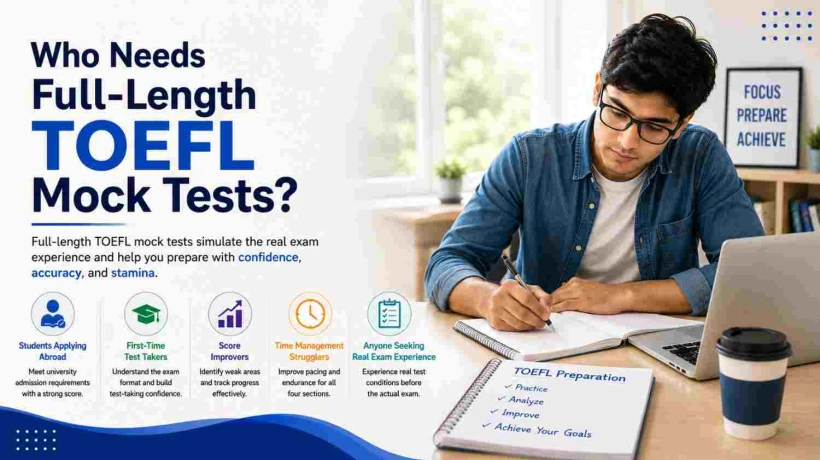
See who benefits from full-length TOEFL mock tests and how realistic practice can improve timing, stamina, skill balance, and exam readiness.
A full-length TOEFL practice test does something that isolated exercises cannot: it shows how well a candidate performs when multiple language skills, strict timing, concentration, and mental stamina come together. While short practice sessions remain valuable, complete simulations reveal whether preparation holds up across an entire testing session.

However, not every candidate needs full-length testing at the same stage. Beginners, repeat test takers, high-score applicants, candidates with timing difficulties, and students approaching test day may use complete mocks differently. Knowing when full-length practice becomes valuable can make preparation more focused, efficient, and measurable.
Why Full-Length TOEFL Practice Matters?
TOEFL preparation often begins with individual skills. Candidates may practice reading passages, listen to academic recordings, record speaking responses, or complete writing exercises separately. However, strong performance on isolated tasks does not automatically guarantee consistent performance across a complete test.
Full-length practice combines several demands. Candidates must manage time, shift between language skills, sustain concentration, and maintain accuracy despite fatigue. Consequently, complete simulations provide information that shorter exercises may miss.
A realistic TOEFL mock exam can help candidates evaluate:
-
Performance across multiple sections
-
Accuracy under sustained time pressure
-
Mental endurance
-
Section-to-section consistency
-
Speaking response control
-
Writing efficiency
-
Reading pace
-
Listening concentration
-
Overall readiness for realistic testing conditions
Moreover, full-length practice creates a useful benchmark. Candidates can compare later attempts with earlier results and determine whether their preparation produces meaningful improvement.
Candidates Approaching Their TOEFL Test Date
Students who have already built basic familiarity with TOEFL tasks often gain substantial value from complete mock testing as their scheduled test date approaches.
They Need Realistic Performance Checks
Knowing individual question formats represents only one part of preparation. Candidates must also prove that they can apply their skills continuously under timed conditions.
A full simulation helps candidates check whether they can:
-
Maintain concentration across sections
-
Complete tasks within available time
-
Recover after difficult questions
-
Shift efficiently between different skills
-
Control stress during challenging sections
-
Maintain response quality near the end
Moreover, candidates can identify last-stage weaknesses while enough preparation time remains to address them.
Testing too late can reduce this benefit. If a candidate identifies a serious pacing problem immediately before test day, there may be little time for correction. Therefore, full mocks work best when candidates leave space for review and targeted practice afterward.
Students Who Struggle With Time Management
Some candidates possess adequate English skills but consistently run short of time. Full-length simulations become particularly valuable for this group because pacing problems often appear differently across a complete testing session.
Full Mocks Reveal Where Time Disappears
Candidates may spend excessive time on difficult reading questions, overthink speaking preparation, or devote too much attention to planning written responses. Consequently, later tasks may receive less time than they require.
After a complete test, candidates should examine:
-
Which tasks consumed unexpected time
-
Where rushing began
-
Whether accuracy declined near deadlines
-
Which decisions caused hesitation
-
Whether checking answers became excessive
-
Which section felt most difficult to finish
Moreover, candidates should distinguish between slow processing and poor time allocation. Someone may read efficiently yet spend too long reconsidering answers.
Once candidates identify these patterns, they can practice specific pacing strategies before completing another full simulation.
Candidates With Strong Skills but Inconsistent Scores
A candidate may perform well during one practice session and considerably worse during another. Such fluctuations can make readiness difficult to judge.
Complete Tests Can Reveal Consistency Problems
Short exercises may hide performance variation because candidates complete them while fresh. In contrast, longer simulations show whether accuracy remains stable as mental demands increase.
Inconsistent results may stem from:
-
Concentration lapses
-
Weak pacing
-
Fatigue
-
Difficulty switching between skills
-
Overreaction to difficult questions
-
Uneven vocabulary knowledge
-
Weak test routines
-
Insufficient timed practice
Therefore, candidates should compare patterns across several complete mocks rather than focusing on a single overall score.
Moreover, section-level consistency deserves attention. If Reading remains stable while Speaking varies significantly, preparation should focus on the variable section rather than treating overall performance as equally unstable.
Students Targeting Competitive TOEFL Scores
Candidates applying to programs with demanding English proficiency expectations may need more than basic readiness. They often need reliable performance near a specific target.
Higher Targets Require Greater Precision
As candidates move toward ambitious scores, avoidable mistakes become increasingly important. A few timing errors, concentration lapses, or poorly structured responses may create an unwanted gap between practice performance and the desired result.
Full-length mocks help high-target candidates examine:
-
Score stability
-
Recurring minor errors
-
Section balance
-
Response precision
-
Pacing consistency
-
Performance under fatigue
-
Weaknesses hidden by strong overall proficiency
Moreover, complete testing can show whether strong English ability translates into efficient test performance.
High-target candidates should not respond to every disappointing mock by immediately taking another one. Instead, they should analyze the cause, correct the weakness, and retest after focused practice.
First-Time TOEFL Test Takers
Candidates preparing for TOEFL for the first time face two challenges: demonstrating English proficiency and becoming comfortable with the testing process.
Complete Practice Reduces Unfamiliarity
First-time candidates may know individual task requirements but still feel uncertain about how a complete testing session flows.
A full simulation can help them become familiar with:
-
The sequence of testing activities
-
Timed decision-making
-
Transitions between skills
-
Sustained concentration
-
Speaking under pressure
-
Writing after earlier mental effort
-
Managing difficult moments without stopping
Consequently, the real testing experience can feel less unfamiliar.
However, first-time candidates should usually build basic task familiarity before relying heavily on complete mocks. Taking repeated full tests without knowing how to approach individual tasks may reinforce inefficient habits rather than improve performance.
Repeat TOEFL Test Takers
Candidates who plan to retake TOEFL often have valuable performance information from their previous preparation. Therefore, full-length mocks can help them determine whether their revised strategy addresses earlier weaknesses.
Retakers Need Evidence of Improvement
Simply studying for additional weeks does not guarantee a different outcome. Candidates need measurable evidence that their preparation has changed their performance.
Before another attempt, retakers can use complete mocks to compare:
-
Previous weak sections with current performance
-
Old pacing problems with current timing
-
Speaking consistency
-
Writing control
-
Reading accuracy
-
Listening concentration
-
Overall endurance
Moreover, repeat candidates should avoid preparing exactly as they did previously if that approach failed to produce the desired result.
Full-length testing can verify whether new methods work under realistic pressure. Consequently, retakers can make preparation decisions based on performance patterns rather than assumptions.
Candidates Who Perform Well in Short Practice Sets
Short exercises can create confidence, but they do not always reflect full-session performance. Candidates who consistently perform well on small sets should eventually test whether those skills remain stable across longer practice.
Strong Short-Session Results Need Confirmation
A candidate may complete ten reading questions accurately while fresh but struggle after sustained concentration. Similarly, speaking responses may sound controlled during isolated practice yet become less organized after demanding listening and reading tasks.
Full simulations can expose:
-
Endurance limitations
-
Late-session mistakes
-
Reduced response quality
-
Concentration decline
-
Changes in pacing
-
Difficulty transitioning between tasks
Therefore, candidates should treat strong short-session performance as encouraging evidence rather than final proof of readiness.
Moreover, complete testing provides an opportunity to combine individually developed skills into one coordinated performance.
Students Who Become Mentally Tired During Exams
Language tests demand sustained cognitive effort. Candidates must read, listen, organize information, retrieve vocabulary, make decisions, and produce responses repeatedly.
Full-Length Practice Builds Testing Stamina
Mental endurance improves through realistic practice. However, candidates should build stamina gradually rather than completing exhausting simulations every day.
Signs that endurance needs attention include:
-
Accuracy falling later in practice
-
Repeated rereading
-
Increased careless mistakes
-
Slower decision-making
-
Reduced speaking organization
-
Difficulty maintaining writing focus
-
Growing frustration near the end
Consequently, full-length mocks can help candidates identify when their performance begins to decline.
Between simulations, candidates can gradually increase focused practice duration. Moreover, they should maintain active engagement rather than simply spending longer periods at a desk. Quality concentration matters more than passive study time.
Candidates With Uneven Section Performance
Many candidates have one or two strong skills and another area that limits their overall result. Full-length practice helps show how these differences affect complete test performance.
Section Balance Matters
For example, a candidate may read accurately but struggle to organize spoken responses quickly. Another may listen effectively yet lose control of written organization under time pressure.
After each full mock, candidates should compare:
-
Accuracy across sections
-
Time management
-
Confidence levels
-
Repeated error types
-
Response completion
-
Concentration
-
Performance consistency
Moreover, candidates should allocate preparation according to evidence. Equal study time across all skills may prove inefficient when one section requires substantially more attention.
Full mocks therefore provide direction as well as measurement.
Students Preparing Without Classroom Support
Independent candidates need reliable ways to assess whether their study routine produces results. Without regular classroom testing, full mocks can serve as structured checkpoints.
Mocks Can Add Accountability to Independent Preparation
Self-directed candidates can schedule complete simulations at planned intervals and compare performance over time.
After each test, they should record:
-
Section results
-
Major mistakes
-
Time-management problems
-
Difficult question types
-
Vocabulary gaps
-
Speaking issues
-
Writing weaknesses
-
Priorities for the next study cycle
Consequently, preparation becomes more systematic.
However, candidates should avoid using full mocks as their entire study method. Assessment identifies problems, while targeted practice addresses them. Therefore, independent preparation should alternate between measurement and focused skill development.
Candidates Unsure Whether They Are Test Ready
One of the hardest preparation decisions involves determining whether current performance is sufficiently stable for the actual test.
Full Mocks Provide Readiness Evidence
No practice result can guarantee an official score. However, several realistic simulations can provide useful evidence about current readiness.
Candidates should look for:
-
Stable performance across multiple attempts
-
Consistent completion within time limits
-
Fewer recurring mistakes
-
Controlled speaking responses
-
Efficient writing
-
Reliable reading accuracy
-
Sustained listening concentration
-
Stronger mental endurance
Moreover, readiness should depend on patterns rather than one unusually strong score.
If several realistic mocks produce similar results near the candidate's goal, confidence has stronger evidence behind it. In contrast, dramatic fluctuations may indicate that additional preparation could improve reliability.
Beginners Who Have Finished Foundational Preparation
Beginners do not need to avoid full-length testing completely. However, they usually gain more value after developing basic familiarity with task formats and core language requirements.
Timing the First Complete Simulation Matters
Before taking regular full mocks, beginners should ideally feel comfortable with:
-
Basic task instructions
-
Common question formats
-
Fundamental reading strategies
-
Academic listening
-
Timed speaking responses
-
Structured writing
-
Essential vocabulary
Once these foundations become manageable, a full simulation can reveal how effectively candidates combine them.
Consequently, beginners can move from skill acquisition toward performance development.
Taking a complete test too early may still provide a useful baseline. However, repeated full testing at that stage may consume preparation time better spent strengthening individual skills.
Candidates Who Feel Anxious Under Timed Conditions
Some candidates perform effectively during relaxed practice but lose accuracy when timers create pressure. Realistic mock testing can help them become more familiar with timed decision-making.
Repeated Exposure Can Make Timing More Familiar
Candidates can practice staying focused when a difficult question appears instead of allowing one problem to affect later tasks.
Useful habits include:
-
Following predetermined pacing targets
-
Moving forward after reasonable effort
-
Avoiding excessive answer changes
-
Maintaining controlled breathing
-
Refocusing after mistakes
-
Treating each task independently
Moreover, candidates should increase realism gradually. Beginning with timed sections and progressing toward full simulations may work better than immediately completing frequent full tests.
The objective involves making timed performance more routine and manageable.
Candidates in the Final Weeks of Preparation
The final preparation phase often represents the most appropriate period for regular full-length testing.
Mocks Should Confirm Rather Than Replace Preparation
During the final weeks, candidates can use complete simulations to test pacing, endurance, section balance, and strategy execution.
However, full mocks should still leave room for correction. A productive cycle may involve:
-
Complete a full simulation.
-
Review every significant mistake.
-
Categorize the causes.
-
Practice weak areas separately.
-
Repeat difficult task types.
-
Complete another simulation.
-
Compare performance trends.
Consequently, each test becomes part of an improvement cycle.
Candidates should avoid filling the final days with exhausting simulations. Strategic review and stable routines can provide greater value than excessive last-minute testing.
Who May Not Need Frequent Full-Length Mocks Yet?
Full simulations offer significant benefits, but some candidates should prioritize other forms of practice first.
Early-Stage Candidates May Need Targeted Work
Frequent complete tests may provide limited value for candidates who:
-
Still struggle with basic task instructions
-
Have major vocabulary gaps
-
Cannot complete individual tasks effectively
-
Need substantial grammar improvement
-
Have not practiced speaking formats
-
Lack basic writing organization
-
Need foundational listening practice
In these situations, shorter skill-focused sessions may produce faster improvement.
Moreover, candidates can still take an occasional diagnostic mock to measure progress. The key difference involves frequency. Full simulations should increase as foundational weaknesses decrease and realistic performance becomes a greater priority.
How Often Should Full-Length Mock Tests Be Taken?
No single schedule works for every candidate. Frequency should depend on preparation stage, available time, target score, and the amount of corrective practice required between tests.
Quality Matters More Than Quantity
Candidates should leave enough time to analyze results and address weaknesses before retesting.
A useful approach includes:
-
Occasional diagnostics during early preparation
-
Periodic full mocks during skill development
-
More regular simulations as test day approaches
-
Reduced testing when fatigue begins affecting preparation
Moreover, candidates should avoid chasing scores through repeated testing. If the same weaknesses appear in several mocks, another simulation may simply confirm information already available.
Targeted correction should come before retesting.
How to Review a Full-Length TOEFL Mock Test?
Review determines how much educational value candidates gain from each simulation.
Analyze the Cause Behind Every Major Error
Candidates should ask:
-
Did vocabulary cause the mistake?
-
Did timing create pressure?
-
Was the instruction misread?
-
Did concentration decline?
-
Did grammar affect the response?
-
Was the speaking answer poorly organized?
-
Did note-taking miss essential information?
-
Did writing planning consume excessive time?
Moreover, correct answers based on guessing deserve review because they may hide weaknesses.
After identifying causes, candidates should assign specific corrective actions. Consequently, every full mock should shape the next phase of preparation rather than merely produce another score.
Conclusion
Full-length TOEFL mock tests benefit candidates who need realistic evidence of readiness, stronger pacing, greater stamina, and more consistent performance. They become especially useful for first-time candidates, retakers, high-score applicants, independent students, and anyone approaching test day. However, complete simulations work best when candidates already possess basic task familiarity and leave enough time for review. Each mock should reveal specific weaknesses, lead to targeted correction, and provide a meaningful comparison with later performance. By balancing full testing with focused skill practice, candidates can build the consistency, efficiency, concentration, and confidence required for a demanding English proficiency assessment.
FAQs
1. Does every TOEFL candidate need full-length mock tests?
Most candidates can benefit from at least some complete simulations because they test timing, stamina, concentration, and skill integration. However, frequency should vary by preparation stage. Beginners may need more targeted practice first, while candidates approaching their test date generally benefit from more realistic full-session assessments.
2. When should candidates start taking full-length tests?
Candidates can take an early diagnostic assessment, but regular full testing becomes more useful after they know major task formats and possess basic strategies. Moreover, they should start early enough to correct weaknesses revealed by simulations rather than waiting until the final days before their scheduled test.
3. How many full-length practice tests are necessary?
There is no ideal number for every candidate. Current proficiency, target score, preparation duration, and performance consistency should influence frequency. Consequently, candidates should prioritize careful review over quantity. Several thoroughly analyzed simulations usually provide greater preparation value than numerous tests completed without correcting recurring weaknesses.
4. Can strong English speakers skip full mock tests?
Strong English proficiency does not automatically ensure efficient performance under testing conditions. Full mocks can reveal pacing problems, concentration lapses, task-specific weaknesses, and endurance limitations. Therefore, proficient English speakers can still benefit from complete simulations, particularly when they need consistent performance near a demanding target score.
5. Are full mocks useful for repeat test takers?
Yes. Retakers can use complete simulations to determine whether revised preparation methods have corrected previous weaknesses. Moreover, comparing section performance, pacing, endurance, and recurring errors can provide evidence of improvement. Retakers should focus especially on problems that affected their previous attempt instead of simply repeating familiar practice.
6. Should beginners take complete TOEFL practice tests?
Beginners can use an early complete test as a baseline, but frequent full simulations may not provide the best return initially. Candidates who still struggle with basic vocabulary, task requirements, grammar, or response structure should prioritize foundational practice. Later, full mocks can measure how effectively those skills work together.
7. Can full-length mocks improve time management?
Yes. Complete simulations reveal where candidates spend excessive time and when rushing begins. After identifying those patterns, candidates can practice pacing strategies through targeted timed exercises. Moreover, later mocks can confirm whether the adjustments work across a complete session rather than only during isolated practice activities.
8. What should candidates track after each mock?
Candidates should record section performance, timing problems, recurring errors, concentration changes, incomplete tasks, speaking consistency, writing efficiency, and difficult question types. Additionally, they should note why mistakes occurred. Tracking causes rather than scores alone makes it easier to choose productive exercises before completing another full simulation.
9. Should candidates take full mocks immediately before test day?
Excessive full testing immediately before the test may create fatigue without leaving enough time for meaningful correction. Instead, candidates should prioritize stable routines, targeted review, and manageable practice. A final simulation can confirm readiness when scheduled appropriately, but repeated last-minute testing rarely offers proportional preparation value.
10. How can candidates tell whether full mocks are helping?
Candidates should look for greater score stability, better pacing, fewer recurring errors, stronger concentration, improved response organization, and more consistent section performance. Moreover, they should compare several attempts rather than relying on one result. Useful mock testing should gradually produce clearer control over both language tasks and testing conditions.



Comments
Login to Comment