Biometric Check-in Is Changing What Great Airport Hospitality Looks Like
29 Sep, 2026
11 Views 0 Like(s)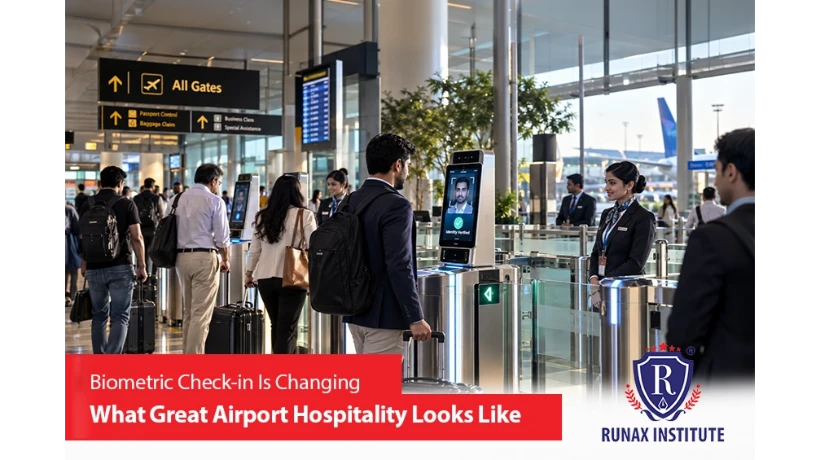
See how biometric check-in is redefining hospitality skills, and why an aviation management course in Kolkata now matters more than ever.
Remember standing in a snaking airport queue, boarding pass in one hand, passport in the other, silently praying the line moves faster? That scene is fading fast. Facial recognition gates now wave passengers through in seconds, and this shift is quietly rewriting what airport hospitality actually means. For students eyeing an aviation management course in Kolkata, this raises a genuine question worth sitting with.
If machines now check identities, scan boarding passes, and process passengers automatically, where does the human hospitality professional fit in? Some assume automation shrinks their role. That assumption is wrong, and believing it could mean missing where the real career opportunity now lies. Airports still need warm, capable humans, just for different moments than before.
Keep reading. This guide breaks down exactly how biometric check-in is reshaping airport hospitality roles in India, what skills future professionals need, and why empathy has become more valuable, not less, in this increasingly automated world.
How Biometric Check-in Actually Works at Indian Airports
Biometric boarding sounds futuristic, but the mechanics are refreshingly simple once explained properly. A passenger registers once using a government app, links their Aadhaar identity, uploads a live selfie, and attaches their boarding pass before travel. At the airport, a camera at the entry gate scans their face, matches it against the stored template, and opens the gate automatically.
India's flagship system for this is DigiYatra, and its growth numbers are genuinely staggering. The Ministry of Civil Aviation and Airports Authority of India reported over 75 million DigiYatra journeys by December 2025, with the platform expanding from just 14 airports in 2023 to more than 100 airports by the end of 2025. That is a sevenfold expansion in roughly two years.
What is biometric check-in and how does it work at airports? Biometric check-in uses facial recognition technology to verify a passenger's identity against their pre-registered digital profile, allowing them to move through entry, security, and boarding without repeatedly showing physical documents.
Kolkata airport itself joined this rollout early, going live with the biometric boarding system back in March 2023 alongside Pune and Vijayawada. For any student studying airport operations in the city, that means Kolkata isn't watching this transformation from the sidelines. It is actively part of it.
The Speed Numbers That Actually Matter
Processing throughput at DigiYatra e-gates now averages just 20 to 30 seconds per traveller, compared to the multiple minutes traditional document checks required. Some industry reports note that overall terminal processing time, from entrance to boarding gate, has dropped from around 45 minutes to closer to 10 minutes at India's busiest hubs. That's not a small efficiency gain. That's a fundamental redesign of how passengers move through a terminal.
What Happens to Hospitality Roles When Machines Handle Check-in
Here's where things get genuinely interesting for aspiring aviation professionals. When machines absorb the repetitive verification tasks, human staff don't become unnecessary. They become more focused, and arguably more valuable.
Think about it practically. A staff member no longer spends their shift scanning boarding passes and checking photo IDs against faces manually. That time gets redirected toward passengers who actually need help. The elderly traveller confused by the e-gate. The family with a crying toddler and too much hand luggage. The business traveller whose flight just got rebooked and needs answers immediately.
Does automation reduce the number of hospitality jobs at airports? Not necessarily; automation shifts hospitality roles away from routine document checking and toward higher value tasks like passenger assistance, problem resolution, and personalised service, which actually require stronger interpersonal skills than before.
This is a genuinely important distinction for anyone considering an aviation management institute in India right now. The job description is changing shape, not disappearing. Employers increasingly want graduates who understand both the technology stack passengers interact with and the emotional intelligence needed to step in when that technology isn't enough.
Where Human Judgment Still Beats Any Algorithm
A biometric gate can verify identity in seconds. It cannot decide whether a distressed passenger needs a translator, a wheelchair, or simply a calm voice explaining what happens next. Machines handle certainty well. Humans handle ambiguity, emotion, and genuine problem solving, which remains firmly in the hospitality professional's court.
Digital Identity, Privacy, and Why Passengers Still Ask Question
Biometric systems raise a fair question among travellers, and honestly, it's one worth taking seriously rather than brushing aside. People hand over their face, essentially their most personal identifier, to a government platform. Naturally, some hesitate.
India's DigiYatra system addresses this through a decentralised design. Rather than storing facial data on a central server, the passenger's encrypted face template lives on their own phone. At the airport, the phone shares an access token with the e-gate, which matches it against the live camera capture, and the match itself happens locally at the gate rather than in some distant database.
Is DigiYatra biometric data safe and privacy compliant? DigiYatra stores facial templates in encrypted form on the passenger's own device rather than a centralised server, and verification happens locally at the airport gate, which is designed to limit unnecessary data exposure.
Even with strong technical safeguards, passengers often want a human to explain this to them in plain language. This is precisely where hospitality staff earn their keep. A well-trained professional who can calmly explain how the data works, why it's optional for domestic flyers, and what happens if someone prefers not to register builds genuine trust. That reassurance simply cannot come from a kiosk screen.
The Trust Gap Technology Alone Cannot Close
Numbers show adoption is strong, with more than 1.2 crore passengers onboarded onto DigiYatra since its 2022 launch. But strong adoption doesn't mean zero hesitation. New flyers, older travellers, and first-time international passengers often need a reassuring human presence before they trust a camera with their identity. That reassurance is a hospitality skill, not a technical one.
Service Recovery Becomes a Bigger Deal in Automated Terminals
Automated systems are impressively reliable, but they aren't flawless. A facial match might fail because of a bad hair day, a new pair of glasses, or simply poor camera lighting. A passenger might arrive without completing app registration. A first-time international traveller might not even know biometric transit is now mandatory at certain checkpoints.
Since June 1, 2026, passengers making international transfers through Delhi, Mumbai, Bengaluru, and Hyderabad airports are required to use DigiYatra's facial recognition system for that transit segment specifically. Mandates like this inevitably create confused, occasionally frustrated passengers who missed the memo entirely.
What happens if biometric check-in fails at the airport? When facial recognition fails to match a passenger, staff step in immediately to verify identity manually using traditional documents, ensuring the passenger isn't delayed or denied boarding due to a technical glitch.
This exact scenario is where service recovery becomes a genuinely critical hospitality skill. A calm, well-trained staff member turns a stressful failed scan into a minor, forgettable hiccup. A poorly trained one turns it into a passenger complaint, a social media post, and a headache for airport management. Training in service recovery, therefore, deserves serious attention in any modern aviation management course.
Building Confidence Through Repeated Small Interactions
Passengers remember how they were treated far more than they remember how fast the gate opened. A staff member who resolves a glitch with patience and a genuine smile builds airport loyalty in ways automation alone simply cannot replicate.
The New Skill Set Aviation Hospitality Professionals Actually Need
Given this shift, what should students studying aviation hospitality management in Kolkata actually focus on? The answer blends technology awareness with classic hospitality fundamentals, and honestly, that combination is more interesting than either skill alone.
Technology awareness means understanding how biometric systems work at a functional level, without needing engineering depth. Graduates should know what DigiYatra does, how e-gates process passengers, and what happens during a system failure. This knowledge lets them troubleshoot confidently instead of standing helplessly beside a malfunctioning kiosk.
What skills do aviation hospitality professionals need in the biometric era? Future professionals need working knowledge of digital identity systems, strong problem-solving ability, multilingual communication skills, and genuine emotional intelligence to manage passengers when automated processes fall short.
Classic hospitality fundamentals remain just as essential, though. Clear communication, patience under pressure, cultural sensitivity, and genuine warmth cannot be automated away, no matter how sophisticated airport technology becomes. If anything, these skills matter more now, because they're increasingly what differentiates one airport's service reputation from another's in a world where the technology itself looks nearly identical everywhere.
Why This Combination Is Rare and Valuable
Most candidates lean heavily toward either technical literacy or soft skills, rarely both. Graduates who genuinely combine the two become disproportionately valuable to airlines and airport operators building out their next generation of ground staff and passenger experience teams.
Where Kolkata Fits into This Growing Industry
Kolkata's airport has been part of India's biometric rollout since the early phase, giving the city a genuine advantage for hospitality education tied to real, functioning infrastructure rather than theoretical case studies alone. Students training here can observe live biometric boarding operations rather than only reading about systems deployed elsewhere.
The broader Indian aviation sector is also scaling fast, with government plans to extend DigiYatra to 27 additional airports beyond the current network. That expansion means growing demand for professionals trained specifically at the intersection of airport operations, digital passenger processing, and traditional hospitality service.
Why should students consider an aviation management course in Kolkata specifically? Kolkata offers hands-on exposure to live biometric airport systems, growing regional aviation infrastructure, and increasing demand for hospitality professionals trained to manage technology-enabled passenger journeys.
Institutes across the city are increasingly weaving digital passenger processing, contactless travel systems, and automated terminal operations directly into their curriculum. This positions graduates ahead of a curve that most traditional hospitality training programs elsewhere in India have yet to fully catch up with.
Conclusion
Biometric check-in hasn't shrunk airport hospitality. It has redirected it toward moments that genuinely matter. Machines now handle identity verification quickly and reliably, freeing human staff to focus on empathy, problem-solving, and the personal touch that no camera or algorithm can replicate.
For students exploring an aviation management course, this shift represents genuine opportunity rather than a threat. The professionals who thrive in this new landscape will understand both sides of the passenger journey, the technology powering seamless entry gates, and the human warmth needed when that technology occasionally stumbles.
Kolkata's evolving aviation ecosystem, backed by real biometric infrastructure already operating at its airport, gives students a genuine head start. The future of airport hospitality isn't about choosing between people and technology. It's about mastering both, and that combination is exactly what tomorrow's aviation employers are actively searching for.
Frequently Asked Questions (FAQs)
Q1. Is DigiYatra mandatory for all domestic flights in India?
No, DigiYatra remains voluntary for domestic travel, though it is now mandatory for international transit passengers at Delhi, Mumbai, Bengaluru, and Hyderabad airports since June 2026.
Q2. How many airports currently support biometric boarding in India?
DigiYatra operates at more than 100 Indian airports as of late 2025, up from just 14 airports in 2023, with continued expansion planned through 2027.
Q3. Will biometric technology eventually replace airport hospitality staff?
No, biometric systems handle identity verification, but human staff remain essential for problem solving, service recovery, passenger assistance, and situations technology alone cannot resolve.
Q4. What career opportunities exist in airport hospitality after an aviation management course?
Graduates can pursue roles in passenger services, ground handling, guest relations, airport operations, and digital passenger experience management across airlines and airport operators.
Q5. How does biometric check-in improve the overall passenger experience?
It reduces processing time from several minutes to under 30 seconds per traveller, cutting queues significantly while allowing staff more time for personalised passenger assistance.


Comments
Login to Comment