How Payment Solutions Help Businesses Manage Multiple Payment Methods Efficiently
30 Sep, 2026
9 Views 0 Like(s)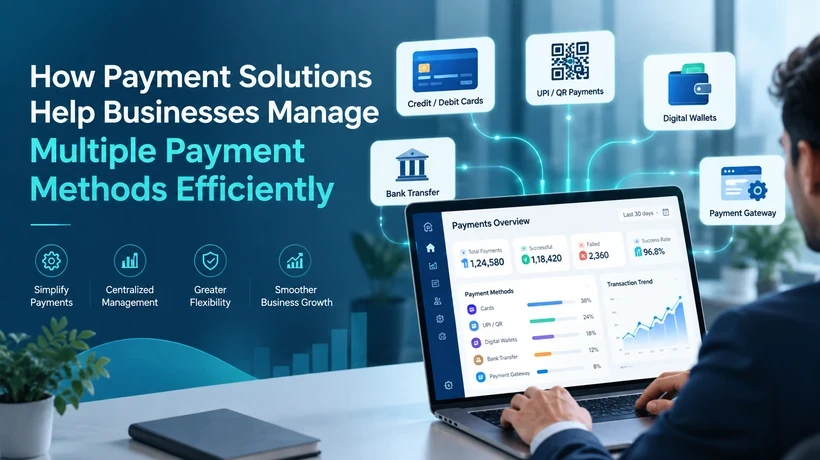
Modern businesses often need to accept payments through cards, bank transfers, digital channels, and international payment methods. Reliable payment solutions help companies bring these different methods into one organized system while improving transaction visibility and financial control. With the right business payment solution, companies can simplify collections, reduce manual work, and provide customers with convenient ways to pay.
Introduction
Customers and businesses no longer depend on a single way to make payments. A company may receive card payments from one customer, bank transfers from another, and international transactions from clients in different countries.
As the number of payment methods increases, managing transactions can become difficult. Finance teams may need to track payments across different platforms, match transactions with invoices, monitor settlements, and prepare financial reports.
Modern payment solutions help businesses manage these activities through structured payment infrastructure.
A reliable business payment solution can bring multiple payment methods together, improve transaction monitoring, and reduce the amount of manual work required to manage payments.
This becomes increasingly important as a company grows and begins serving more customers across different markets.
Why Businesses Need Multiple Payment Methods
Different customers have different payment preferences.
Some prefer card payments, while others use bank transfers or digital payment channels. Business customers may prefer invoice-based payments, and international clients may need payment options suited to their local markets.
Providing more payment options can make transactions more convenient.
Businesses may need to support:
-
Credit and debit cards
-
Bank transfers
-
Digital payment methods
-
Online payment links
-
Recurring payments
-
International payment methods
-
B2B transactions
Managing all these methods separately can increase administrative work.
A centralized payment system can make the process easier.
Centralized Payment Management
One of the main benefits of modern payment solutions is the ability to manage several transaction types through a more organized system.
Without centralized payment management, finance teams may need to check multiple dashboards, bank statements, and transaction records.
This can make reconciliation slower and increase the risk of errors.
A centralized business payment solution allows businesses to view transaction information from a single system or connected financial environment.
Teams can monitor:
-
Successful transactions
-
Pending payments
-
Failed payments
-
Refunds
-
Settlements
-
Transaction values
-
Payment methods
Better visibility can improve financial reporting and reduce confusion.
How Online Payment Solutions Simplify Digital Transactions
Digital channels have become an important part of modern business.
Customers expect to make payments through websites, applications, payment pages, and other digital platforms.
Online payment solutions allow companies to accept these transactions without relying completely on manual processes.
Businesses can use online payment systems to make payment collection faster and more convenient.
For example, an e-commerce company can accept payments during checkout, while a service company can provide customers with digital payment options after issuing an invoice.
Online systems can also record transaction details automatically, reducing the need for employees to enter information manually.
Improving Payment Collection Through Pay-in Services
Receiving money efficiently is just as important as offering multiple payment methods.
Pay-in services support businesses that need structured ways to receive customer payments.
They can help businesses collect funds from different payment channels while improving transaction tracking.
Effective Pay-in services may help companies:
-
Receive customer payments efficiently
-
Track incoming transactions
-
Improve reconciliation
-
Reduce manual record keeping
-
Monitor payment status
-
Improve cash flow visibility
For companies processing a high number of transactions, these capabilities can save significant administrative time.
Managing Business Payments More Efficiently
B2B transactions often involve different processes compared with consumer payments.
Businesses may receive large invoice payments, recurring supplier payments, wholesale transactions, or payments from corporate customers.
A strong system for business payments can help organizations manage these transactions more effectively.
Companies can maintain better records, track pending amounts, and connect payment information with accounting or enterprise systems.
This becomes especially useful as transaction volumes increase.
Supporting Cross Border Payments
Companies that operate internationally face additional payment requirements.
They may receive money from overseas customers or send payments to suppliers in other countries.
Cross border payments can involve multiple currencies, settlement processes, banking networks, and regulatory requirements.
A reliable payment platform can help businesses manage these transactions in a more structured way.
Instead of handling each international transaction through separate manual processes, businesses can use payment infrastructure designed to support global operations.
This can improve transaction visibility and reduce administrative complexity.
The Importance of B2B Cross Border Payments
International B2B transactions often involve suppliers, distributors, service providers, and commercial partners.
These transactions may also involve higher payment values and detailed financial records.
Efficient B2B cross-border payments can help businesses manage international commercial relationships more effectively.
Companies benefit from knowing:
-
When payments were initiated
-
Whether transactions were completed
-
Which currency was used
-
When settlement occurred
-
Which customer or supplier was involved
Accurate information can reduce payment disputes and make reconciliation easier.
Reducing Manual Reconciliation
Reconciliation is one of the most time-consuming parts of payment management.
Finance teams need to confirm that incoming payments match the correct invoices or customer accounts.
When payments come from several channels, this task can become difficult.
Modern payment technology can automate parts of the reconciliation process.
Automatic transaction records can help businesses match payment information more quickly and identify missing or failed transactions.
Reduced manual reconciliation also lowers the possibility of data-entry errors.
Improving the Customer Payment Experience
Payment convenience can influence the overall customer experience.
If customers cannot use their preferred payment method, they may delay or abandon the transaction.
Businesses should therefore offer payment methods that match customer expectations and market requirements.
A well-designed payment process should be:
-
Easy to understand
-
Fast to complete
-
Secure
-
Compatible with common devices
-
Suitable for different customer types
Modern online payment solutions allow businesses to create more convenient digital payment experiences while keeping transaction management organized.
Improving Cash Flow Visibility
When businesses receive payments through several channels, it can become difficult to understand how much money is arriving and when it will become available.
A centralized business payment solution gives finance teams a clearer view of payment activity.
This information can support better cash flow planning.
Businesses can use transaction data to estimate upcoming settlements, monitor unpaid invoices, and plan operating expenses.
Better payment visibility can therefore improve financial decision-making.
Payment Security and Risk Management
Offering more payment options also increases the need for strong security.
Businesses should use payment systems that protect financial information and monitor transactions appropriately.
Security measures may include authentication, encryption, fraud monitoring, and access controls.
Companies should also consider applicable payment regulations and industry requirements when selecting payment providers.
Customers are more likely to trust businesses that provide reliable and secure payment experiences.
Integration With Business Systems
Payment management becomes more efficient when payment technology connects with existing business systems.
Businesses may integrate payment platforms with:
-
Accounting software
-
E-commerce platforms
-
ERP systems
-
Customer management software
-
Billing systems
-
Reporting tools
Integration reduces duplicate data entry and makes it easier to maintain accurate financial records.
It also allows businesses to automate processes such as payment confirmation and invoice updates.
How Uniteller Can Support Payment Management
As businesses handle more digital and international transactions, they need payment infrastructure that can support multiple transaction requirements.
Uniteller provides payment capabilities for businesses that need to manage digital payment operations and international transactions.
A structured payment environment can help companies improve payment collection, transaction visibility, and financial workflows.
Businesses can assess their transaction needs and select payment services that fit their customer base, operational model, and international requirements.
Choosing Payment Infrastructure for Future Growth
Companies should select payment technology with future growth in mind.
A business that currently accepts only a few payment methods may eventually need:
-
More digital payment options
-
Higher transaction capacity
-
International payments
-
Additional currencies
-
B2B transaction support
-
Better reporting tools
A scalable payment system reduces the need to replace infrastructure every time the company expands.
Conclusion
Managing multiple payment methods can become difficult as a business grows.
Modern payment solutions help companies organize card payments, digital transactions, bank transfers, international transactions, and other payment methods within a more structured environment.
A reliable business payment solution can improve transaction visibility, reduce manual reconciliation, and support better financial management.
Businesses that operate internationally can also benefit from reliable cross border payments and structured b2b cross border payments.
By combining online payment solutions, efficient Pay-in services, and organized business payments, companies can create a payment system that supports both customer convenience and operational efficiency.
Providers such as Uniteller can form part of this payment infrastructure as businesses develop more efficient systems for managing domestic and international transactions.



Comments
Login to Comment