When Did Digital Forensics Begin? Tracing Its Evolution From 1978 to Today
29 Jul, 2026
646 Views 0 Like(s)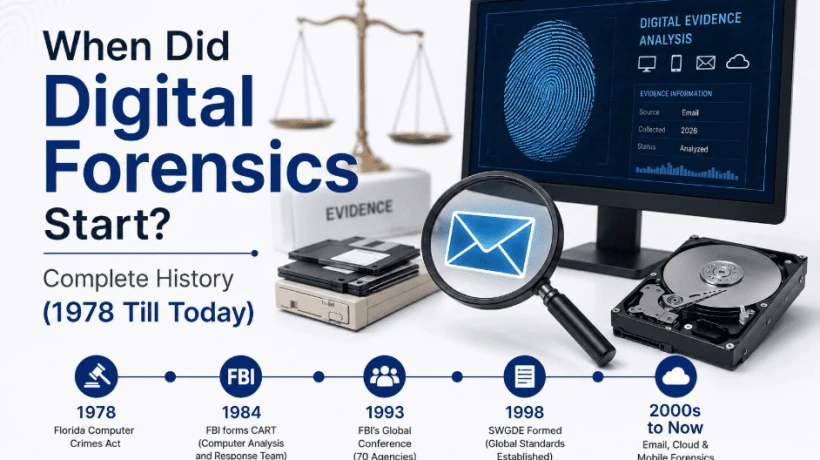
Discover when digital forensics started and how it evolved from early computer crime laws in 1978 to modern email, cloud, mobile, and digital evidence investigations today.
Computers have changed almost every aspect of how people communicate, work, store information, and conduct business. They have also changed how crimes and disputes are investigated. Evidence that once existed mainly as paper documents, fingerprints, photographs, and physical objects can now be hidden inside computers, smartphones, cloud accounts, and emails.
This change did not happen overnight. Digital forensics developed gradually as governments and law enforcement agencies realized that electronic information could become an important source of evidence.
So, when did digital forensics actually begin?
The roots of modern digital forensics are commonly traced to the late 1970s. From early computer crime legislation to specialized forensic teams and internationally recognized procedures, the field has evolved considerably. Today, investigators can examine everything from hard drives and mobile devices to cloud environments and email accounts.
The Early Beginning of Digital Forensics
During the 1970s, computers were becoming increasingly important to governments, universities, and businesses. However, laws and investigative procedures had been designed primarily for crimes involving physical property.
This created a new problem.
What should happen when someone illegally accesses a computer, modifies electronic information, or steals data without physically taking anything?
Florida took an important early step in 1978 by introducing computer crime legislation. It is frequently cited as one of the earliest legislative efforts in the United States specifically addressing computer-related offenses.
This development was important because authorities were beginning to recognize something that seems obvious today: information stored electronically could have real value, and unauthorized actions involving computer systems could constitute criminal activity.
However, passing laws was only one part of the challenge.
Investigators also needed reliable methods to identify, preserve, recover, and examine electronic information.
The FBI and the Rise of Computer Evidence Analysis
By the early 1980s, personal computers were becoming increasingly common. Computers were no longer limited to major institutions, which meant investigators encountered electronic evidence more frequently.
The FBI began developing greater capabilities for examining computer evidence during this period. Its Computer Analysis and Response Team, commonly known as CART, traces its origins to 1984.
This represented an important stage in the professionalization of digital evidence examination.
Investigators increasingly needed specialists who understood how information was stored on electronic media and how it could be recovered without compromising its evidentiary value.
Early examinations were very different from modern investigations. Instead of analyzing terabytes of cloud data, investigators might work with floppy disks and relatively small hard drives.
Nevertheless, the central problem remains familiar today: how can investigators extract useful information while maintaining the integrity of the original evidence?
Why Standard Procedures Became Necessary
As computer use expanded during the late 1980s and 1990s, electronic evidence started appearing in more investigations.
A major challenge soon became apparent. Different organizations could follow different procedures when collecting and examining the same type of digital evidence.
That inconsistency created problems, particularly when evidence needed to be shared across agencies or presented in legal proceedings.
Digital evidence is especially sensitive because investigators can potentially alter information simply by interacting with a device incorrectly. Therefore, forensic procedures needed to be documented, repeatable, and defensible.
The 1990s consequently became an important period for cooperation and standardization.
International discussions among law enforcement organizations helped establish a more consistent understanding of how computer evidence should be handled. Organizations and working groups dedicated to computer and digital evidence subsequently played an important role in developing guidance for investigators.
The Scientific Working Group on Digital Evidence, better known as SWGDE, emerged during this period and became influential in developing best practices for digital evidence.
Digital forensics was gradually moving away from improvised computer examination and toward a recognized professional discipline.
The Internet Completely Changed Digital Investigations
The next major transformation arrived with widespread internet adoption.
During the 1990s and early 2000s, people increasingly used computers not only to store files but also to communicate.
Email became particularly important.
Unlike a traditional letter, an email can contain several layers of technical information. Depending on the available evidence, investigators may examine message headers, timestamps, sender and recipient information, routing details, attachments, mailbox records, and other metadata.
This created the specialized field of email forensics.
Instead of examining only a computer's hard drive, investigators increasingly needed to understand mailbox formats and email infrastructure. Files such as PST, OST, MBOX, and EML could contain valuable information relevant to an investigation.
Modern investigators may use specialized Email Forensics software to process large collections of messages, search for relevant communications, examine metadata, identify relationships between messages, recover available evidence, and generate findings for further investigation.
Email evidence became particularly valuable because a conversation can provide context that an isolated computer file cannot.
From Computers to Smartphones and the Cloud
Digital forensics continued expanding throughout the 2000s and 2010s.
Smartphones introduced another enormous source of evidence. Messages, call information, photographs, application data, location-related records, browsing activity, and account information could potentially become relevant depending on the investigation.
Cloud computing created additional challenges.
Evidence might no longer exist on one physical machine sitting in an office. Information could be distributed across remote servers, online accounts, collaboration platforms, cloud storage services, and multiple devices.
As a result, digital forensics expanded into several specialized areas, including computer forensics, mobile forensics, network forensics, cloud forensics, database forensics, and email forensics.
The technology changed, but the underlying forensic principles remained largely consistent.
Investigators still need to preserve evidence integrity, document their procedures, maintain appropriate records, and ensure that their findings can be independently examined when necessary.
What Digital Forensics Looks Like Today
In 2026, the scale of digital investigations is dramatically different from what early computer investigators encountered.
A single investigation may involve millions of emails, multiple computers, smartphones, cloud accounts, encrypted files, messaging applications, and enormous quantities of metadata.
Modern forensic technologies therefore focus heavily on searching, filtering, correlation, recovery, and reporting.
Automation can help investigators narrow huge datasets to information that deserves closer examination. However, software alone does not make evidence reliable. Proper acquisition, preservation, documentation, validation, and interpretation remain essential.
This is particularly important in email investigations because one message rarely tells the complete story. Investigators may need to examine related conversations, attachments, metadata, headers, timestamps, and mailbox structures before reaching conclusions.
Why the History of Digital Forensics Still Matters
Understanding the history of digital forensics helps explain why modern investigators follow strict procedures.
The field developed because traditional investigative techniques were insufficient for electronic evidence.
Early computer crime legislation demonstrated that digital information required legal recognition. Specialized forensic teams showed that electronic evidence required technical expertise. International cooperation and professional working groups helped establish more consistent methods for handling that evidence.
Today, those ideas apply to technologies that investigators in 1978 could hardly have imagined.
The floppy disk may have been replaced by cloud storage. Early computer networks have been replaced by a globally connected internet. Simple electronic messages have evolved into enormous enterprise mail environments.
Yet the fundamental question remains unchanged:
What happened, and what digital evidence can reliably demonstrate it?
Digital forensics exists to answer that question.
Conclusion
The history of digital forensics stretches back several decades. Its early foundations emerged alongside computer crime legislation in the late 1970s, while dedicated law enforcement capabilities expanded during the 1980s. The 1990s brought greater international cooperation and more formal approaches to handling digital evidence.
The internet, email, smartphones, and cloud computing then transformed both the quantity and complexity of evidence available to investigators.
What started as the examination of relatively simple computer storage has become a broad forensic discipline covering nearly every part of modern digital life.
Technology will continue to change, but the purpose of digital forensics remains remarkably consistent: preserve electronic evidence, examine it methodically, document what was done, and establish findings that can withstand scrutiny.



Comments
Login to Comment