Thales Key Management for Secure Cloud and Hybrid IT Environments
22 Sep, 2026
17 Views 0 Like(s)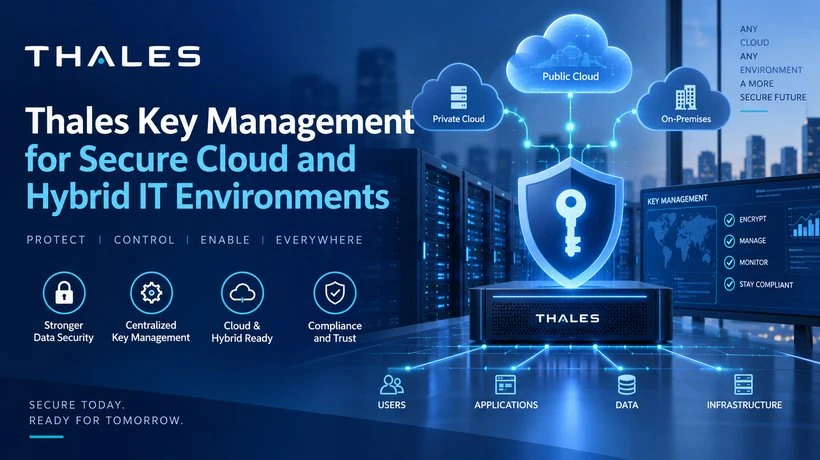
Cloud and hybrid IT environments distribute business data across multiple platforms, increasing the need for centralized and secure cryptographic key management. Thales key management can help organizations control encryption keys across cloud, on-premises, and hybrid infrastructure.
Introduction
Cloud computing has transformed the way organizations store, process, and manage business information. Enterprises now rely on public cloud platforms, private cloud infrastructure, SaaS applications, virtual environments, and traditional data centers to support their daily operations.
Many businesses have adopted hybrid IT environments that combine cloud resources with on-premises infrastructure. Others use multiple cloud providers to support different applications and workloads.
While these models offer flexibility and scalability, they also introduce new security challenges. Sensitive information may move between different environments, applications may communicate across platforms, and encryption keys may support several systems at the same time.
This makes effective Key management an essential part of modern cybersecurity.
Organizations need to protect cryptographic keys throughout their lifecycle while maintaining appropriate access and availability. Thales key management can support enterprises that require centralized management of encryption keys across distributed environments.
When organizations combine centralized key management with HSM Solutions, HSM modules, encryption, and applicable Data security standards, they can establish a stronger approach to protecting sensitive information.
Understanding Cloud and Hybrid IT Environments
A cloud environment allows organizations to access computing resources through remote infrastructure. A hybrid IT environment combines cloud resources with systems operated within an organization's own data center.
A typical enterprise may use:
-
Public cloud applications
-
Private cloud infrastructure
-
On-premises databases
-
Cloud storage
-
SaaS platforms
-
Virtual machines
-
Enterprise applications
Sensitive information can move between these systems every day.
Organizations therefore need consistent security controls regardless of where their data resides.
Why Encryption Matters in Cloud Security
Encryption protects information by converting readable data into an encrypted format.
Businesses can use encryption to protect:
-
Customer information
-
Financial records
-
Employee data
-
Application information
-
Cloud storage
-
Database records
-
Backup data
However, encryption depends on cryptographic keys.
If an attacker gains access to an encryption key, the security of the information protected by that key may be compromised.
For this reason, key management in cryptography plays an important role in cloud and hybrid security.
What Is Key Management in Cryptography?
Key management in cryptography covers the processes involved in controlling cryptographic keys throughout their lifecycle.
A typical lifecycle includes:
-
Key generation
-
Key storage
-
Key distribution
-
Key access
-
Key usage
-
Key rotation
-
Key backup
-
Key recovery
-
Key retirement
-
Key destruction
Cloud environments can make these activities more complex because keys may support applications running across different platforms.
A centralized management approach can help security teams maintain greater visibility.
The Role of Thales Key Management
Thales key management can provide centralized capabilities for managing encryption keys across enterprise environments.
Organizations can use centralized key management to improve visibility into:
-
Key ownership
-
Key lifecycle
-
Access permissions
-
Rotation schedules
-
Key usage
-
Cryptographic policies
This approach can help reduce the fragmentation that often occurs when organizations manage keys separately within each cloud platform.
Centralized management can also help security teams establish common policies across cloud and on-premises infrastructure.
Thales Key Management in Hybrid Infrastructure
Hybrid IT environments require security controls that work across multiple infrastructure types.
For example, a business may store customer information in an on-premises database while running its customer-facing application in the cloud.
The application may need to access encrypted information from the database.
In such an environment, organizations need to control the associated encryption keys without exposing them unnecessarily.
Centralized Key management can help security teams establish policies for how applications access cryptographic keys.
HSM Modules and Cloud Key Protection
HSM modules provide dedicated hardware environments for protecting cryptographic keys and performing sensitive cryptographic operations.
Organizations can use HSM modules to protect:
-
Encryption keys
-
Authentication keys
-
Digital signing keys
-
Certificate keys
-
Database encryption keys
HSM technology adds an additional security layer because critical keys can remain within protected hardware rather than being stored directly within application servers.
HSM Solutions in Hybrid Environments
HSM Solutions provide enterprise capabilities for deploying and managing hardware-based cryptographic protection.
Organizations can use HSM Solutions for:
-
Database security
-
Application encryption
-
Authentication
-
Digital signatures
-
Payment processing
-
Certificate management
HSM technology can complement centralized Key management.
The key management platform can provide lifecycle and administrative controls, while the HSM provides hardware-based protection for critical cryptographic assets.
Protecting Cloud Databases
Cloud databases frequently contain sensitive business information.
A database encryption solution can protect data stored within these systems.
However, the encryption keys require protection as well.
Organizations can combine database encryption with centralized Key management and HSM modules.
This creates a layered architecture:
Sensitive data → Database encryption → Key management → HSM protection
The architecture separates encrypted information from the cryptographic keys used to protect it.
Supporting Data Security Standards
Cloud and hybrid environments must comply with applicable Data security standards, regulations, contractual requirements, and internal security policies.
These requirements may address:
-
Encryption
-
Access control
-
Key protection
-
Authentication
-
Logging
-
Monitoring
-
Data confidentiality
Centralized Key management can help organizations establish consistent policies and maintain records related to cryptographic assets.
However, businesses should evaluate their complete security architecture against the specific requirements applicable to their operations.
Key Rotation in Cloud Environments
Key rotation is an important part of cryptographic lifecycle management.
Organizations may rotate keys based on:
-
Security policies
-
Risk levels
-
Key age
-
Application requirements
-
Applicable standards
Cloud environments can make rotation more complicated because several applications may depend on the same key.
Centralized Key management can help organizations coordinate these activities and reduce the risk of inconsistent rotation procedures.
Access Control and Least Privilege
Cloud security requires strict control over who can access cryptographic assets.
Organizations should apply least-privilege principles.
Users and applications should receive only the permissions required for their approved functions.
Security teams should also protect administrative interfaces using strong authentication and appropriate authorization controls.
Monitoring Cryptographic Activity
Organizations should monitor cryptographic operations across cloud and hybrid environments.
Useful events may include:
-
Key creation
-
Key access
-
Key rotation
-
Administrative changes
-
Failed access attempts
-
Key retirement
Monitoring provides greater visibility and can help security teams identify unusual activity.
Best Practices for Cloud Key Management
Create a Centralized Key Inventory
Document important keys, their purpose, owners, and lifecycle status.
Separate Keys From Data
Avoid unnecessary exposure of encryption keys alongside the data they protect.
Use HSM Technology for Critical Keys
Protect high-value cryptographic assets using appropriately configured HSM modules.
Establish Consistent Policies
Use common requirements for access, rotation, backup, and retirement.
Automate Routine Operations
Automate lifecycle activities where appropriate to reduce manual errors.
Test Recovery Procedures
Ensure authorized teams can recover critical keys when required.
Conclusion
Cloud and hybrid IT environments create new requirements for cryptographic security. Organizations need to protect sensitive information while maintaining control over encryption keys across multiple platforms.
Thales key management can support centralized control over cryptographic keys across cloud, hybrid, and on-premises environments. Key management in cryptography provides the lifecycle framework needed to generate, store, access, rotate, and retire keys securely.
HSM modules add hardware-based protection, while HSM Solutions provide enterprise capabilities for cryptographic security. A database encryption solution can protect sensitive information stored in cloud and on-premises databases.
By combining centralized Key management, HSM technology, encryption, access controls, monitoring, and applicable Data security standards, organizations can create a stronger security framework for modern cloud and hybrid IT environments.

Comments
Login to Comment