Using Sentiment Data to Train AI for Customer Support
06 Oct, 2026
9 Views 0 Like(s)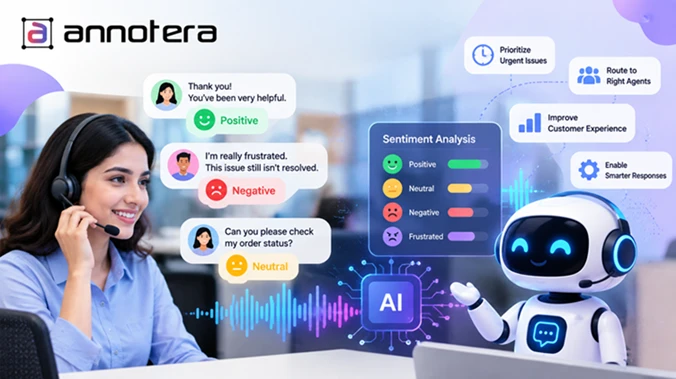
Sentiment data helps train AI systems to understand customer emotions, identify frustration, prioritize support requests, personalize responses, improve chatbot performance, and deliver more responsive, effective customer experiences.
Customer support is no longer limited to answering questions and resolving tickets. Modern support systems are expected to understand what customers are saying, recognize how they feel, identify urgency, and respond appropriately. This is where sentiment data becomes valuable for artificial intelligence (AI).
Sentiment data helps AI models learn to distinguish between positive, negative, neutral, and more nuanced emotional states within customer interactions. When properly annotated and incorporated into training datasets, this information can help AI-powered support systems recognize frustration, satisfaction, confusion, urgency, and other signals that influence customer experience.
For organizations developing conversational AI, chatbots, voice assistants, and automated ticket-routing systems, high-quality sentiment data can provide an important foundation for more context-aware customer support.
What Is Sentiment Data in Customer Support?
Sentiment data refers to information that captures the emotional attitude or opinion expressed by a customer during an interaction. It can be derived from support tickets, emails, live chats, reviews, social media comments, or recorded customer-service calls.
For example, consider these statements:
-
“Thank you, the issue was resolved quickly.” — Positive
-
“I have contacted support three times and nobody has helped me.” — Negative or frustrated
-
“Can you tell me how to change my billing address?” — Neutral
-
“I understand the solution, but I’m still disappointed with the experience.” — Mixed sentiment
Simply assigning positive, negative, or neutral labels may not always be enough. Customer-support AI may benefit from more detailed labels such as frustration, satisfaction, confusion, urgency, disappointment, appreciation, or anger.
Sentiment analysis can use customer interactions across multiple channels to identify patterns and understand the factors influencing customer experience.
Why Sentiment Data Matters for AI Training
AI models learn patterns from training data. Data labeling adds meaningful information to raw datasets, allowing machine-learning systems to associate specific examples with desired classifications or outcomes. Consequently, both the quality and relevance of labeled data can influence model performance.
For customer-support AI, sentiment labels provide an additional layer of context.
Imagine a customer writing:
“Great. Another error. Exactly what I needed today.”
A basic keyword-based system could incorrectly identify “Great” as positive. A properly trained model, however, can learn from annotated examples that phrases like this may communicate sarcasm or frustration depending on context.
This distinction is critical when AI systems are expected to prioritize tickets, recommend responses, identify escalation risks, or assist human support representatives.
How Sentiment Annotation Supports Customer-Support AI
The process generally begins by collecting representative customer interactions. These may include chat conversations, support tickets, emails, call transcripts, or other customer-service data.
Human annotators then apply predefined sentiment guidelines to each relevant data point.
A practical annotation workflow can include:
1. Defining the Sentiment Taxonomy
Organizations first establish the categories the AI system needs to recognize. A basic taxonomy might include positive, negative, and neutral. More advanced projects can introduce categories such as frustrated, angry, satisfied, confused, disappointed, or urgent.
The taxonomy should reflect the intended AI application rather than simply creating as many labels as possible.
2. Annotating Customer Interactions
Human annotators review customer statements and assign the appropriate sentiment labels. For conversational datasets, sentiment can be assigned at the utterance, message, conversation, or issue level depending on the project requirements.
For voice-based support, transcripts can also be enriched with information such as speaker identity, emotion, tone, or relevant audio events.
3. Capturing Context
Customer sentiment frequently depends on context. A single sentence may appear positive when viewed independently but communicate frustration within a longer conversation.
Annotation guidelines should therefore explain how to interpret previous messages, conversation history, product references, negation, sarcasm, and mixed emotions.
4. Reviewing Annotation Quality
Quality assurance is essential. Multiple annotators can review selected samples, disagreements can be analyzed, and guidelines can be refined where recurring ambiguity is discovered.
Consistent annotation helps create a more reliable ground-truth dataset for model development.
Training AI to Recognize Frustrated Customers
One of the most practical applications of sentiment data is frustration detection.
A customer-support AI trained on appropriately labeled interactions can learn patterns associated with escalating dissatisfaction. These patterns may include repeated complaints, negative language, unresolved issues, or statements indicating that previous support attempts have failed.
The model can then support workflows such as:
-
Prioritizing highly frustrated customers
-
Routing conversations to specialized agents
-
Triggering escalation workflows
-
Suggesting empathetic responses
-
Identifying recurring customer pain points
-
Monitoring support quality
Real-world implementations demonstrate how sentiment analysis can be integrated into customer-care operations. For example, IBM describes a Wix deployment in which sentiment prediction was applied to support interactions to help monitor customer and support sentiment.
Using Audio Sentiment Data for Voice Support
Text is only one part of customer service. Voice interactions contain additional information that can be useful for AI systems.
A customer may say, “That’s fine,” while their overall interaction indicates dissatisfaction. For voice AI, useful training data can therefore include transcribed speech alongside annotations for sentiment, emotion, speaker turns, and relevant acoustic characteristics.
This makes audio annotation outsourcing services particularly useful for organizations building speech-enabled customer-support systems. Specialized annotation teams can help prepare large volumes of conversational audio according to project-specific labeling guidelines.
An experienced audio annotation company can support datasets designed for speech recognition, emotion detection, conversational AI, and sentiment-aware virtual assistants while maintaining consistent annotation standards.
Improving Chatbots With Sentiment-Aware Training Data
Traditional chatbots may respond to the words in a customer's message without fully considering emotional context. Sentiment-aware AI can introduce another decision-making signal.
For instance, two customers may ask the same question about a delayed delivery:
-
“Could you please tell me when my order will arrive?”
-
“Where is my order? It was supposed to arrive days ago!”
Both messages concern delivery status, but the second indicates stronger dissatisfaction.
A sentiment-aware support system can use this distinction to adjust response tone, prioritize the interaction, or recommend human intervention.
AI systems can also combine sentiment classification with other support-related tasks, including ticket categorization, urgency detection, and response recommendation. Recent AI workflows demonstrate how specialized classification models can be integrated with conversational agents for support-related applications.
Challenges in Building Sentiment Training Datasets
Creating useful sentiment datasets requires more than assigning simple labels. Customer language is often informal, multilingual, contextual, and emotionally complex.
Common challenges include:
-
Sarcasm and indirect expressions
-
Mixed positive and negative sentiment
-
Ambiguous language
-
Cultural differences in emotional expression
-
Domain-specific terminology
-
Long conversational histories
-
Inconsistent annotation decisions
-
Privacy and sensitive customer information
These challenges make detailed annotation guidelines, trained annotators, multi-level quality checks, and representative datasets important components of the training-data pipeline.
Build Better Customer-Support AI With High-Quality Sentiment Data
The effectiveness of customer-support AI depends not only on the sophistication of the model but also on the quality of the data used to train and evaluate it. Well-designed sentiment datasets can help AI systems recognize customer emotions, understand conversational context, prioritize interactions, and support more appropriate responses.
For companies developing chatbots, voice assistants, ticket-classification systems, or customer-experience analytics platforms, sentiment annotation can turn unstructured customer interactions into structured training signals.
At Annotera, we help businesses prepare high-quality annotated datasets for AI and machine-learning applications. From text and conversational data to speech and emotion-related datasets, our annotation workflows are designed around project-specific taxonomies, quality requirements, and AI objectives.
As customer support becomes increasingly intelligent and automated, sentiment data can help bridge the gap between simply understanding what customers say and understanding how they feel.


Comments
Login to Comment