The Unseen Symphony: How Understanding Human Psychology Transforms Learning
05 Dec, 2025
9990 Views 12 Like(s)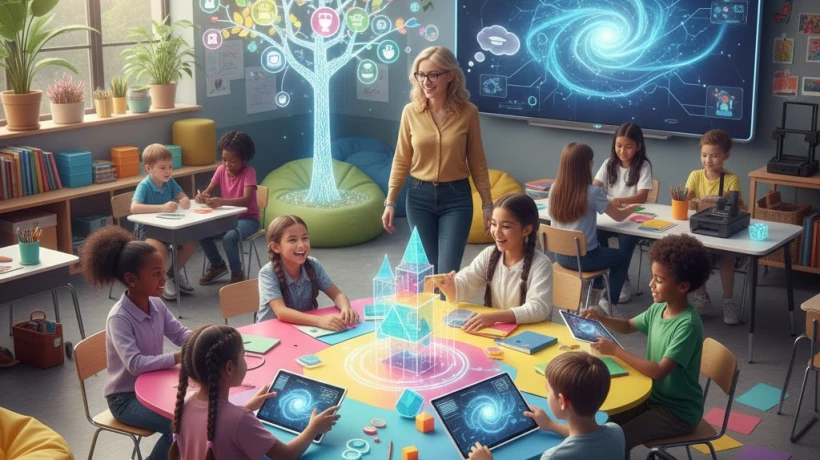
Learning. It's a word we throw around constantly, from the first babble of a toddler to the seasoned scholar dissecting ancient texts. But what is learning, really?
Learning. It's a word we throw around constantly, from the first babble of a toddler to the seasoned scholar dissecting ancient texts. But what is learning, really? Is it just absorbing facts, memorizing dates, or mastering a skill? Or is there a deeper, more intricate dance at play – a subtle symphony conducted by the very wiring of our brains, our emotions, and our social connections?
For too long, education has often been treated as a one-size-fits-all conveyor belt, designed to process students through a standardized curriculum. We’ve focused on what to teach and how to deliver content, sometimes forgetting the most crucial element: the human being doing the learning. But a quiet revolution is underway, fueled by a growing understanding of human psychology. When we truly grasp how our minds work, how we feel, and how we interact, we unlock a powerful potential to transform learning from a chore into a joyous, deeply meaningful experience.
The Brain: Your Personal Supercomputer (with Quirks!)
Imagine your brain as an incredibly sophisticated supercomputer, but one that didn’t come with a user manual. Neuropsychology is slowly writing that manual, revealing fascinating insights into how we process information, form memories, and solve problems.
Take, for instance, the concept of neuroplasticity. For a long time, we believed our brains were largely fixed after childhood. Now, we know that’s far from the truth. Your brain is constantly rewiring itself, forming new connections and pruning old ones, based on your experiences. This isn't just a biological marvel; it's a profound message of hope for learners of all ages. It means you are never "too old" or "not smart enough" to learn something new. Every effort, every challenge, every new piece of information literally changes your brain. This understanding empowers us to embrace challenges, knowing that struggle isn't a sign of failure, but a catalyst for growth.
Another key insight is the role of attention. In our hyper-connected world, sustained attention is a superpower. Our brains are not designed to multitask; they rapidly switch between tasks, leading to decreased efficiency and poorer retention. Understanding this allows educators to design lessons that minimize distractions, incorporate focused activities, and provide opportunities for mindful engagement. For learners, it’s a call to create dedicated learning spaces and practice single-tasking – a skill as vital as any academic subject.
Then there's memory. It's not a single vault but a complex system with different types and stages. We have working memory, which is like a temporary notepad, and long-term memory, our vast library of knowledge and experiences. Psychology teaches us about effective encoding strategies (how we get information into long-term memory), like spaced repetition, active recall, and elaborative rehearsal. Instead of rote memorization, we can encourage students to connect new information to existing knowledge, explain concepts in their own words, and retrieve information regularly – making learning stick.
Here’s a little visual to get you thinking about the brain’s incredible complexity!
Think back to a time you learned something effortlessly, almost joyfully. Chances are, positive emotions were involved – curiosity, excitement, a sense of accomplishment. Now, recall a time learning felt like pulling teeth. Frustration, anxiety, or boredom likely played a significant role. This isn't coincidence; it's psychology in action.
Our emotions are not separate from our cognitive processes; they are deeply intertwined. The amygdala, the brain's alarm system, lights up when we feel threatened or anxious. When it's overactive, it can hijack our prefrontal cortex – the part of the brain responsible for higher-order thinking, problem-solving, and decision-making. This is why test anxiety can make even the most prepared student blank out. Understanding this allows us to create emotionally safe learning environments, where mistakes are seen as opportunities, not failures, and where support and encouragement are paramount.
Conversely, positive emotions enhance learning. Curiosity, for example, acts like a magnet, drawing us towards new information and making it more memorable. When we're genuinely interested, our brains release dopamine, a neurotransmitter associated with pleasure and motivation. This creates a virtuous cycle: curiosity leads to engagement, engagement leads to understanding, and understanding fuels further curiosity. Educators can tap into this by designing lessons that spark wonder, ask intriguing questions, and connect content to students' real-world interests.
Motivation, another emotional driver, comes in many forms. Intrinsic motivation, the desire to learn for its own sake, is the holy grail. Extrinsic motivation, driven by external rewards or punishments, can be useful but often less sustainable. Psychology helps us understand how to nurture intrinsic motivation by fostering a sense of autonomy (allowing choice), competence (providing opportunities for success), and relatedness (feeling connected to others).
Social Animals: Learning in the Collective
Humans are fundamentally social creatures. We thrive on connection, communication, and collaboration. It's no surprise, then, that our social nature profoundly impacts how we learn.
Social learning theory, pioneered by Albert Bandura, highlights the power of observational learning. We learn by watching others, imitating their actions, and observing the consequences. This is why role-modeling by teachers, mentors, and peers is so effective. When students see others grappling with challenges and eventually succeeding, it builds their own self-efficacy – their belief in their ability to achieve a goal.
Collaboration is another cornerstone of humanized learning. When students work together, they don't just share the workload; they engage in rich cognitive and social processes. They articulate their thoughts, challenge each other's assumptions, negotiate meaning, and learn to compromise. This peer interaction not only deepens understanding but also develops essential social-emotional skills like empathy, communication, and conflict resolution. Group projects, debates, and peer tutoring are not just "nice-to-haves" but powerful pedagogical tools.
Furthermore, a sense of belonging is crucial. When students feel accepted, valued, and connected to their learning community, they are more likely to participate, take risks, and persevere through difficulties. Creating an inclusive classroom culture where diverse perspectives are celebrated and where every voice is heard is not just about being "nice"; it's about optimizing the learning environment for every individual.
Bringing it All Together: The Humanized Classroom
So, what does a "humanized" approach to learning look like in practice? It's not about abandoning structure or rigor; it's about integrating psychological insights into every aspect of the educational experience.
-
Empathy-Driven Design: Teachers become attuned to students' emotional states, recognizing when anxiety is high or motivation is low, and adjusting accordingly.
-
Active Engagement: Lessons move beyond passive listening, incorporating hands-on activities, discussions, problem-solving, and creative projects.
-
Personalized Pathways: Recognizing individual differences in learning styles, pace, and interests, offering choices and differentiated instruction.
-
Feedback as Fuel: Shifting from grades as judgment to feedback as guidance, focusing on growth and improvement.
-
Cultivating Growth Mindset: Encouraging students to see intelligence as something that can be developed through effort, rather than a fixed trait.
-
Building Community: Fostering a supportive, collaborative, and inclusive environment where every learner feels safe to explore and grow.
Imagine a classroom where students are genuinely excited to come to school, where they feel challenged but supported, where their voices are heard, and where they understand why they are learning what they are learning. This isn't a utopian dream; it's an achievable reality when we remember that at the heart of every educational endeavor is a complex, emotional, and social human being.
By embracing the insights of human psychology, we can move beyond simply transmitting information and instead cultivate environments where minds flourish, spirits soar, and the true, unseen symphony of learning plays on.

Comments
Login to Comment