The Complete Guide to Scaling Podcast in a Competitive Market
29 Apr, 2026
1929 Views 0 Like(s)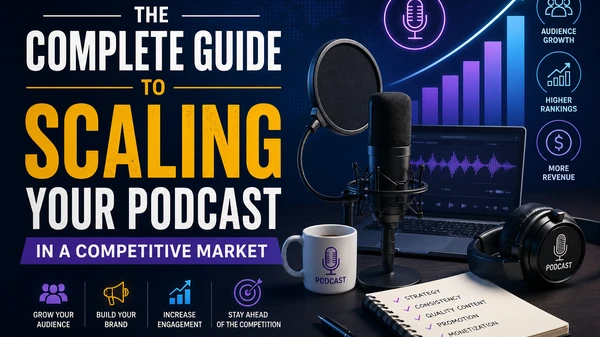
Learn how to scale your podcast in a competitive market with proven strategies to grow your audience, boost engagement, and build a powerful brand.
Podcasting is no longer an emerging medium—it’s a crowded arena where thousands of new shows launch every day. What once felt like an open playing field has evolved into a highly competitive ecosystem where only the most strategic creators grow consistently. Scaling a podcast today requires more than just good content; it demands clarity, positioning, systems, and a deep understanding of audience behavior.
This guide explores modern, practical, and often overlooked strategies to help you grow your podcast sustainably—even in a saturated market.
Understanding What “Scaling” Really Means
Before diving into tactics, it’s important to redefine scaling. Many creators assume scaling simply means getting more downloads. While audience growth is a component, true scaling involves:
- Increasing listener retention
- Expanding brand authority
- Building revenue streams
- Creating systems that grow without constant manual effort
Scaling is not about chasing viral spikes—it’s about building a compounding ecosystem.
Step 1: Define a Sharp Market Position
Most podcasts fail to grow because they are too broad. In a competitive market, specificity wins.
Instead of:“A podcast about business”
“A podcast for first-time founders building SaaS products under $1M ARR”
This sharp positioning does three things:
- Attracts the right audience faster
- Makes your content easier to discover
- Builds authority in a niche instead of being lost in a crowd
The “Category Gap” Strategy
Look for gaps between existing shows. Instead of competing directly, position yourself between categories.
Example:
- Not just “fitness”
- Not just “mental health”
- But: “Mental fitness for entrepreneurs”
This creates a new micro-category where competition is lower but demand still exists.
Step 2: Engineer Binge-Worthy Content
Scaling isn’t about attracting new listeners—it’s about turning first-time listeners into loyal subscribers.
The Binge Loop Framework
Design your episodes so each one leads naturally into another:
- End episodes with a teaser:
“In the next episode, we’ll break down how this strategy failed—and what you should do instead.” - Create thematic clusters (mini-series)
- Use callbacks to previous episodes
This increases session time and signals platforms that your content is valuable.
Step 3: Optimize for Discovery Algorithms
Podcast platforms now function similarly to search engines and social feeds. You need to optimize for discoverability.
Title Strategy
Avoid vague titles:
- ❌ “Episode 12: Interview with John”
- ✅ “How John Built a $100K/Month Business Without Ads”
Keyword Layering
Use keywords naturally in:
- Episode titles
- Descriptions
- Show notes
Think about how your audience searches:
- “How to start a podcast”
- “Podcast growth tips”
- “Monetizing podcasts”
Step 4: Mid-Stage Growth Acceleration
Once your podcast has a foundation, scaling requires more structured strategies.
This is where working with the best podcast marketing company can make a significant difference. Instead of guessing what works, you gain access to proven systems for:
- Audience targeting
- Paid promotion strategies
- Analytics-driven growth
- Brand positioning
However, outsourcing only works if your core content and positioning are already strong. No marketing strategy can fix unclear messaging.
Step 5: Leverage Strategic Guesting
Guest appearances are one of the fastest ways to grow—if done strategically.
The Audience Overlap Rule
Don’t just invite big names. Invite people whose audience matches yours.
Ask:
- Do they speak to the same type of listener?
- Will their audience actually care about my content?
Reverse Guesting
Instead of waiting for guests, go on other podcasts. This exposes you to established audiences without paid ads.
Step 6: Create a Listener Conversion Funnel
Most podcasts lose potential subscribers because they lack a clear conversion path.
The 3-Step Funnel
- Listener → Subscriber
Ask for subscription clearly and consistently - Subscriber → Community Member
Invite listeners to join:- Email list
- WhatsApp group
- Discord
- Community → Customer
Offer products, services, or memberships
Scaling is easier when you own your audience outside podcast platforms.
Step 7: Build Authority Through Depth, Not Frequency
Many creators believe posting more episodes leads to growth. In reality, depth often beats frequency.
The Authority Signal
Instead of:
- 5 shallow episodes per week
Focus on:
- 1 high-value, deeply researched episode
Listeners share insights, not volume.
Step 8: Collaborate Instead of Compete
In a saturated market, collaboration is a growth shortcut.
Types of Collaborations
- Episode swaps
- Co-hosted series
- Cross-promotions
- Joint live sessions
This allows you to tap into existing audiences without starting from scratch.
Step 9: Monetization as a Growth Tool
Monetization isn’t just about revenue—it can accelerate scaling.
Smart Monetization Models
- Sponsorships
- Premium content
- Courses
- Consulting
When done right, monetization:
- Validates your podcast
- Attracts better guests
- Increases perceived value
Step 10: Build a Distribution Engine
Most podcasters spend 90% of their time creating and 10% distributing. This should be reversed.
Content Multiplication System
Turn one episode into multiple assets:
- Short-form video clips
- LinkedIn posts
- Twitter threads
- Blog articles
- Email newsletters
Each format reaches a different segment of your audience.
Platform-Specific Strategy
Don’t post the same content everywhere. Adapt it:
- Instagram → Emotional hooks
- LinkedIn → Insights and lessons
- YouTube → Search-based content
Scaling happens when your content travels beyond the podcast platform.
Step 11: Use Data to Guide Decisions
Scaling without data is like navigating without a map.
Key Metrics to Track
- Listener retention rate
- Episode completion rate
- Subscriber growth
- Traffic sources
The Insight Loop
- Analyze data
- Identify patterns
- Adjust content
- Test again
Small improvements compound over time.
Step 12: Build a Recognizable Brand Identity
In a competitive market, your podcast needs to be instantly recognizable.
Brand Elements
- Consistent tone of voice
- Unique intro/outro
- Visual identity (cover art, thumbnails)
- Signature themes or segments
Your podcast should feel familiar even before someone hears your voice.
Step 13: Create “Shareable Moments”
Growth often comes from listeners sharing your content.
The Share Trigger Formula
People share content that is:
- Surprising
- Useful
- Relatable
- Emotional
Design moments in your episodes that naturally encourage sharing.
Step 14: Long-Term Scaling Through Systems
Sustainable growth comes from systems, not effort.
Build Repeatable Processes
- Content calendar
- Editing workflow
- Publishing checklist
- Distribution plan
This reduces burnout and ensures consistency.
Step 15: Adapt to Changing Trends
Podcasting is evolving rapidly. What worked last year may not work today.
Emerging Trends
- Video podcasts
- AI-assisted production
- Interactive content
- Community-driven shows
Stay flexible and experiment regularly.
Step 16: Mindset Shift for Scaling
Finally, scaling requires a different mindset.
From Creator to Operator
Early stage:
- Focus on creating content
Growth stage:
- Focus on building systems
Scale stage:
- Focus on strategy and leverage
This shift is what separates small podcasts from scalable brands.
Final Thoughts
Scaling a podcast in a competitive market isn’t about luck—it’s about strategy, consistency, and adaptability. The creators who succeed are not necessarily the loudest or the most frequent, but the ones who understand their audience deeply and build systems that compound over time.
If you focus on:
- Clear positioning
- High-value content
- Strategic distribution
- Data-driven decisions
Your podcast can grow—even in the most crowded spaces.
The market may be competitive, but it’s far from saturated for those who approach it intelligently.
Disclaimer: ThynkTales is a public blogging platform where content is contributed by individual users. While we encourage thoughtful and accurate sharing, we do not independently verify the information provided. Readers are advised to use their discretion and verify any information before relying on it.


Comments
Login to Comment