The 2026 Transit Shield: Navigating How to Transport a Car Without Insurance
11 May, 2026
1800 Views 0 Like(s)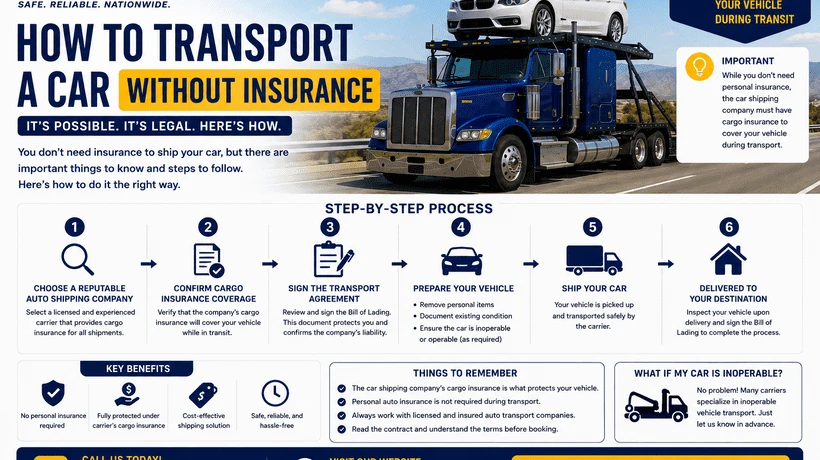
Learning how to transport a car without insurance in 2026? Understand the difference between personal auto policies and mandatory carrier cargo insurance. Discover how Rapid Auto Shipping’s $0-down booking and fully insured transport model provide the legal and financial safety net for your vehicle relocation.
In the 2026 automotive ecosystem, the question of how to transport a car without insurance is a common inquiry for buyers of project cars, classic barn finds, or those in the middle of a title transfer. Many owners mistakenly believe that if their vehicle is not currently registered or covered by a personal insurance policy, it cannot be legally moved across state lines. However, the professional transport industry is structured specifically to handle these scenarios. While a car must be insured to be driven on public roads, the legal framework for shipping a vehicle relies primarily on the carrier’s cargo and liability insurance, not the owner’s personal policy. This distinction is the cornerstone of professional logistics, allowing for the secure movement of non-operational or uninsured assets from one driveway to another.
At Rapid Auto Shipping, we have spent over 14 years bridging the gap between vehicle ownership and professional logistics. In 2026, we have enhanced our "Security-First" protocol to ensure that every vehicle—insured or not—is covered under a comprehensive $1,000,000+ cargo insurance policy. Our signature $0-down booking policy and TruePrice guarantee ensure that you can secure a professional transport solution without the stress of upfront fees or hidden insurance surcharges.
The 2026 Insurance Divide: Personal Policy vs. Carrier Cargo
When you are looking for how to transport a car without insurance, it is vital to understand where the liability sits. In 2026, federal regulations from the FMCSA (Federal Motor Carrier Safety Administration) mandate that all licensed interstate carriers maintain substantial cargo insurance.
1. The Carrier’s Cargo Shield
When your vehicle is loaded onto a Rapid Auto Shipping trailer, it is officially classified as "cargo." Our carriers maintain high-limit policies that cover the vehicle against transit-related incidents, including collisions, fire, theft, and equipment failure. This insurance is primary, meaning it pays out regardless of whether you have a personal policy on the car.
2. $0-Down Financial Security
In the 2026 market, reputable companies do not ask for payment before a carrier is assigned. By choosing a $0-down model, you ensure that your capital is protected until a vetted, insured driver is officially dispatched to your location, verifying their credentials and insurance status before you commit financially.
Strategic Transit Hubs: Navigating the 2026 Interstate Grid
A professional car transport service relies on the "Precision Pipeline"—a network of high-velocity interchanges where carriers can move efficiently while minimizing the risk of urban congestion.
Common Route Main Intersections
If your uninsured vehicle is moving through these strategic 2026 nodes, our routing engine prioritizes them for their superior road quality and carrier density:
-
The Tom Moreland Interchange (Spaghetti Junction - Atlanta, GA): The definitive "Logistics Anchor of the South," essential for vehicles moving between the Atlantic coast and the Midwest.
-
The Judge Harry Pregerson Interchange (Los Angeles, CA): The ultimate multi-level hub for the West Coast, connecting the I-110 and I-105 for high-speed delivery to the Pacific ports.
-
The Jane Byrne Interchange (Circle Interchange - Chicago, IL): The vital pivot point for the Heartland, connecting the I-90/94 and I-290 corridors.
-
The High Five Interchange (Dallas, TX): A critical junction for the "Texas Triangle," facilitating massive volume for transcontinental hauls.
-
The Kew Gardens Interchange (Queens, NY): The primary Northeast gateway, serving nearly 600,000 vehicles daily and acting as a major staging hub for the Tri-State area.
2026 Service Tiers: Specialized Solutions for Uninsured Assets
Even without personal insurance, your vehicle deserves the highest level of protection. In 2026, we offer specialized tiers to match the value and condition of your asset.
Open-Air Secure Transport
The industry standard for 2026. This service utilizes high-capacity trailers on major corridors like the I-80 and I-10. It is the most cost-effective method for shipping project cars or daily drivers that are currently in-between insurance coverages.
Enclosed "Vault" Protection
For high-value classics or luxury exotics bound for private collections, enclosed transport provides a hard-sided environment. This shields the vehicle from road debris, weather, and prying eyes, backed by higher insurance limits—often up to $5,000,000—to reflect the vehicle's market value.
Inoperable Vehicle Logistics
If you are transporting a car without insurance because it doesn't currently run, we utilize specialized "Winch-Equipped" carriers. Our 2026 inoperable division is trained to load and unload non-running vehicles without causing damage to the suspension or frame, maintaining the vehicle's integrity throughout the journey.
The Rapid Auto Shipping Trust Mandate: 2026 Integrity
In an industry where "hidden fees" are common, Rapid Auto Shipping leads with professional ethics:
-
Full Insurance Inclusion: Every quote we provide includes the cost of the carrier's cargo insurance. You will never be asked to pay extra for "basic coverage."
-
TruePrice Guarantee: Our 2026 quotes are all-inclusive, factoring in fuel, tolls, and the specific equipment needed for your vehicle’s condition.
-
Privacy-First Quoting: Use our platform to explore your transport options without having your personal data sold to third-party marketing lists.
Professional Preparation for the Insurance-Free Move
To ensure a seamless transport experience in 2026, follow these industry-standard preparation protocols:
-
The e-BOL Documentation: Even without insurance, you must document the vehicle's condition. In 2026, we use an electronic Bill of Lading (e-BOL). Take 20+ high-resolution, timestamped photos at pickup. This is your primary evidence should a claim need to be filed against the carrier's insurance.
-
Quarter-Tank Protocol: Keep fuel at exactly 1/4 tank. This is a mandatory 2026 safety standard that optimizes the weight balance of the trailer and ensures DOT compliance.
-
Personal Property Removal: Carrier insurance only covers the car. Remove all personal belongings, electronics, and spare parts from the interior, as these are not covered under the cargo policy.
-
Disable Alarms: Ensure any aftermarket alarms are fully disabled. Constant vibrations during transit can trigger alarms, draining the battery and causing delays at delivery.
Conclusion: Relocating with Professional Confidence
Moving a vehicle without active personal insurance doesn't have to be a risk. By understanding how to transport a car without insurance through the lens of professional carrier liability, you can relocate any asset with total peace of mind. By choosing Rapid Auto Shipping, you are leveraging 14 years of veteran expertise and a commitment to total transparency.
From the massive interchanges of Texas to the coastal gateways of New York and California, we move your vehicle with the precision, care, and technological edge that the 2026 market demands.
Ready to secure a safe, insured transport solution for your vehicle? Contact Rapid Auto Shipping today for a personalized, $0-down quote and experience the premier standard in professional vehicle relocation.
Comments
Login to Comment