Stock Market Crash: New War Looms, Trump Threatens... Stock Market Crashes Again, Sensex Falls 1000 Points
18 May, 2026
1673 Views 0 Like(s)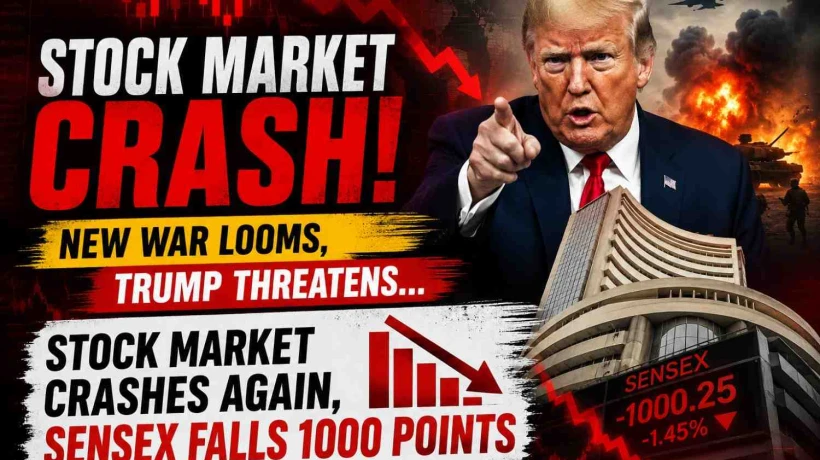
Stock Market Crash: New War Looms, Trump Threatens... Stock Market Crashes Again, Sensex Falls 1000 Points
The Indian stock market witnessed another massive selloff as rising global tensions and fresh warnings from former US President Donald Trump triggered panic among investors. The Sensex plunged over 1000 points during intraday trading, while the Nifty also slipped sharply as fears of a possible geopolitical conflict rattled global financial markets.
Investors across the world are becoming increasingly nervous due to escalating tensions between major countries. Reports of military build-ups, aggressive political statements, and uncertainty over international trade policies have once again pushed markets into a risk-off mode. The Indian market, which had been showing signs of recovery in recent sessions, came under heavy pressure as foreign investors rushed to pull money out of equities.
Market experts say the sharp decline was not caused by a single event but rather a combination of global fears, weak investor sentiment, and concerns about future economic stability. The biggest trigger came after Donald Trump issued strong remarks regarding ongoing geopolitical disputes, raising fears that global tensions could intensify further in the coming weeks.
As soon as the news spread, Asian markets turned red. Indian investors also reacted quickly, leading to massive selling in banking, IT, auto, and metal stocks. Major companies listed on the Sensex witnessed heavy losses, dragging the index down sharply. Small-cap and mid-cap stocks were also not spared, with many shares falling between 3% and 7%.
Analysts believe that whenever global uncertainty increases, investors usually move their money toward safer assets such as gold and the US dollar. This trend was visible once again as gold prices climbed while equity markets struggled. Foreign Institutional Investors (FIIs) reportedly sold large amounts of Indian equities, increasing pressure on domestic markets.
The banking sector was among the worst-hit segments during the crash. Leading private and public sector bank stocks fell significantly as concerns over global economic slowdown resurfaced. IT companies also faced strong selling pressure because many of them depend heavily on business from the United States and Europe. If geopolitical tensions escalate further, global corporate spending could slow down, affecting earnings growth for technology firms.
Another major reason behind the market decline is rising crude oil prices. Any possibility of war or military conflict in oil-producing regions often pushes crude prices higher. Since India imports a large portion of its oil requirements, rising crude prices can increase inflation and widen the fiscal deficit. Investors fear that higher fuel costs may hurt economic growth and reduce consumer spending.
Retail investors were seen reacting emotionally to the sudden fall, with many panic-selling their holdings. However, financial advisors are urging investors not to make decisions based solely on short-term market movements. Historically, stock markets have shown resilience after major corrections, especially when the underlying economy remains strong.
Experts also pointed out that volatility may remain high in the coming days. Traders are closely watching global developments, especially political statements from world leaders and any signs of military escalation. If tensions continue to rise, markets could witness further corrections. On the other hand, any diplomatic breakthrough or calming signals from global powers may help markets recover quickly.
Despite the sharp crash, some analysts believe long-term investors should view corrections as an opportunity rather than a threat. Many fundamentally strong companies are now trading at lower valuations, which could attract buyers once panic subsides. Sectors linked to infrastructure, defense, and domestic consumption may continue to remain relatively stable compared to export-driven industries.
Meanwhile, the Indian government and financial regulators are closely monitoring the situation. Officials have assured that the country’s economic fundamentals remain strong and that temporary global shocks should not create unnecessary panic. India continues to maintain steady GDP growth compared to several major economies facing slowdown concerns.
Global markets have become extremely sensitive to political developments in recent years. Even a single statement from influential leaders can trigger sharp movements in stocks, currencies, and commodities. Investors are therefore advised to stay cautious, maintain diversified portfolios, and avoid excessive speculation during volatile periods.
The coming weeks will be crucial for the stock market. Much will depend on whether geopolitical tensions escalate further or diplomatic efforts succeed in calming the situation. Until then, uncertainty is likely to dominate investor sentiment.
For now, the sharp fall in the Sensex serves as another reminder that global politics and financial markets are deeply interconnected. Whenever fears of war rise and world leaders exchange aggressive warnings, markets across the globe react immediately — and Indian investors are once again feeling the impact.



Comments
Login to Comment