RAG vs LLM Fine-Tuning: Which Approach Is Best for Modern AI Applications?
18 Jun, 2026
1315 Views 0 Like(s)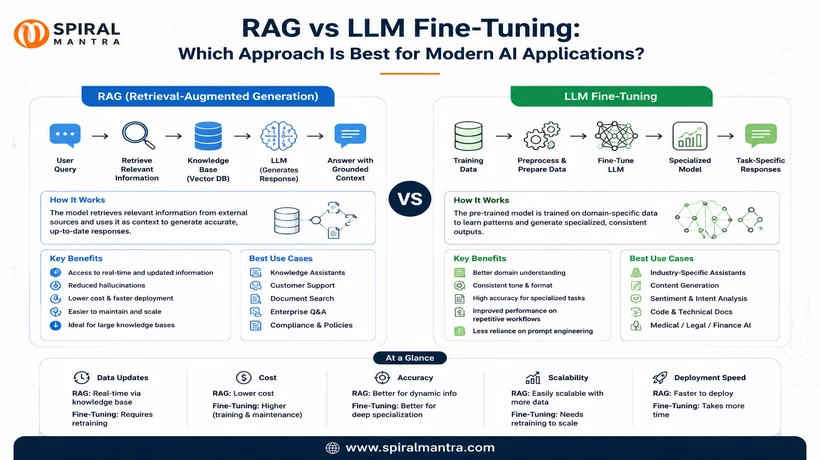
Compare RAG and LLM Fine-Tuning to understand their benefits, costs, and use cases. Learn how AI Development Services help businesses build scalable AI solutions.
Artificial Intelligence is transforming the way businesses interact with data, automate workflows, and deliver customer experiences. Large Language Models (LLMs) such as GPT, Claude, and Llama have unlocked powerful capabilities, but organizations often face a critical question: Should they use Retrieval-Augmented Generation (RAG) or Fine-Tuning to customize AI models?
Both approaches help improve AI performance, but they serve different purposes. Understanding their differences can help businesses choose the right strategy and maximize the value of their AI investments.
Understanding Retrieval-Augmented Generation (RAG)
Retrieval-Augmented Generation (RAG) is an AI architecture that combines a language model with an external knowledge source. Instead of relying solely on information learned during training, the model retrieves relevant data from databases, documents, knowledge bases, or vector stores before generating a response.
How RAG Works
- A user submits a query.
- The system searches a knowledge repository for relevant information.
- The retrieved content is passed to the LLM as context.
- The model generates a response based on both the query and retrieved information.
This approach allows AI systems to access the most current and domain-specific information without retraining the model.
Benefits of RAG
- Access to real-time and updated information
- Reduced hallucinations and inaccuracies
- Lower implementation costs compared to training models
- Faster deployment and maintenance
- Improved compliance through controlled data sources
Common Use Cases
- Enterprise knowledge assistants
- Customer support chatbots
- Legal document search
- Healthcare information systems
- Internal company knowledge bases
Understanding LLM Fine-Tuning
Fine-tuning is the process of training a pre-trained language model on a specialized dataset to improve performance for specific tasks or industries.
During fine-tuning, the model's parameters are adjusted using domain-specific examples, allowing it to learn particular terminology, writing styles, workflows, or business requirements.
How Fine-Tuning Works
- Collect a high-quality training dataset.
- Prepare and clean the data.
- Train the model on the custom dataset.
- Evaluate and deploy the fine-tuned model.
The resulting model becomes highly specialized for specific tasks and use cases.
Benefits of Fine-Tuning
- Better domain-specific understanding
- Consistent response formats and tone
- Higher accuracy for specialized tasks
- Improved performance on repetitive workflows
- Reduced need for extensive prompt engineering
Common Use Cases
- Medical diagnosis assistants
- Financial analysis tools
- Industry-specific virtual assistants
- Automated content generation
- Technical support systems
RAG vs LLM Fine-Tuning: Key Differences
Data Updates
RAG can instantly access newly added information from connected databases. Fine-tuned models require retraining whenever significant new information must be incorporated.
Cost
RAG is generally more cost-effective because it avoids expensive retraining processes. Fine-tuning involves dataset preparation, training infrastructure, and ongoing maintenance.
Accuracy
For dynamic information, RAG often delivers better accuracy because it retrieves current data. For highly specialized tasks requiring deep domain knowledge, fine-tuning may provide superior results.
Scalability
RAG scales easily as knowledge repositories grow. Fine-tuned models may require repeated updates and retraining to maintain effectiveness.
Deployment Speed
Organizations can deploy RAG systems relatively quickly by connecting existing knowledge sources. Fine-tuning projects typically require more time for dataset preparation and model training.
When Should You Choose RAG?
RAG is ideal when:
- Information changes frequently
- Real-time data access is required
- Large document repositories need to be searched
- Budget constraints exist
- Rapid deployment is a priority
Businesses implementing AI-powered knowledge management platforms often find RAG to be the most practical solution.
When Should You Choose Fine-Tuning?
Fine-tuning is the better choice when:
- Tasks require specialized domain expertise
- Consistent output formatting is critical
- Industry-specific language must be understood
- Large volumes of similar tasks are processed
- The underlying knowledge remains relatively stable
Organizations seeking highly customized AI behavior often benefit from fine-tuned models.
The Best Approach: Combining RAG and Fine-Tuning
Many modern AI solutions combine both approaches. Fine-tuning helps the model understand industry-specific terminology and workflows, while RAG provides access to current and external information.
This hybrid strategy delivers:
- Higher accuracy
- Better contextual understanding
- Reduced hallucinations
- Real-time knowledge access
- Improved user experiences
For enterprise applications, combining RAG and fine-tuning often produces the strongest results.
How AI Development Services Help Businesses Implement RAG and Fine-Tuning
Implementing advanced AI systems requires expertise in data engineering, machine learning, vector databases, model deployment, and security. Professional AI Development Services help businesses evaluate requirements, select the right architecture, and build scalable solutions.
An experienced AI development team can:
- Design RAG-based knowledge systems
- Fine-tune language models for specific industries
- Build vector search infrastructure
- Integrate AI into existing business applications
- Optimize performance, security, and scalability
By leveraging expert AI Development Services, organizations can accelerate deployment while reducing technical risks.
Conclusion
The choice between RAG and LLM Fine-Tuning depends on your business goals, data requirements, budget, and use case. RAG excels in delivering up-to-date information and cost-effective deployment, while fine-tuning provides deeper specialization and task-specific accuracy.
For many organizations, a hybrid approach that combines RAG with fine-tuned models offers the best balance of performance, scalability, and accuracy. As AI adoption continues to grow, selecting the right strategy will be essential for building intelligent applications that deliver measurable business value.
Looking to Build AI-Powered Solutions?
Our AI Development Services help businesses design, develop, and deploy advanced RAG systems, custom LLMs, intelligent chatbots, and enterprise AI applications tailored to their unique requirements.

Comments
Login to Comment